Photo: Wikipedia
Political ClimatePolitical Climate in Gering, NE
District shown is the primary district for this city’s centroid. Cities may span multiple districts.
Local Political AnalysisPolitical Analysis of Gering, NE
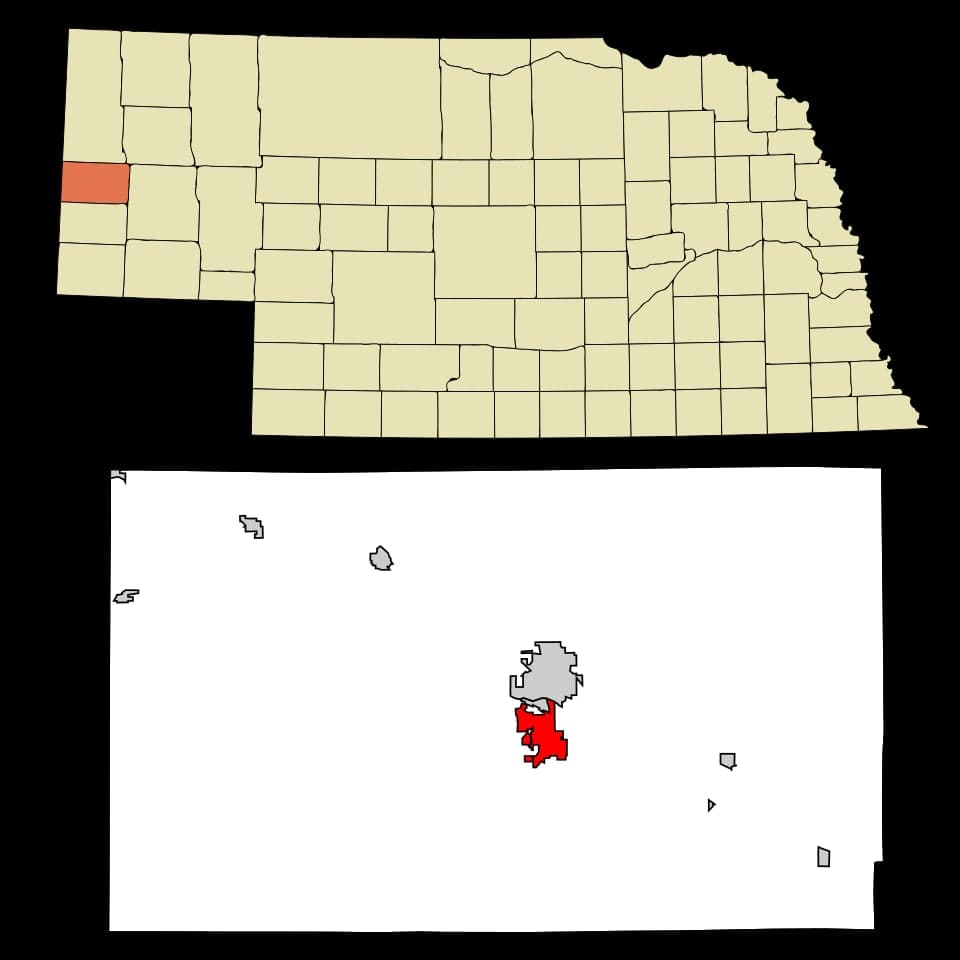
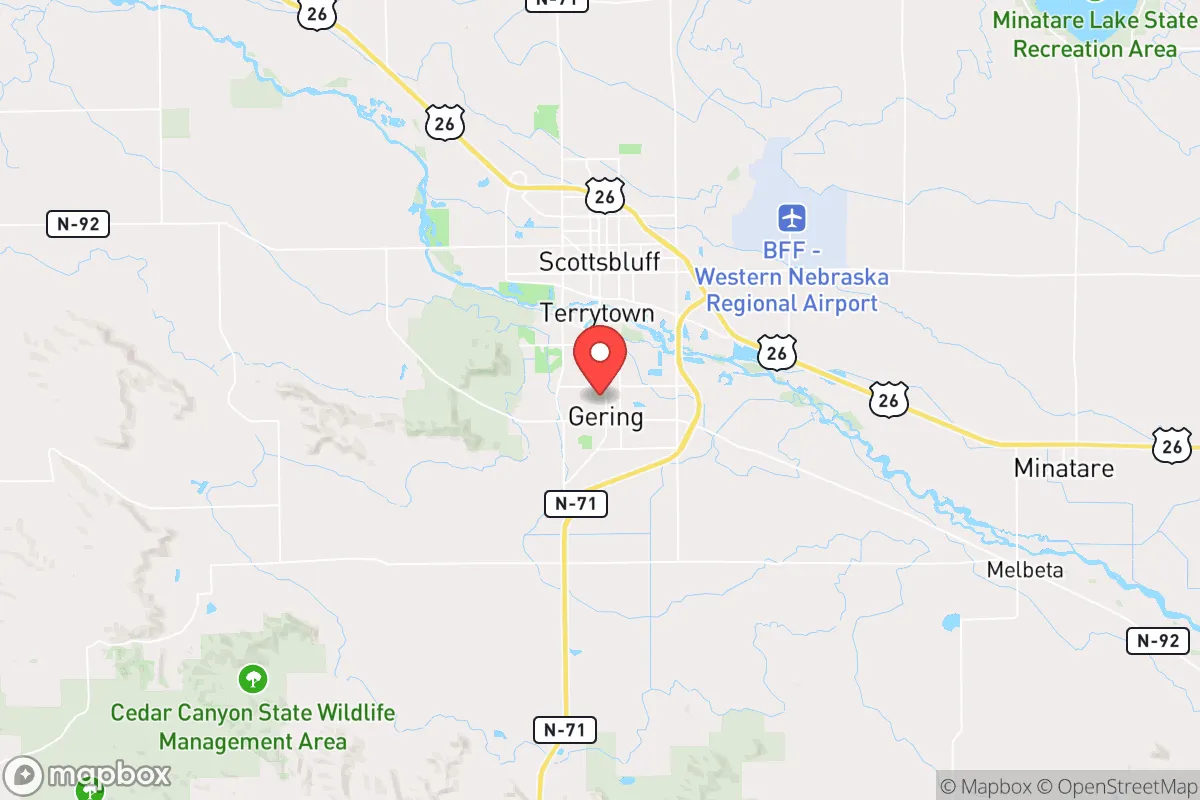
Gering, Nebraska, sits deep in the heart of Scotts Bluff County, and politically, it’s about as solidly red as they come. The Cook PVI clocks the area at R+27, which means you’re looking at a place that votes Republican by a margin nearly 30 points above the national average. That’s not a fluke or a recent shift—this has been the lay of the land for generations. In the 2024 election, the county went heavily for Trump, and local races rarely see a competitive Democrat. The trajectory here is steady: Gering remains a conservative stronghold, and while you’ll hear murmurs about younger folks moving in from Lincoln or Denver, the voting patterns haven’t budged in any meaningful way. The real story is how the surrounding towns—like Scottsbluff just across the river or the smaller farming communities like Mitchell and Morrill—share the same lean, though Scottsbluff has a slightly more mixed feel due to its larger population and a handful of progressive-leaning college faculty at Western Nebraska Community College.
How it compares
If you drive 20 miles east to Bayard, or 30 miles south to Kimball, you’ll find the same conservative DNA—R+25 to R+30 territory across the Panhandle. The real contrast comes when you compare Gering to places like Lincoln or Omaha, which are deep blue islands in a red state. In Gering, you don’t see the same push for progressive policies like sanctuary city status, defunding police, or heavy-handed mask mandates that you’d find in those urban centers. The local city council and county board are overwhelmingly Republican, and they’ve kept a tight lid on government overreach. For example, during the COVID years, Scotts Bluff County resisted statewide shutdowns more than most, and local businesses largely stayed open. That’s a point of pride for folks here—the idea that the government in Lincoln shouldn’t dictate how a Panhandle town lives its life. If you’re looking for a place where your rights aren’t constantly under threat from zoning overreach or woke school board policies, Gering is a breath of fresh air compared to what’s happening in the state’s eastern corridor.
What this means for residents
For someone living in Gering, the political climate translates directly into daily life. You’re not going to see a city council debating a ban on gas stoves or pushing for a 15-minute city model. Property taxes are a perennial gripe—Nebraska’s system leans heavily on them—but the local government keeps spending in check. The school board, which oversees Gering Public Schools, has resisted controversial curriculum changes like critical race theory or gender ideology in elementary grades, which is a big deal for families who want their kids taught basics, not activism. Gun rights are respected; you can carry openly or concealed with a permit, and there’s no talk of red flag laws at the local level. The downside? If you’re hoping for rapid change or progressive amenities like a light rail or a bustling arts scene, you’ll be disappointed. But for most residents, that’s the point—stability, predictability, and a government that stays out of your business.
Culturally, Gering has a few distinctions that set it apart. The town is home to the Oregon Trail Museum and a strong agricultural heritage, so there’s a deep respect for self-reliance and hard work. You’ll see more American flags than rainbow banners, and the local churches—mostly Evangelical and Catholic—play a central role in community life. One policy quirk: Nebraska’s unicameral legislature is officially nonpartisan, but in practice, Gering’s state senator, Brian Hardin, is a conservative Republican who votes against tax hikes and government expansion. The long-term outlook? As long as the Panhandle’s population stays stable and doesn’t see an influx from coastal transplants, Gering will likely remain a conservative anchor. The biggest threat is if Lincoln or the feds try to impose mandates on land use or energy—like restricting irrigation or pushing wind farms on private property. For now, though, it’s a place where you can still live free, and that’s getting harder to find.

State Political ClimatePolitical Climate in Nebraska
State Political AnalysisPolitical Environment in the State
Nebraska is a solidly red state in presidential elections, but its political landscape is far more nuanced than the statewide vote totals suggest. The state has voted Republican in every presidential election since 1968, and Donald Trump carried it by 19 points in 2024, but the real story is the growing urban-rural split and the rise of a libertarian-leaning conservative wing that is increasingly at odds with the establishment. Over the past 20 years, the state has shifted rightward on cultural issues while maintaining a pragmatic, low-tax posture, but the influx of new residents to the Omaha and Lincoln metros is beginning to introduce a subtle, yet noticeable, progressive undercurrent that long-time residents are watching closely.
Urban vs. rural divide
The political map of Nebraska is a textbook example of the urban-rural divide. The two major population centers, Omaha (Douglas County) and Lincoln (Lancaster County), are the only blue-leaning areas in the state. Douglas County has been trending Democratic for a decade, with Joe Biden winning it by 6 points in 2020 and Kamala Harris carrying it by a similar margin in 2024. Lincoln is more of a purple battleground, with the city itself leaning left but the surrounding rural parts of Lancaster County keeping it competitive. Outside of these two islands, the rest of the state is deeply Republican. The Panhandle, anchored by Scottsbluff and Gering, votes Republican by 40-point margins. The Sandhills region and the Platte River Valley are among the most conservative areas in the entire country. A notable exception is Grand Island (Hall County), which has seen a significant influx of Hispanic and refugee populations, making it a swing county that has voted Republican but by shrinking margins. Norfolk and Columbus in the northeast remain rock-ribbed Republican strongholds, driven by agriculture and manufacturing.
Policy environment
Nebraska’s policy environment is a mixed bag for conservatives. On the positive side, the state has a unicameral, nonpartisan legislature, which sounds good in theory but often leads to backroom deals and a lack of clear accountability. The tax structure is relatively friendly: there is no tax on Social Security benefits, and the state has been gradually lowering its top individual income tax rate, which is now 5.84% and scheduled to drop further. Property taxes, however, are a persistent pain point, especially in rural areas where school funding relies heavily on them. The state has a constitutional carry law (permitless concealed carry) that went into effect in 2023, a major win for gun rights. On education, Nebraska has a robust school choice movement, with a new school voucher program (LB 753) passed in 2023 that provides tax credits for donations to scholarship-granting organizations. However, the state’s K-12 education system is heavily centralized, and the Nebraska Department of Education has been a flashpoint for conservative parents concerned about curriculum and library content. Healthcare policy is a mixed bag: the state expanded Medicaid under the Affordable Care Act in 2020, a move that many conservatives opposed, but it has not pursued a state-based insurance exchange or other progressive healthcare experiments. Election laws are generally sound, with voter ID now required (passed in 2021, implemented in 2024), but the state still allows same-day voter registration, which some conservatives view as a vulnerability.
Trajectory & freedom
Nebraska is moving in a decidedly more freedom-oriented direction on several key fronts, but there are warning signs. The passage of LB 77 in 2023, which eliminated the need for a permit to carry a concealed handgun, was a landmark victory for Second Amendment advocates. The same year, the legislature passed LB 574, which banned gender-affirming care for minors and restricted abortion to the first 12 weeks of pregnancy, a significant win for parental rights and the pro-life movement. On the other hand, the state’s COVID-19 response was a mixed bag: Governor Pete Ricketts (R) kept the state open longer than many, but local health districts in Omaha and Lincoln imposed mask mandates and business restrictions that many residents felt were overreaching. The Nebraska Department of Health and Human Services has been criticized for overreach in child welfare cases, particularly regarding parental rights in medical decisions. Property rights are generally strong, with no statewide zoning mandates, but some municipalities like Lincoln have been aggressive in imposing inclusionary zoning and rent control proposals, which have so far been defeated. The state’s tax burden is still too high for many conservatives, but the trajectory is positive, with income tax rates scheduled to drop to 4.99% by 2027.
Civil unrest & political movements
Nebraska has not seen the kind of large-scale civil unrest seen in coastal states, but there have been notable flashpoints. The 2020 George Floyd protests in Omaha turned violent, with looting and arson in the downtown area, leading to a heavy National Guard presence and a lasting sense of unease among residents. The Black Lives Matter movement has a visible presence in Omaha and Lincoln, but it has not gained significant traction in the rest of the state. On the right, the Nebraska Republican Party has been riven by infighting between the establishment wing and a more populist, grassroots faction that is skeptical of the unicameral system and wants more transparency. The Nebraska Farmers Union and Rural Nebraskans for Freedom have been active in opposing federal overreach on land use and environmental regulations. Immigration politics are a simmering issue, particularly in Grand Island and South Sioux City, where refugee resettlement has changed the demographic makeup. There have been no sanctuary city policies, but some local leaders have resisted cooperation with ICE, creating tension. Election integrity remains a concern for many conservatives, particularly after the 2020 election saw some irregularities in mail-in ballot processing in Douglas County, though no widespread fraud was proven. The Kearney area has seen a growing homeschool and private school movement, driven by dissatisfaction with public school curriculum.
Projection
Over the next 5-10 years, Nebraska is likely to remain a red state, but the margins will continue to narrow as the Omaha and Lincoln metros grow. The in-migration from blue states like California and Illinois is still relatively small compared to Texas or Florida, but it is concentrated in the urban centers, which will make Douglas and Lancaster counties more Democratic. The rural areas will continue to hemorrhage population, which will amplify the political power of the cities. The state’s unicameral legislature is likely to face increasing pressure from both sides: conservatives will push for more transparency and term limits, while progressives will try to chip away at the filibuster rule that currently protects conservative priorities. The school choice movement will likely expand, with a possible universal voucher program on the horizon. The gun rights landscape is secure for now, but a Democratic governor in the future could try to roll back constitutional carry. The biggest wildcard is the Hispanic population, which is growing rapidly in the central and western parts of the state; if that bloc shifts left, it could flip several legislative districts. A new resident moving in now should expect a state that is still conservative but increasingly contested, with the cultural battles of the coasts slowly arriving in the heartland.
Bottom line for a new resident: Nebraska offers a high degree of personal freedom compared to coastal states, with strong gun rights, a pro-life legal framework, and a low-tax trajectory. But don’t expect a libertarian paradise. Property taxes are high, the education bureaucracy is entrenched, and the urban centers are becoming more progressive by the year. If you’re looking for a place where your values are still the majority and the government mostly stays out of your way, Nebraska is a solid bet—just keep an eye on Omaha and Lincoln, because that’s where the future of the state is being decided.
* Values derived from national, state, county, city and local statistics and may differ in a specific area. Last updated: 2026-05-01T05:51:39.000Z
Narrative content on this page is AI-generated and may contain mistakes. Verify any details that matter before acting on them.
ReloMaps may earn a commission from affiliate links at no extra cost to you.

