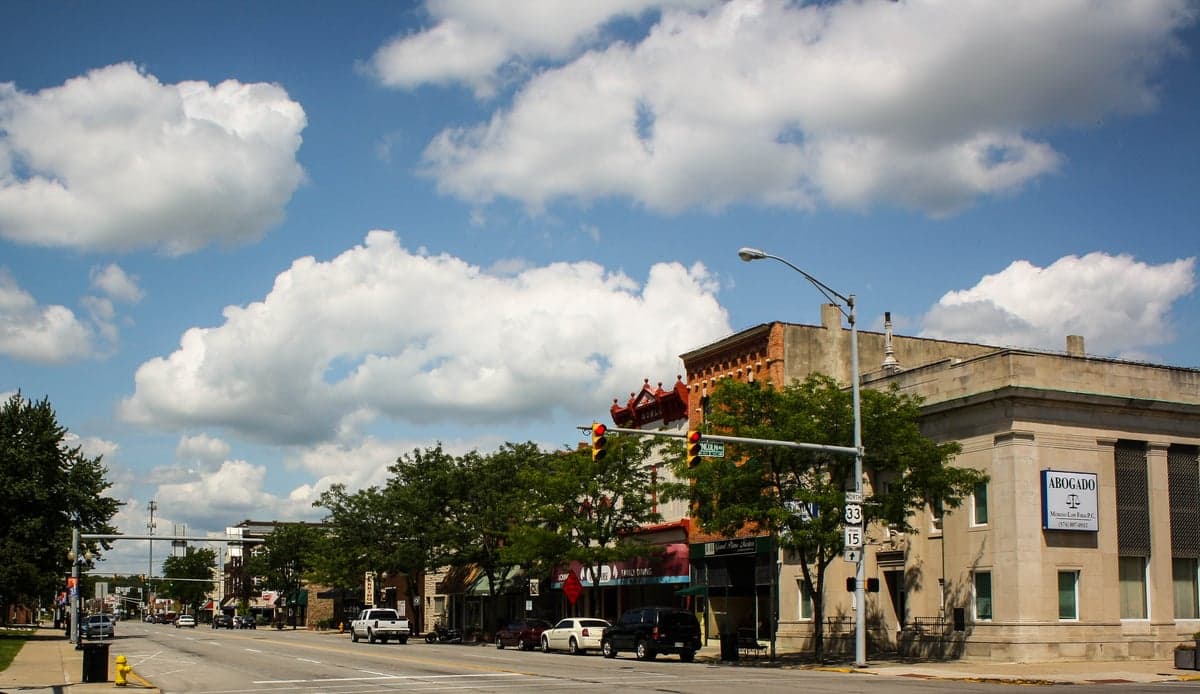
Photo: Wikipedia
Strategic Assessment of Goshen, IN
Meaningful friction. Expect exposure to either population pressure, blast zones, or natural disaster risk. Consider buying a retreat property.
What does the Strategic Assessment tell us?
Our Strategic Assessment grades tactical survivability of an area. Major population centers, military targets, fallout zones, natural disasters, and border exposure all drive risk — lower exposure means a more defensible position in a crisis.
This is heavily inspired by Joel Skousen's Strategic Relocation book. Highly recommended you checkout the book ($)What does this tell us?
Our Strategic Assessment grades tactical survivability of an area. Major population centers, military targets, fallout zones, natural disasters, and border exposure all drive risk — lower exposure means a more defensible position in a crisis.
This is heavily inspired by Joel Skousen's Strategic Relocation book. Highly recommended you checkout the book ($)Strategic Pillars

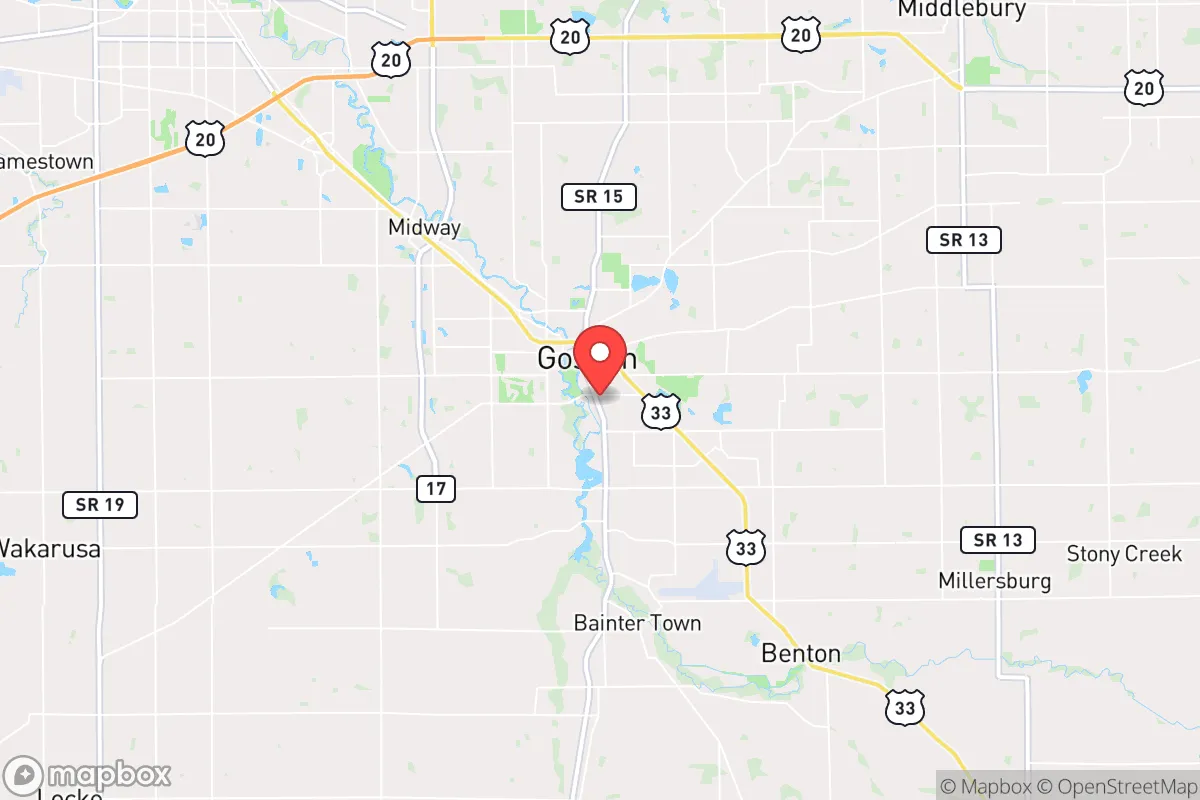
Key Distances
Regional Safe Places
Below is our recommended "safe zones" in Indiana and the surrounding area based on our strategic heuristics. For most people, it's unrealistic to live in a “safe zone” full-time due to work, family or other personal reasons. They tend to be more rural. However, many of these areas are perfect for second homes and retreat properties that double as a vacation home or even a short-term rental.

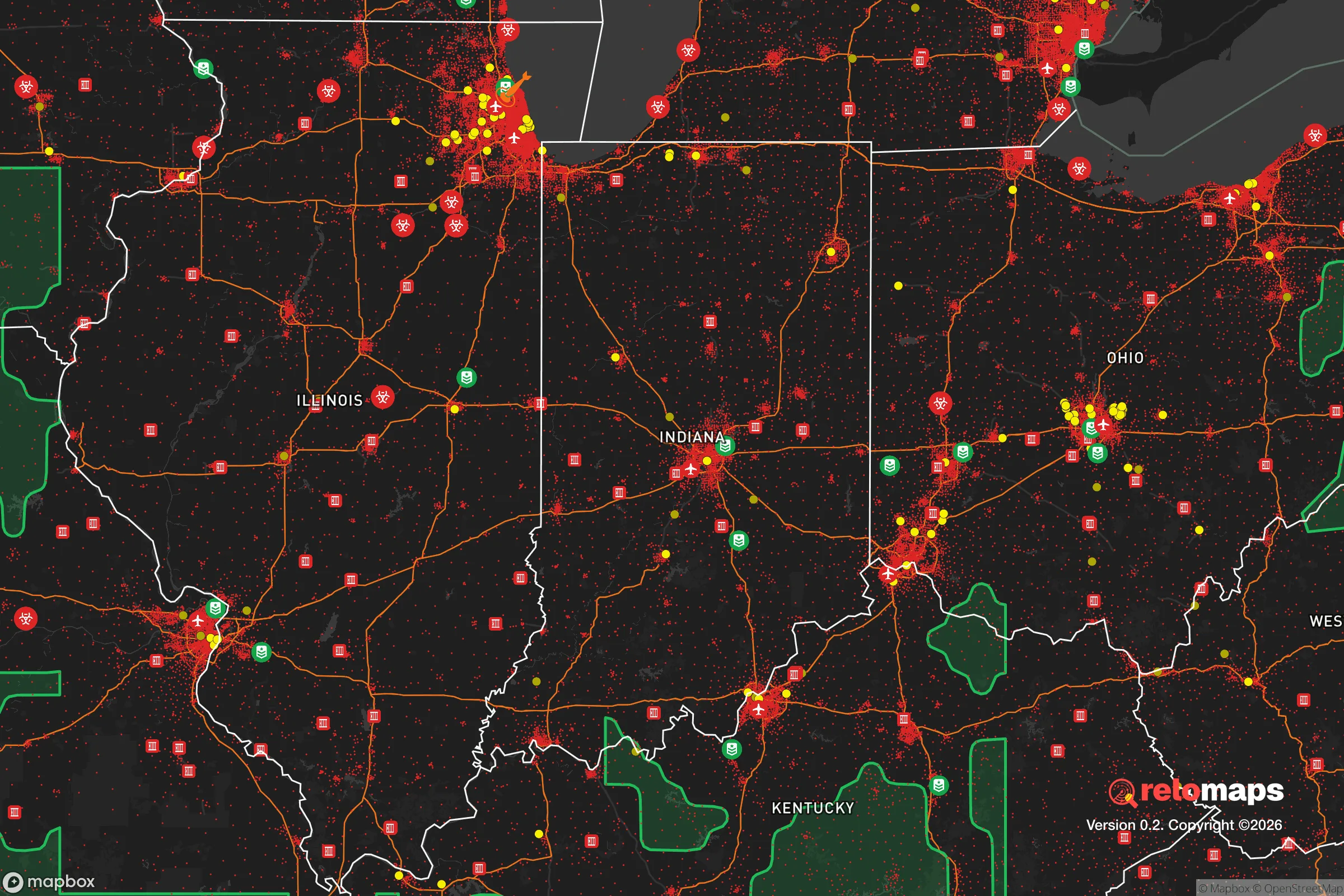


Important Note: For informational purposes only. This does not mean nothing bad ever happens in the green zones. Please use common sense. This is based on public data and modeled with AI. We tried to take a conservative approach but mistakes happen. We update this regularly as new information becomes available.
Solar Generator Recommendations
Backup power matters more here than in safer locations. We've picked three solar generators across budgets and capacity tiers — start with the budget unit if you only need a few essentials, or step up if you want to run a fridge and HVAC for days at a time.

Jackery Portable Power Station Explorer 300
Budget OptionPower on the Go: Weighing only 11 lbs, it's convenient to set up and store with book-sized foldable solar panels

BLUETTI Portable Power Station AC180
Designed for both indoor and outdoor scenarios, AC180 is highly capable as it has a robost capacity and continuous output power.

EF ECOFLOW DELTA Pro Ultra Power Station
Upgraded PickEcoFlow DELTA Pro Ultra is a whole-home energy system designed to grow with your family. Integrated with the Smart Home Panel 2, it scales to meet your evolving energy needs — keeping your home powered, intelligent, and secure through every stage of life.
We earn a commission, at no additional cost to you.
Strategic Assessment Analysis
Goshen, Indiana, sits in a sweet spot that resilience-minded relocators should take seriously: far enough from the major urban cores to avoid the worst of a collapse scenario, yet close enough to supply chains and medical infrastructure to make daily life workable. The city’s position in Elkhart County, roughly 20 miles southeast of South Bend and 100 miles east of Chicago, places it in a region that has historically been a manufacturing and agricultural backbone—meaning local food production, industrial capacity, and a population accustomed to self-reliance are baked into the landscape. For someone assessing strategic relocation from a prepper or survivalist perspective, Goshen offers a blend of rural buffer and functional small-city logistics that many Midwestern towns can’t match.
Geographic position and natural advantages for long-term security
Goshen’s geography is defined by the St. Joseph River and the surrounding flat-to-rolling farmland of northern Indiana. The area sits on the edge of the Michigan moraine, giving it decent drainage and fertile soil—critical for anyone thinking about food security beyond a grocery store. The river itself is a reliable water source, though it’s not a massive, flood-prone system like the Mississippi; the Elkhart River and its tributaries weave through the county, providing multiple points for catchment and filtration. The region’s elevation is modest (around 800 feet), but it’s high enough to avoid the worst of the Lake Michigan snowbelt effect that buries places like South Bend. Winters are cold and snowy, but that’s a double-edged sword: it discourages transient populations and keeps the area less attractive to mass migration during a crisis. The surrounding farmland is some of the most productive in the state, with corn, soybeans, and dairy operations within a 10-mile radius of downtown. For a relocator, that means local food sources are not theoretical—they’re operational and within reach. The lack of major mountain ranges or coastlines also means Goshen is insulated from hurricane, tsunami, and wildfire risks, which are increasingly common in the West and Gulf regions.
Risks, exposures, and proximity to fallout-relevant landmarks
The biggest strategic downside to Goshen is its proximity to the Chicago metropolitan area—roughly 100 miles west. In a major civil unrest event or a mass casualty scenario, Chicago’s population of nearly 9 million could push refugees east along I-80 and I-90, both of which pass within 30 miles of Goshen. The Indiana Toll Road (I-80/90) runs just north of the city, and US 33 connects directly to the urban corridor. That’s a vulnerability. If you’re planning for a long-term grid-down situation, you need to account for the fact that Goshen is on a secondary evacuation route from the Great Lakes megaregion. Additionally, the area is within 50 miles of the Michigan City nuclear power plant (the Donald C. Cook plant), which sits on Lake Michigan’s shore. While the plant has a solid safety record, any radiological incident—whether from accident or sabotage—would put Goshen in the downwind plume path depending on prevailing westerlies. The Elkhart County area also has a high concentration of RV and recreational vehicle manufacturing (the industry that gives the region its economic backbone), which means a lot of propane, fiberglass, and chemical storage in industrial parks. A localized industrial accident is possible, but the bigger risk is that the area’s economic dependence on a single sector could collapse quickly during a national crisis. On the plus side, there are no major military bases, nuclear weapons storage sites, or high-value government targets within 100 miles, which reduces the likelihood of Goshen being a direct target in a conflict scenario.
Practical resilience for a relocator: food, water, energy, and defensibility
For someone serious about self-sufficiency, Goshen’s practical resilience is above average. The city itself has a municipal water system drawing from groundwater wells, but the surrounding rural areas rely on private wells—meaning a relocator with a property outside city limits can secure water independent of a centralized grid. The St. Joseph River and Elkhart River are both fishable and navigable by small craft, offering a secondary water source and a potential transportation corridor if roads become impassable. Food production is the standout advantage: Elkhart County is one of Indiana’s top agricultural producers, with thousands of acres of row crops and a strong Amish and Mennonite presence that keeps small-scale farming, animal husbandry, and food preservation skills alive. A relocator can buy directly from Amish farmers at roadside stands or through local co-ops without relying on grocery chains. Energy-wise, the area is served by Indiana Michigan Power, which draws from a mix of coal, natural gas, and nuclear. Solar potential is moderate (the region gets about 180 sunny days per year), but the long winters and cloud cover make battery-backed solar a supplementary rather than primary solution. Wood heating is common in rural homes, and the surrounding hardwood forests provide ample fuel for those willing to process it. Defensibility is mixed: Goshen is a small city of about 35,000, with a grid-like street pattern and open farmland on all sides. That makes it hard to defend against a determined group, but it also means there are multiple escape routes and few natural chokepoints. The Amish and Mennonite communities, while non-violent, are highly self-reliant and tend to keep to themselves—they’re not a threat, but they’re also not a resource you can count on in a crisis unless you’ve built relationships beforehand. For a relocator, the key is to buy land outside the city limits, preferably with a well, a woodlot, and southern exposure for solar. Properties in the 5- to 20-acre range are still affordable relative to the coasts, and the county’s zoning is lenient on outbuildings, livestock, and alternative energy systems.
The overall strategic picture for Goshen is one of cautious optimism for the prepared relocator. It’s not a remote bunker location—it’s a working-class Midwestern town with real economic and social infrastructure that can function during normal times and be adapted for harder ones. The risks are real: proximity to Chicago’s potential chaos, a nuclear plant within fallout range, and a single-industry economy that could buckle under pressure. But the advantages—abundant local food, multiple water sources, a culture of self-reliance, and low land costs—make it a viable base for someone who wants to be ready without disappearing into the wilderness. If you’re looking for a place that balances day-to-day livability with genuine resilience potential, Goshen deserves a spot on your short list. Just don’t buy on the main roads, and make sure your well is deep.

* Values derived from national, state, county, city and local statistics and may differ in a specific area. Last updated: 2026-04-22T09:11:54.000Z
Narrative content on this page is AI-generated and may contain mistakes. Verify any details that matter before acting on them.
ReloMaps may earn a commission from affiliate links at no extra cost to you.

