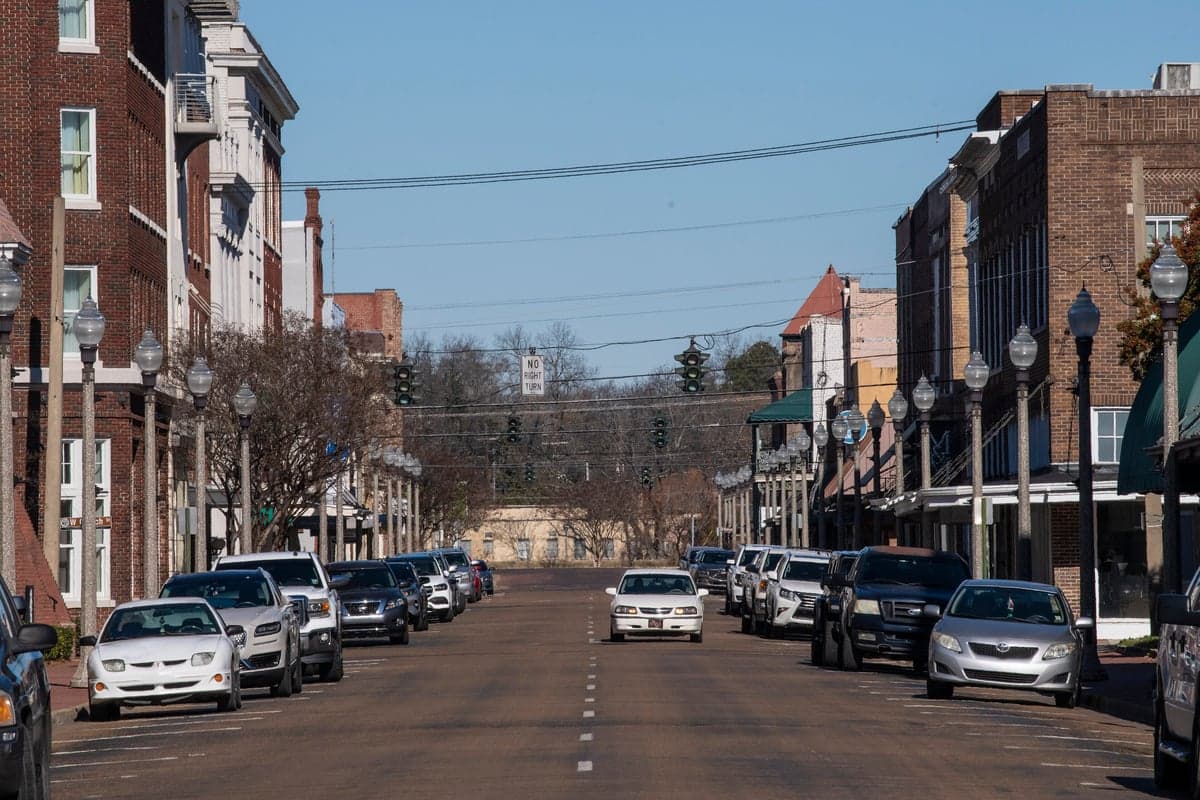
Photo: Wikipedia
Personal Sovereignty in Greenwood, MS
Viable for self-reliance. Generally workable, though some barriers may limit total independence.
What does Personal Sovereignty tell us?
Personal Sovereignty measures your capacity for self-reliance and independence with minimal government friction. Higher scores mean fewer barriers between you and the way you want to live... but it assumes you have the space you need and good neighbors.
What does this tell us?
Personal Sovereignty measures your capacity for self-reliance and independence with minimal government friction. Higher scores mean fewer barriers between you and the way you want to live... but it assumes you have the space you need and good neighbors.
State Policy
Energy independence: Importer (50% of energy produced in-state)
Personal Liberty
Homesteading

Personal Liberty Analysis
Greenwood, Mississippi, offers a personal sovereignty environment that stands in stark contrast to the coastal and urban jurisdictions where government overreach has become the norm. For the survivalist or prepper, this Delta town represents a pocket where the state’s constitutional carry laws, low regulatory burden, and deep-rooted culture of self-reliance create a buffer against the creeping erosion of individual freedoms seen elsewhere. While no location is a perfect fortress, Greenwood’s alignment with Mississippi’s broader posture—one that consistently ranks among the most liberty-respecting states in the nation—makes it a serious consideration for those prioritizing autonomy over convenience.
Tax burden and regulatory posture: How Mississippi’s low-tax framework supports independence
Mississippi’s tax and regulatory environment is designed to keep government off your back and money in your pocket, which is the bedrock of personal sovereignty. The state levies a flat personal income tax rate of 4.0% on all taxable income over $10,000, but this is being phased down toward elimination—a clear signal that the legislature values economic freedom. Property taxes in Greenwood are among the lowest in the nation, with effective rates averaging around 0.7% of assessed home value, meaning a $150,000 home costs roughly $1,050 annually. Sales tax in Leflore County is 7.0% (state plus local), but necessities like groceries and prescription drugs are exempt. For the prepper, this low tax burden means more capital for land, supplies, and infrastructure—not for funding programs you don’t support. The regulatory posture is equally favorable: Mississippi is a right-to-work state with minimal occupational licensing hurdles, and Greenwood’s local government generally defers to state preemption on zoning and business rules. There is no state-level red tape on rainwater collection, composting toilets, or backyard livestock, which are common targets for overregulation in blue states. The state’s “Mississippi Business Friendly” certification reflects a deliberate policy of reducing bureaucratic friction, and that extends to individual property owners who want to build a workshop, install solar panels, or dig a well without a parade of permits.
Self-defense and gun law specifics: Constitutional carry and stand-your-ground protections
Greenwood sits in a state that treats the Second Amendment as a fundamental right, not a privilege to be licensed away. Mississippi adopted permitless (constitutional) carry in 2016, meaning any law-abiding adult 18 or older can carry a concealed or open firearm without a permit. There is no duty to inform law enforcement that you are carrying, and no “gun-free zone” signage carries the force of law except on federal property, courthouses, and schools (though even school carry is allowed with an enhanced permit). The state’s stand-your-ground law, codified in Mississippi Code § 97-3-15, removes any duty to retreat before using deadly force if you are lawfully present and reasonably believe force is necessary to prevent death, great bodily harm, or a forcible felony. This is not a “castle doctrine” limitation—it applies anywhere you have a right to be, including public streets. For the prepper, this legal framework means you can defend your home, vehicle, and family without worrying about prosecutorial second-guessing. Magazine capacity is unrestricted, and there is no state-level registry or waiting period. The only practical caveat is that Greenwood is in Leflore County, which has a higher-than-average violent crime rate (roughly 800 incidents per 100,000 residents, per recent FBI data), so carrying is not just a right but a practical necessity. The local sheriff’s office is generally pro-2A, and concealed carry permits (still available for reciprocity) are issued on a shall-issue basis.
Self-reliance and homesteading viability: Lot sizes, zoning, and off-grid feasibility
Greenwood’s zoning and land-use policies are remarkably permissive compared to suburban or urban areas, making it a viable location for serious homesteading and off-grid living. Within the city limits, residential lots typically range from one-quarter to one-half acre, but the surrounding unincorporated areas of Leflore County offer parcels from 1 to 40 acres at prices well below national averages—often $2,000 to $5,000 per acre. Zoning in the county is minimal: there are no county-wide building codes, no restrictions on keeping chickens, goats, or even a few head of cattle, and no prohibitions on alternative energy systems. Solar panels, wind turbines, and rainwater catchment are fully legal, and the state explicitly protects the right to install solar without homeowner association interference (though HOAs are rare in rural Greenwood). Off-grid feasibility is high: the water table is shallow (typically 20–40 feet), making well drilling affordable (around $3,000–$5,000), and septic systems are straightforward to permit. The climate supports year-round growing seasons, with 220+ frost-free days, so a serious garden or small orchard can provide significant food security. The only regulatory hurdle is that any permanent dwelling must meet basic state health department standards for septic and water, but there is no “minimum square footage” requirement or occupancy permit process that would block a tiny home or cabin. For the prepper looking to establish a retreat with minimal government interference, Greenwood’s rural outskirts offer a rare combination of affordability, legal permissiveness, and agricultural viability.
Personal liberties: Parental rights, medical autonomy, speech, and property protections
Mississippi has positioned itself as a stronghold for parental rights and medical autonomy, which directly impacts personal sovereignty in Greenwood. The state’s “Parents’ Bill of Rights” (HB 1309, enacted 2023) explicitly affirms that parents have the fundamental right to direct the upbringing, education, and healthcare of their children, including the right to opt out of any school curriculum or medical treatment they find objectionable. This is not just rhetoric—school districts in Leflore County, including Greenwood Public Schools, are required to obtain parental consent before any mental health screening or non-emergency medical service. On medical autonomy, Mississippi has banned nearly all forms of vaccine mandates for employment and education, and the state’s “Medical Freedom Act” prohibits discrimination based on vaccination status. For the prepper concerned about government-mandated medical interventions, this is a significant buffer. Free speech protections are robust: Mississippi has no hate speech laws or “misinformation” statutes that chill political expression, and Greenwood’s public forums (including city council meetings) are generally open to citizens speaking their minds without fear of retaliation. Property rights are equally strong, with the state’s “Private Property Rights Protection Act” requiring government to compensate landowners for any regulatory taking that reduces property value by more than 40%. Eminent domain for private economic development is prohibited. The only notable limitation is that Mississippi is a “dry” county by default for alcohol sales (though Greenwood has local option allowing beer and wine), but that is a minor constraint compared to the broad autonomy granted in other areas.
Overall, Greenwood’s personal sovereignty profile places it in the top tier of American towns for those who value independence over collective compliance. Compared to states like California, New York, or Illinois—where tax burdens, gun control, vaccine mandates, and zoning overreach have turned citizens into tenants of the state—Mississippi’s legal framework treats the individual as the primary unit of authority. The trade-offs are real: Greenwood’s economy is modest, its infrastructure is aging, and the violent crime rate demands vigilance. But for the survivalist or conservative parent who wants to raise a family free from curriculum indoctrination, defend their home without legal jeopardy, and build a self-sufficient homestead without a permit for every nail, this Delta town offers a sovereignty that is increasingly rare in 2026. It is not a utopia—no place is—but it is a jurisdiction where the government’s default answer is “yes” rather than “no,” and that alone makes it worth a serious look.

* Values derived from national, state, county, city and local statistics and may differ in a specific area. Last updated: 2026-04-30T13:22:52.000Z
Narrative content on this page is AI-generated and may contain mistakes. Verify any details that matter before acting on them.
ReloMaps may earn a commission from affiliate links at no extra cost to you.

