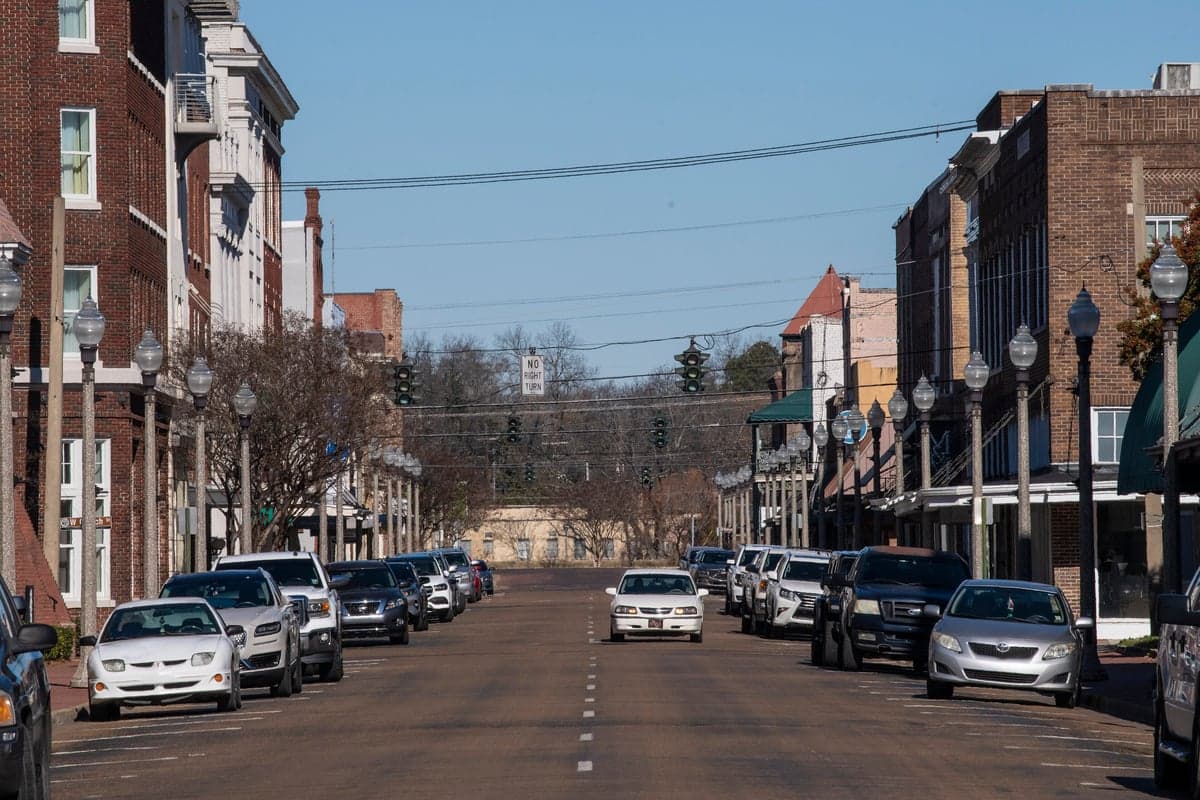
Photo: Wikipedia
Political ClimatePolitical Climate in Greenwood, MS
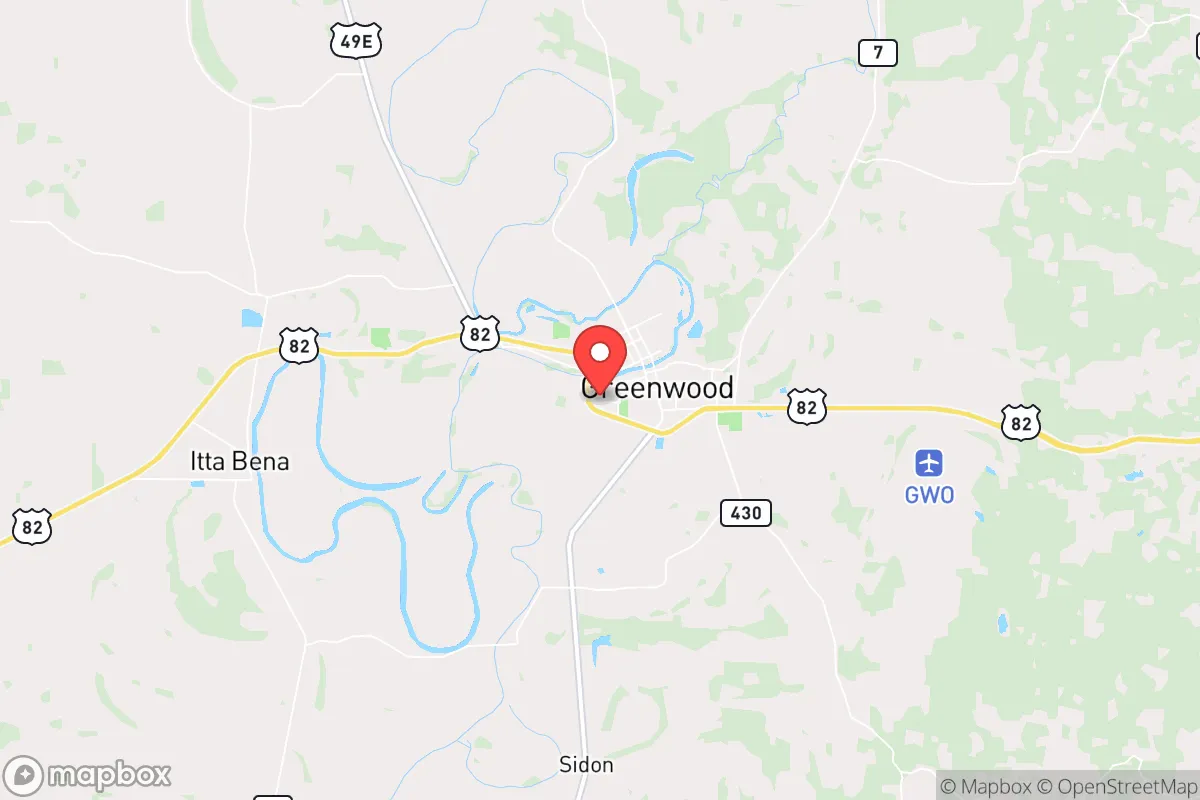
District shown is the primary district for this city’s centroid. Cities may span multiple districts.
Local Political AnalysisPolitical Analysis of Greenwood, MS
Greenwood, Mississippi, sits deep in the Mississippi Delta, and its political climate has historically been a mixed bag, but the numbers tell a clear story today. The Cook PVI rating of D+11 means this area leans heavily Democratic, and that’s been the case for a while now, though it wasn’t always this way. If you’ve been around here long enough, you remember when local politics were more about common-sense, conservative values—small government, personal responsibility, and keeping Washington out of your backyard. But over the last couple of decades, the shift has been noticeable, and it’s not slowing down. The county and city leadership have increasingly embraced progressive policies, and that’s something that gives a lot of us pause.
How it compares
Drive just 30 minutes north to Cleveland, and you’ll find a similar D+11 lean, but head east to Grenada or south to Yazoo City, and the picture starts to change. Grenada County, for instance, is more of a toss-up, with a Cook PVI of R+1, and you can feel the difference in the local conversations—people there are more skeptical of government overreach and more protective of their Second Amendment rights. Even within Leflore County, the rural precincts outside Greenwood proper tend to vote more conservatively than the city itself. It’s a stark contrast: in the city, you see more support for things like expanded public housing programs and stricter local regulations on businesses, while out in the county, folks just want to be left alone to run their farms and their lives. That divide is real, and it’s growing.
What this means for residents
For someone living in Greenwood, the political lean means you’re dealing with a local government that’s more inclined to get involved in your day-to-day decisions. We’ve seen pushes for higher property taxes to fund new city initiatives, and there’s always talk about more zoning restrictions that make it harder to do what you want with your own land. The school board and city council have become more vocal about progressive social policies, which can feel like an overstep when you just want them to focus on keeping the streets paved and the crime rate down. Property crime has been a concern here, and instead of focusing on law and order, some leaders seem more interested in social experiments. It’s frustrating when you feel like your voice is drowned out by a political machine that doesn’t share your values.
Looking ahead, the trajectory is concerning. As younger, more progressive transplants move in—often drawn by the low cost of living and the Delta’s cultural history—the political needle is likely to shift even further left. Long-time residents, especially those who remember when Greenwood was a more conservative place, are feeling like outsiders in their own town. The next few election cycles will be telling: if the trend continues, we could see even more government programs and less personal freedom. For now, if you value limited government and individual rights, you might find yourself more at home in the surrounding counties, where the political climate still respects the idea that you know what’s best for your own family.

State Political ClimatePolitical Climate in Mississippi
State Political AnalysisPolitical Environment in the State
Mississippi is one of the most reliably conservative states in the nation, with a Republican lean that has only deepened over the past two decades. The state has not voted for a Democratic presidential candidate since Jimmy Carter in 1976, and in 2024, Donald Trump carried it by roughly 16 points. The dominant coalition is a mix of rural white evangelicals, suburban families in the Jackson metro exurbs, and Gulf Coast retirees, all united around low taxes, gun rights, and cultural conservatism. Over the last 10-20 years, the shift has been steady: Democrats held the governorship as recently as 2003, but today Republicans control every statewide office and hold supermajorities in both legislative chambers.
Urban vs. rural divide
The political map of Mississippi is a textbook study in the urban-rural split. The state’s three major population centers — Jackson, the Gulf Coast (Biloxi-Gulfport), and the Memphis suburbs (Southaven, Olive Branch) — are the only areas where Democrats remain competitive. Jackson, the capital and largest city, is overwhelmingly Democratic, driven by a majority-Black population and a strong union presence in government and healthcare. Hinds County, which contains most of Jackson, voted for Joe Biden by 56 points in 2020. But drive 20 minutes east to Rankin County (Brandon, Pearl) or Madison County (Madison, Ridgeland), and you hit some of the reddest suburbs in the South — Rankin gave Trump 73% of the vote. The Gulf Coast is more mixed: Harrison County (Biloxi) leans Republican but has a sizable Democratic base among casino workers and military retirees. DeSoto County, the Memphis exurb, is a Republican stronghold that has grown explosively as families flee Shelby County’s crime and taxes. Meanwhile, the Delta region — places like Greenville, Clarksdale, and Cleveland — is deeply Democratic and heavily Black, but its population is shrinking fast. The rural Pine Belt and northeast hill country (Tupelo, Corinth, Oxford) are solidly red, with Oxford being a slight exception due to the University of Mississippi’s liberal faculty and student influence.
Policy environment
Mississippi’s policy environment is aggressively conservative by design. There is no state income tax on Social Security benefits, and the state has been phasing out its personal income tax entirely — the rate dropped from 5% to 4.7% in 2025, with a path to zero by 2030. Property taxes are among the lowest in the nation, with no state-level property tax and local rates averaging around 0.8% of assessed value. The regulatory climate is business-friendly: Mississippi is a right-to-work state with no state-level minimum wage above the federal $7.25, and it has some of the weakest union protections in the country. On education, the state passed the Mississippi Charter Schools Act in 2013, and the 2024 “School Choice Act” expanded Education Scholarship Accounts (ESAs) to all families, allowing state funds to follow children to private or homeschool settings. Healthcare is more mixed: Mississippi rejected Medicaid expansion under the ACA, leaving roughly 75,000 working poor in a coverage gap, but the state has one of the highest rates of direct primary care and faith-based health-sharing ministries. Election laws are strict: voter ID is required, early voting is limited to in-person absentee with an excuse, and the state purges inactive voters regularly. There is no no-excuse mail voting, and ballot drop boxes are illegal.
Trajectory & freedom
On the freedom index, Mississippi is moving in a clearly libertarian-conservative direction. The 2024 “Mississippi Freedom Act” eliminated the state’s income tax entirely for most filers, and the 2025 “Second Amendment Preservation Act” nullified any federal gun control measure that would infringe on state-defined rights — including red-flag laws and universal background checks. Parental rights were strengthened by the 2023 “Parents’ Bill of Rights,” which requires schools to notify parents of any medical or mental health services sought by a minor and bans instruction on sexual orientation or gender identity in K-3. Medical autonomy took a hit with the state’s near-total abortion ban (triggered in 2022, with no exceptions for rape or incest), but the flip side is that Mississippi has some of the loosest vaccine mandate laws in the country — no state-level COVID vaccine requirement for public workers, and a 2023 law prohibits employers from requiring vaccines as a condition of employment. Property rights are strong: the state has no statewide zoning authority, and the 2024 “Landowner Protection Act” limits eminent domain for private economic development. The trend is unmistakably toward more personal liberty in the traditional sense — lower taxes, fewer mandates, and stronger protections for gun owners and parents.
Civil unrest & political movements
Mississippi has a low baseline of visible political unrest compared to coastal states, but there are flashpoints. The most significant recent movement was the 2022-2023 “Medical Freedom” protests in Jackson and Gulfport, where thousands rallied against federal vaccine mandates for healthcare workers and school employees. These were largely peaceful but drew national attention. On the left, the NAACP and Black Lives Matter chapters in Jackson organized protests after the 2020 George Floyd killing, but they were smaller and shorter than in other Southern capitals. Immigration politics are muted — Mississippi has a very small foreign-born population (about 2.5%), but the state passed a 2024 law requiring all law enforcement to cooperate with ICE detainers and banning sanctuary city policies. Election integrity has been a hot topic: the 2023 “Secure Elections Act” tightened voter ID rules, banned private funding of elections (like Zuckerberg’s 2020 grants), and required hand-counting of ballots in precincts with fewer than 500 voters. There was a brief controversy in 2024 when the state’s Republican secretary of state flagged 1,200 non-citizens on voter rolls, but most were found to be clerical errors. A new resident would notice that political signs are ubiquitous in yards and along highways, especially in rural areas, and that local news covers school board and county supervisor races with the intensity of national elections.
Projection
Over the next 5-10 years, Mississippi is likely to become even more conservative, but with a growing libertarian streak. The income tax phase-out will accelerate in-migration from high-tax states like California, Illinois, and New York — DeSoto County is already seeing a boom of former Chicagoans. The Delta will continue to lose population, reducing the Democratic base, while the Gulf Coast and Memphis suburbs grow. The biggest wild card is the state’s aging population: Mississippi has one of the oldest median ages in the country (38.5), and younger residents often leave for jobs in Texas or Tennessee. If the state can attract remote workers and retirees with its low taxes and gun-friendly laws, it could see a net influx of culturally conservative millennials and Gen Xers. The biggest risk is that the state’s poor health outcomes and low education attainment could deter families who want good schools and healthcare access. Expect more school choice expansion, continued resistance to Medicaid expansion, and possibly a push for a state-level constitutional amendment to protect the right to homeschool. The political climate will remain stable — no party flip is remotely plausible — but the internal debate will shift from “how conservative?” to “how free?”
For a new resident, the bottom line is this: Mississippi offers a low-tax, low-regulation environment where your personal freedoms — especially around guns, parenting, and medical choices — are broadly protected. You will find a deeply conservative culture in most places outside of Jackson and the Delta, and you should expect that local government will stay out of your way on most issues. The trade-offs are real: public schools are underfunded, healthcare access is limited in rural areas, and the summer heat is oppressive. But if your priority is maximum personal liberty with minimal state interference, Mississippi is one of the few places in the country that is actively moving in that direction.
* Values derived from national, state, county, city and local statistics and may differ in a specific area. Last updated: 2026-04-30T13:22:52.000Z
Narrative content on this page is AI-generated and may contain mistakes. Verify any details that matter before acting on them.
ReloMaps may earn a commission from affiliate links at no extra cost to you.

