Photo: Wikipedia
Demographics of Greybull, WY
Affluence Level in Greybull, WY
A below-average socioeconomic profile. Incomes, home values, and educational attainment trail the U.S., with higher poverty and unemployment.
People of Greybull, WY
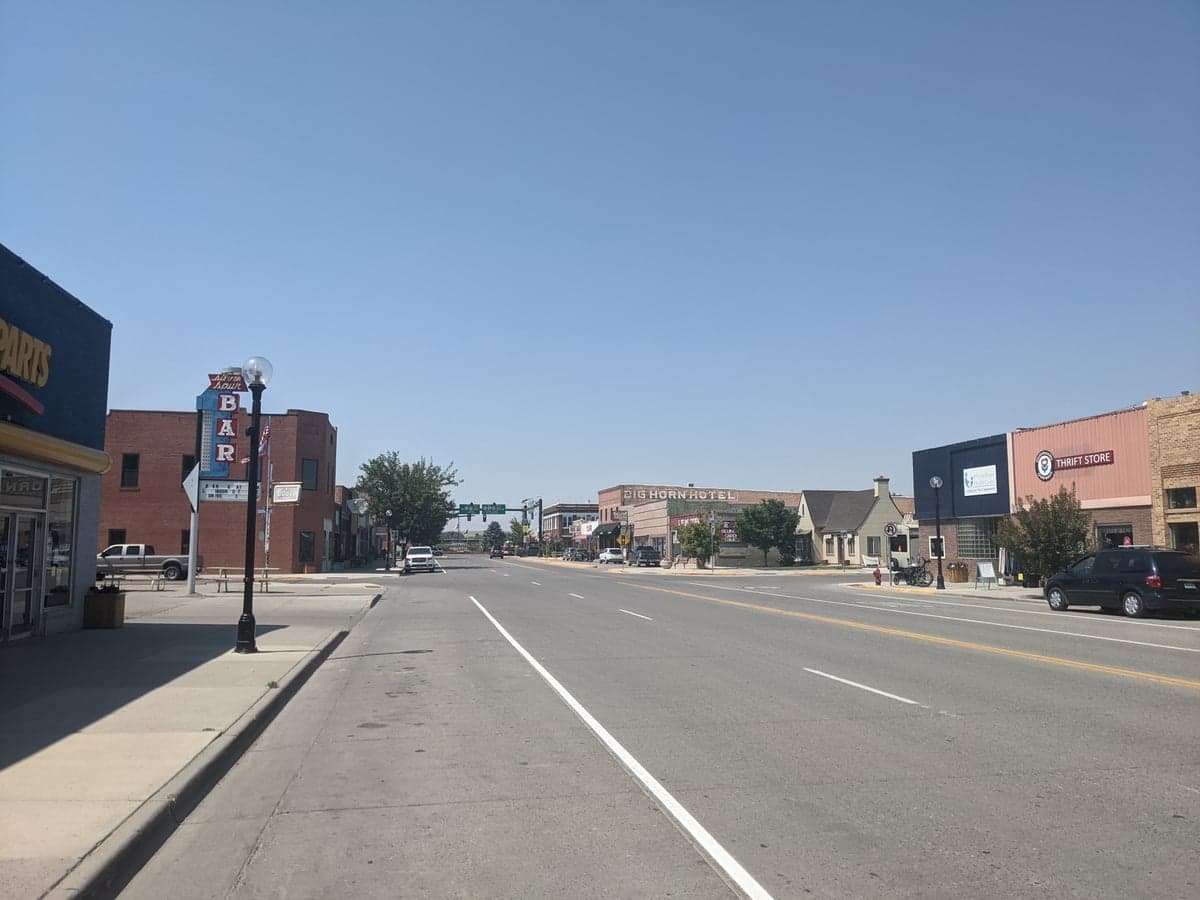
The people of Greybull, Wyoming, today form a small, predominantly white community of 2,061 residents, marked by a significant Hispanic minority of 24.9% and a very low foreign-born share of 5.5%. The city’s identity is rooted in its railroad and agricultural heritage, with a blue-collar character reflected in a 15.9% college education rate. It is a place where family ties run deep, and the population is notably stable, with little recent in-migration from outside the region.
How the city was settled and grew
Greybull was founded in 1901 as a railroad town on the Chicago, Burlington and Quincy Railroad line, which connected the Big Horn Basin to national markets. The original settlers were predominantly white, Anglo-Saxon homesteaders drawn by the federal Homestead Act and the promise of irrigated farming along the Greybull River. The town’s first wave of growth came from ranchers and farmers, who built simple frame houses in the Original Townsite—the grid of streets south of the railroad tracks. A second wave arrived during the 1910s oil boom, when workers for the Greybull Oil Company and related service industries settled in the North Side neighborhood, just north of the tracks, where modest bungalows still stand. The discovery of bentonite clay in the 1920s brought a third wave of miners and processing plant workers, many of whom lived in the East End district, near the clay processing facilities. By 1930, the population had reached roughly 1,500, and the town’s ethnic makeup was almost entirely white, with a small number of Mexican laborers working on the railroad and in the sugar beet fields.
Modern era (post-1965)
After the 1965 Hart-Cellar Act, Greybull saw little direct immigration from new source countries, unlike larger Wyoming cities. The foreign-born population remains low at 5.5%, and the city’s Hispanic growth—now 24.9%—is almost entirely domestic in origin, driven by families from Texas and New Mexico who moved north for work in the bentonite mines and oil fields. These Hispanic residents have concentrated in the South Side neighborhood, south of the Greybull River, where newer, more affordable housing was built in the 1970s and 1980s. The white population, which was 69.7% as of the latest data, remains dominant in the Original Townsite and North Side, where older homes are passed down through generations. The East/Southeast Asian share is 1.4%, a small group of families who arrived in the 1990s to work in the bentonite industry, living scattered across the city without a distinct ethnic enclave. The Black and Indian subcontinent populations are effectively zero, reflecting the city’s lack of diversity beyond the white-Hispanic binary.
The future
Greybull’s population is projected to remain stable or decline slightly, as the city’s economy—heavily reliant on bentonite mining and agriculture—offers limited opportunities for new residents. The Hispanic share is likely to continue growing slowly through natural increase and domestic migration, but the city is not experiencing rapid diversification. The white population is aging, with many younger adults leaving for college or jobs in larger cities like Billings or Casper. The West End neighborhood, a newer subdivision built in the 2000s, has attracted a few families from outside the area, but it remains overwhelmingly white. There is no evidence of tribalization into distinct ethnic enclaves; instead, the city is slowly homogenizing around a working-class, Hispanic-influenced culture, while the white population gradually shrinks. Over the next 10-20 years, Greybull will likely become slightly more Hispanic and slightly older, with little change in its overall character.
For someone moving in now, Greybull offers a stable, tight-knit community where neighbors know each other and the pace of life is slow. The city is becoming more Hispanic in its cultural texture, but remains overwhelmingly white in its power structures and social networks. It is not a place of rapid demographic change or conflict, but rather a quiet, aging town where the future looks much like the present.

* Values derived from national, state, county, city and local statistics and may differ in a specific area. Last updated: 2026-04-21T11:25:07.000Z
Narrative content on this page is AI-generated and may contain mistakes. Verify any details that matter before acting on them.
ReloMaps may earn a commission from affiliate links at no extra cost to you.

