Photo: Wikipedia
Demographics of Hazleton, PA
Affluence Level in Hazleton, PA
A below-average socioeconomic profile. Incomes, home values, and educational attainment trail the U.S., with higher poverty and unemployment.
People of Hazleton, PA
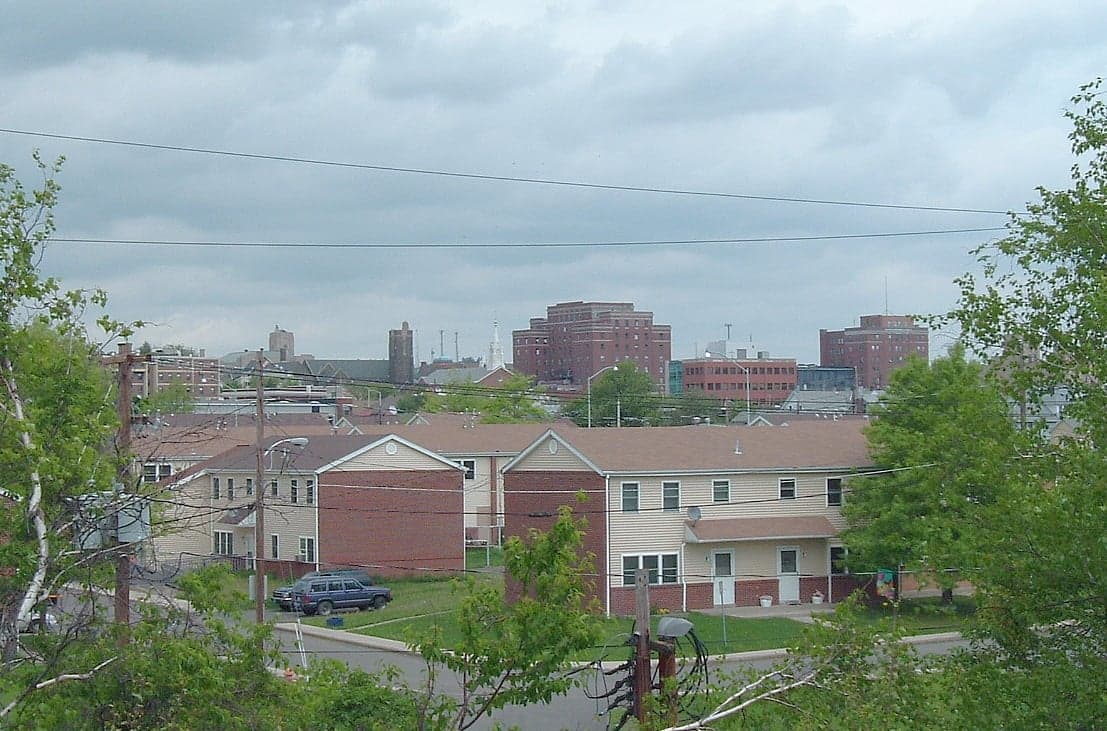
Hazleton, Pennsylvania, is a city of roughly 29,886 residents defined by its dramatic demographic transformation over the past three decades. Once a predominantly white, blue-collar coal and manufacturing hub, it is now a majority-Hispanic city (63.1% of the population) with a significant foreign-born population (21.9%). The city’s character today is one of working-class resilience, cultural reinvention, and a sharp divide between long-established white residents and a rapidly growing Latino community, creating a dense, often tense, but undeniably dynamic social landscape.
How the city was settled and grew
Hazleton’s original population was drawn by the anthracite coal boom of the mid-19th century. The city was founded in 1856 as a planned coal-mining and railroad town, and its early settlers were overwhelmingly European immigrants. The first major wave consisted of Irish and German laborers who built the mines and railroads, settling in the Diamond Avenue and Broad Street corridors near the original downtown. By the 1880s and 1890s, a second wave of Eastern and Southern Europeans arrived—Italians, Poles, Slovaks, and Lithuanians—who formed distinct ethnic enclaves. Italian immigrants concentrated in the South Side (around 15th to 20th streets), while Polish and Slovak families clustered in the Heights neighborhood (north of Diamond Avenue). These groups built the city’s Catholic parishes, social clubs, and row houses, creating a dense, ethnically segregated but cohesive working-class city. By 1920, Hazleton’s population peaked at over 38,000, almost entirely white and European-born or first-generation.
Modern era (post-1965)
The post-1965 era brought two transformative shifts. First, the collapse of the anthracite coal industry and the decline of manufacturing (especially garment and textile factories) triggered a decades-long white out-migration. Between 1960 and 2000, the city lost roughly 30% of its population, and the remaining white population aged in place. Second, the 1990s and 2000s saw a massive influx of Hispanic immigrants, primarily from the Dominican Republic and Puerto Rico, drawn by low housing costs and entry-level jobs in warehousing, food processing, and light manufacturing. This wave settled overwhelmingly in the Downtown and East Side neighborhoods (east of Church Street and south of Diamond Avenue), areas that had been depopulated by white flight. By 2020, the Hispanic share of the population had surged to 63.1%, while the white share fell to 33.7%. The foreign-born population stands at 21.9%, nearly all from Latin America. The city’s Black population remains very small at 1.7%, and East/Southeast Asian communities are negligible at 0.1%, with no measurable Indian-subcontinent population. The college-educated share is just 11.7%, reflecting the city’s persistent working-class character.
The future
Hazleton’s demographic trajectory points toward continued Hispanic growth and white decline, though the pace may slow. The Hispanic population is young (median age in the mid-20s) and has high birth rates, while the white population is elderly (median age over 50) and shrinking. The city is not homogenizing into a single Latino enclave; rather, it is tribalizing into distinct zones. The Downtown and East Side are now overwhelmingly Hispanic and Spanish-dominant, while the Heights and South Side remain majority-white and aging. The West Hazleton borough (a separate municipality but functionally part of the metro area) is also seeing Hispanic growth. Assimilation is occurring slowly—second-generation Hispanic residents are more English-dominant and upwardly mobile, but the city’s low educational attainment and limited high-skill job base may slow full integration. The next 10-20 years will likely see Hazleton become a solidly Hispanic-majority city, with white residents concentrated in a few older neighborhoods and the surrounding townships. The city’s identity will shift from a former coal town to a Latino working-class hub, with all the cultural and economic tensions that entails.
For someone moving in now, Hazleton offers very low housing costs and a tight-knit, family-oriented community, but it is a place of stark demographic divides. The city is becoming a predominantly Hispanic, working-class city with a shrinking white minority—a reality that shapes everything from local politics to school enrollment to daily social interactions. New residents should expect a city in transition, where the past and future coexist uneasily but where opportunity still exists for those willing to navigate its complexities.

* Values derived from national, state, county, city and local statistics and may differ in a specific area. Last updated: 2026-05-01T04:11:46.000Z
Narrative content on this page is AI-generated and may contain mistakes. Verify any details that matter before acting on them.
ReloMaps may earn a commission from affiliate links at no extra cost to you.

