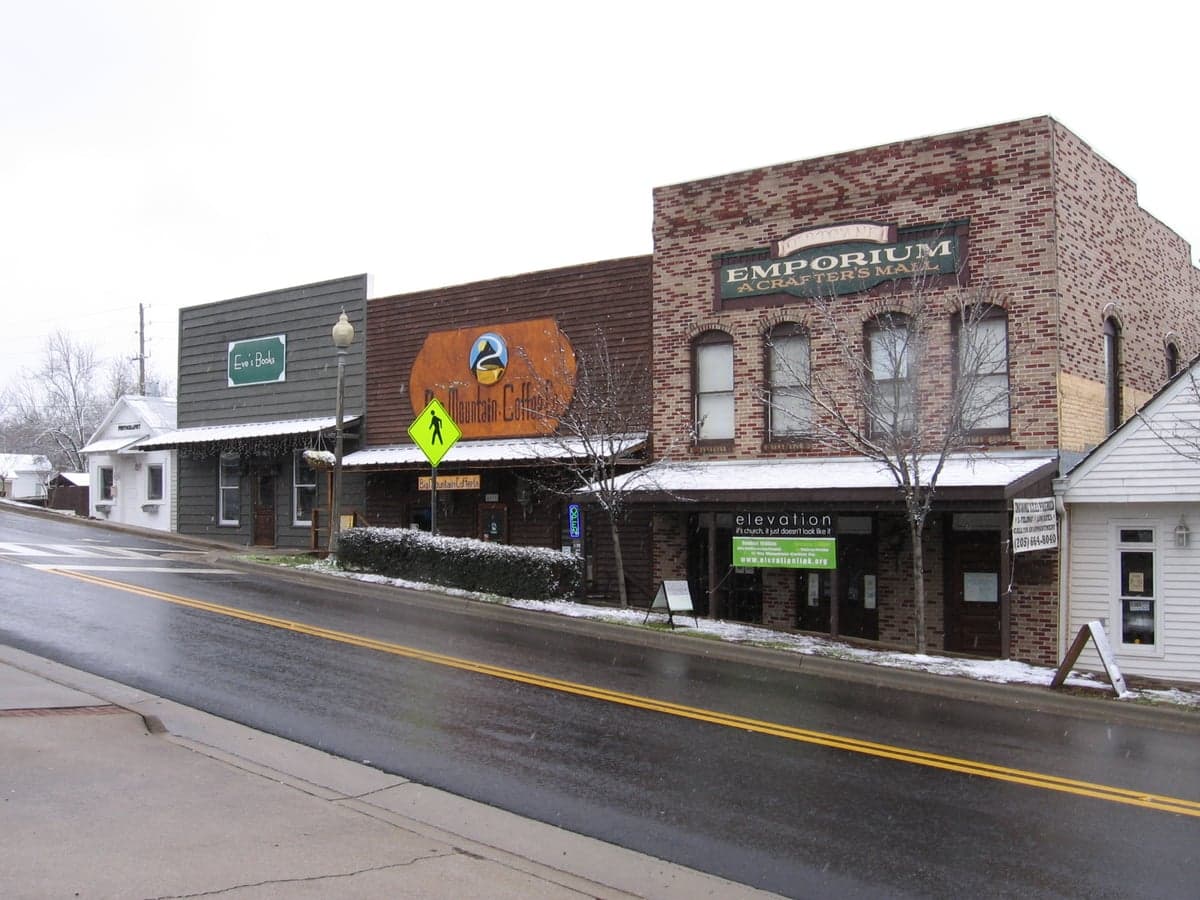
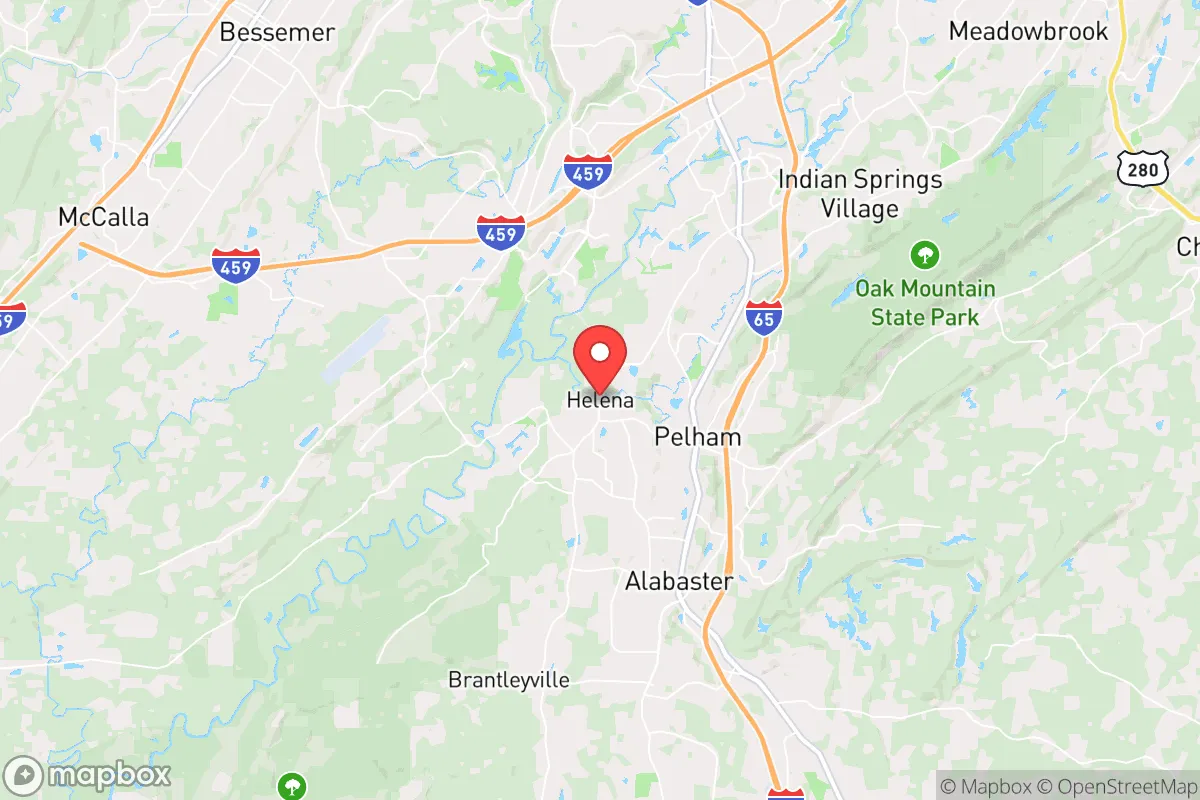
Photo: Wikipedia
Strategic Assessment of Helena, AL
Workable tactical position. Some exposure to population density or targets, but generally defensible in a crisis.
What does the Strategic Assessment tell us?
Our Strategic Assessment grades tactical survivability of an area. Major population centers, military targets, fallout zones, natural disasters, and border exposure all drive risk — lower exposure means a more defensible position in a crisis.
This is heavily inspired by Joel Skousen's Strategic Relocation book. Highly recommended you checkout the book ($)What does this tell us?
Our Strategic Assessment grades tactical survivability of an area. Major population centers, military targets, fallout zones, natural disasters, and border exposure all drive risk — lower exposure means a more defensible position in a crisis.
This is heavily inspired by Joel Skousen's Strategic Relocation book. Highly recommended you checkout the book ($)Strategic Pillars

Key Distances
Regional Safe Places
Below is our recommended "safe zones" in Alabama and the surrounding area based on our strategic heuristics. For most people, it's unrealistic to live in a “safe zone” full-time due to work, family or other personal reasons. They tend to be more rural. However, many of these areas are perfect for second homes and retreat properties that double as a vacation home or even a short-term rental.
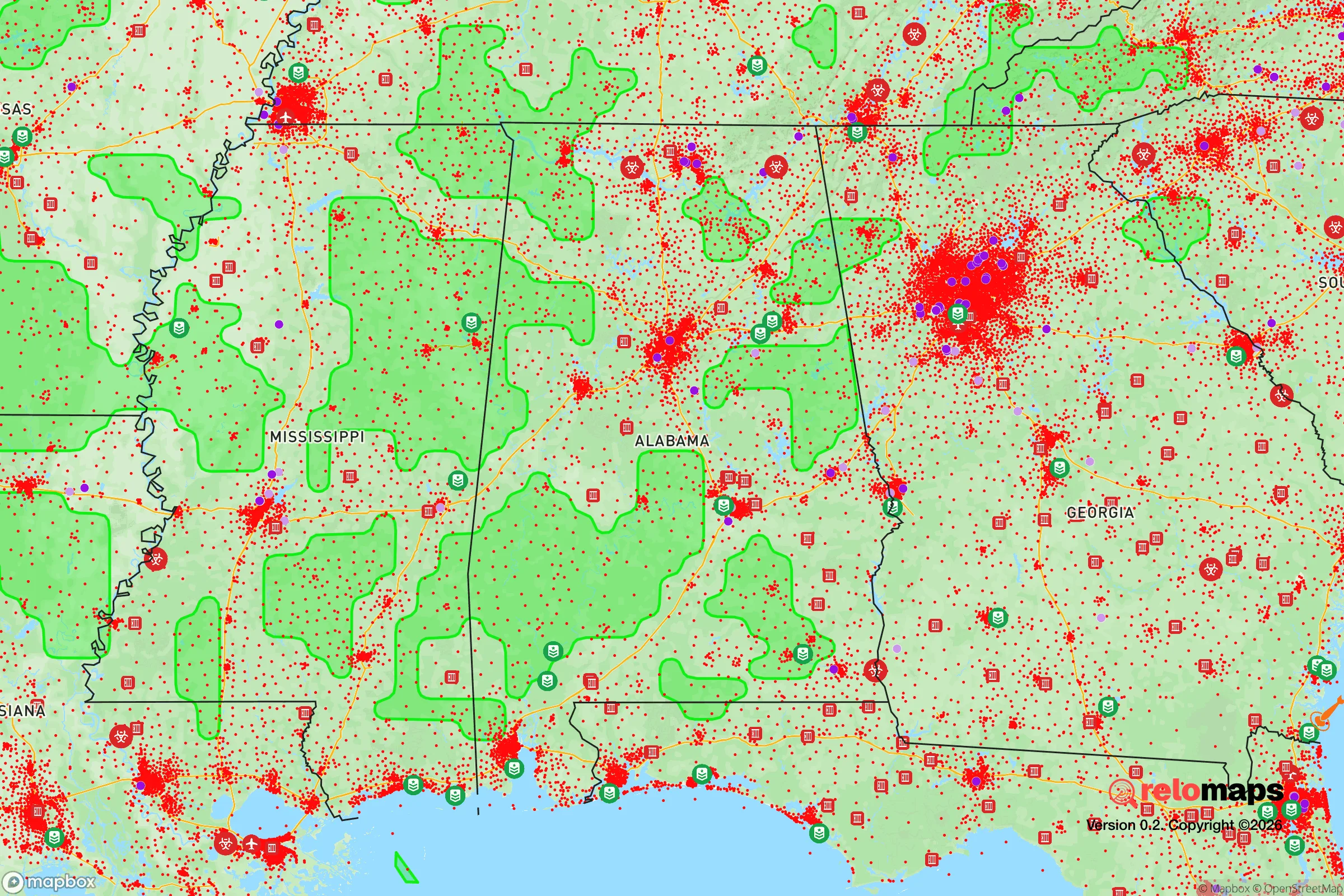
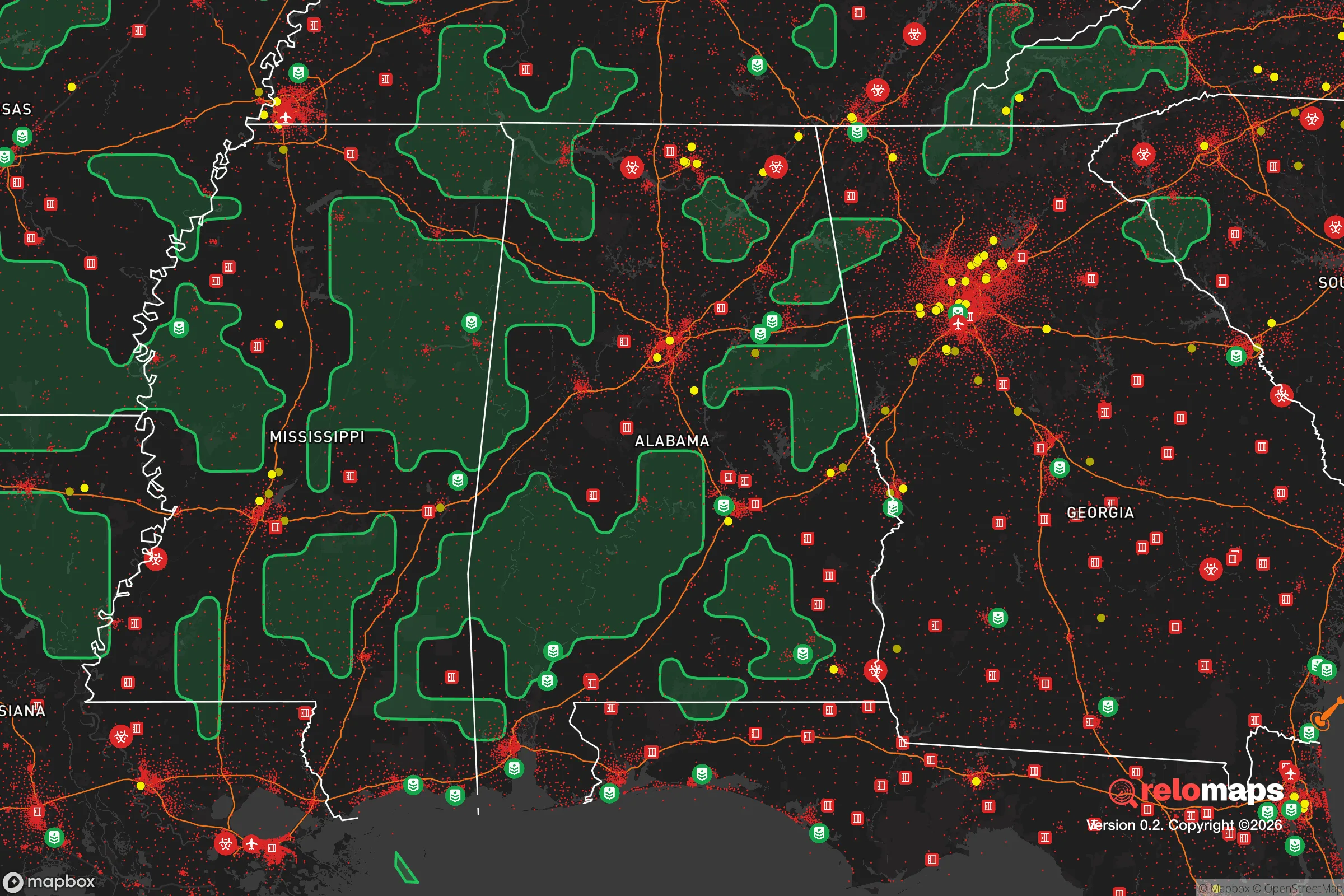


Important Note: For informational purposes only. This does not mean nothing bad ever happens in the green zones. Please use common sense. This is based on public data and modeled with AI. We tried to take a conservative approach but mistakes happen. We update this regularly as new information becomes available.
Solar Generator Recommendations
Backup power matters more here than in safer locations. We've picked three solar generators across budgets and capacity tiers — start with the budget unit if you only need a few essentials, or step up if you want to run a fridge and HVAC for days at a time.

Jackery Portable Power Station Explorer 300
Budget OptionPower on the Go: Weighing only 11 lbs, it's convenient to set up and store with book-sized foldable solar panels

BLUETTI Portable Power Station AC180
Designed for both indoor and outdoor scenarios, AC180 is highly capable as it has a robost capacity and continuous output power.

EF ECOFLOW DELTA Pro Ultra Power Station
Upgraded PickEcoFlow DELTA Pro Ultra is a whole-home energy system designed to grow with your family. Integrated with the Smart Home Panel 2, it scales to meet your evolving energy needs — keeping your home powered, intelligent, and secure through every stage of life.
We earn a commission, at no additional cost to you.
Strategic Assessment Analysis
Helena, Alabama, offers a surprisingly resilient strategic position for those prioritizing preparedness and self-sufficiency, striking a rare balance between proximity to critical infrastructure and insulation from the worst-case scenarios of urban collapse. Located in Shelby County, roughly 20 miles south of Birmingham, this town of about 22,000 sits in a geographic sweet spot—close enough to access medical, logistical, and supply networks, yet far enough from the immediate blast zones and civil unrest corridors that would likely engulf a major city. For the conservative-minded relocator who sees the current national trajectory as unstable, Helena’s combination of defensible terrain, growing local governance, and access to natural resources makes it a strong candidate for a long-term base of operations.
Geographic position and natural advantages for long-term security
Helena’s location in the Ridge and Valley region of central Alabama provides a natural defensive layer that flatland suburbs simply cannot match. The town is nestled among low ridges and hardwood forests, with the Cahaba River running along its western edge—a perennial water source that, with proper filtration, could sustain a household indefinitely. The terrain creates natural chokepoints on the main access routes, particularly along Highway 261 and Interstate 65, which would slow any large-scale movement of displaced populations from Birmingham in a crisis. The area sits well above the 100-year floodplain, so you’re not trading one disaster for another. The local soil is clay-heavy but workable for raised-bed gardening, and the growing season runs from March through October, giving you a solid 7-month window for food production. For a prepper, the key advantage here is defensible geography combined with a moderate climate—no wildfire risk like the West, no hurricane storm surge like the coast, and no earthquake zones. The nearest nuclear plant is the Browns Ferry facility near Athens, about 90 miles north, well outside any plausible fallout radius from a conventional accident or attack.
Risks, exposures, and proximity to fallout-relevant landmarks
No strategic assessment is honest without acknowledging the downsides, and Helena has a few that demand attention. The most obvious risk is proximity to Birmingham’s urban core, which sits just 20 miles north. In a mass-casualty event—whether from a coordinated attack, a pandemic resurgence, or a supply-chain collapse—Birmingham’s population of 200,000 (metro area over 1 million) would likely attempt to flee south along I-65, directly through Helena. The interstate runs right along the town’s eastern edge, and there are only a handful of secondary roads that could serve as alternative routes. If you’re planning to bug in, you’ll need to secure your property against transient traffic. The other major exposure is the Birmingham-Shuttlesworth International Airport, a potential target for any coordinated disruption, and the CSX rail line that runs through the area carrying hazardous materials. On the plus side, Helena has no military bases, no major dams upstream, and no chemical plants within a 10-mile radius. The local government has a functional emergency management office, but it’s a small-town operation—don’t expect FEMA-level response in the first 72 hours. That’s on you.
Practical resilience for a relocator: food, water, energy, and defensibility
For the individual or family looking to build a self-sufficient setup, Helena offers a mix of suburban convenience and rural practicality. The water situation is solid: the Cahaba River is a reliable surface water source, and the local aquifer is tapped by numerous private wells in the surrounding unincorporated areas. If you’re buying property, prioritize a lot with an existing well or the ability to drill one—city water from the Helena Water Works is treated and reliable, but in a prolonged grid-down scenario, you’ll want your own supply. The electric grid is served by Alabama Power, which has a decent track record for storm restoration, but you should plan for solar-plus-battery backup if you’re serious about energy independence. The area gets about 215 sunny days per year, enough for a modest solar array to cover critical loads. Food production is viable: the soil is acidic but amendable, and there are several local farms within a 15-minute drive that sell direct to consumers. The Helena Farmers Market runs seasonally, but for long-term resilience, you’ll want to establish relationships with growers now, not when the shelves are empty. Defensibility is where Helena shines for a single-family home: many lots are on cul-de-sacs or dead-end roads, and the hilly terrain provides natural sightlines. A well-positioned property with a fenced perimeter and a clear field of view to the main approach is achievable within a reasonable budget—think $250,000 to $400,000 for a 3-bedroom on half an acre. The local gun culture is strong, with several ranges and gun shops within 20 minutes, and Shelby County is a constitutional carry jurisdiction as of 2022, meaning no permit is required for concealed carry. That’s a practical advantage for daily readiness.
The overall strategic picture for Helena is cautiously optimistic for the prepared relocator. It’s not a remote bunker—you’re still within the orbit of a major city, and that brings both risk and reward. The reward is access to UAB Hospital, one of the top trauma centers in the Southeast, just 25 minutes away, and a robust local economy that includes employers like the Shelby County School System, the Helena Police Department, and a growing number of logistics and manufacturing firms along the I-65 corridor. The risk is that in a true societal breakdown, the Birmingham exodus would overwhelm the town’s resources within days. Your mitigation strategy is straightforward: build a home with a well, solar panels, a root cellar, and a defensible perimeter; stockpile at least 90 days of food and medical supplies; and establish a network of like-minded neighbors. The local community is predominantly conservative, church-going, and family-oriented—the kind of people who will organize a neighborhood watch before waiting for the government to show up. If you’re looking for a place that’s close enough to civilization to function normally but positioned to weather a storm, Helena is a solid bet. Just don’t expect to be invisible. Prepare accordingly.

* Values derived from national, state, county, city and local statistics and may differ in a specific area. Last updated: 2026-04-19T18:52:50.000Z
Narrative content on this page is AI-generated and may contain mistakes. Verify any details that matter before acting on them.
ReloMaps may earn a commission from affiliate links at no extra cost to you.

