Photo: Wikipedia
Demographics of Henderson, KY
Affluence Level in Henderson, KY
A below-average socioeconomic profile. Incomes, home values, and educational attainment trail the U.S., with higher poverty and unemployment.
People of Henderson, KY
The people of Henderson, Kentucky, today number 27,994, forming a predominantly white (79.3%) and native-born community where just 0.9% of residents are foreign-born. The city carries a distinctively stable, family-oriented character, with a Black population of 10.4% and a Hispanic share of 4.9%, reflecting a modest but growing diversity. College-educated adults make up 18.2% of the population, a figure below national averages that aligns with Henderson’s historic role as a manufacturing and river town rather than a professional-services hub. The city’s identity is rooted in its Ohio River location and a sense of continuity, where generations of families have remained in place, and newcomers are often drawn by affordable housing and proximity to Evansville, Indiana.
How the city was settled and grew
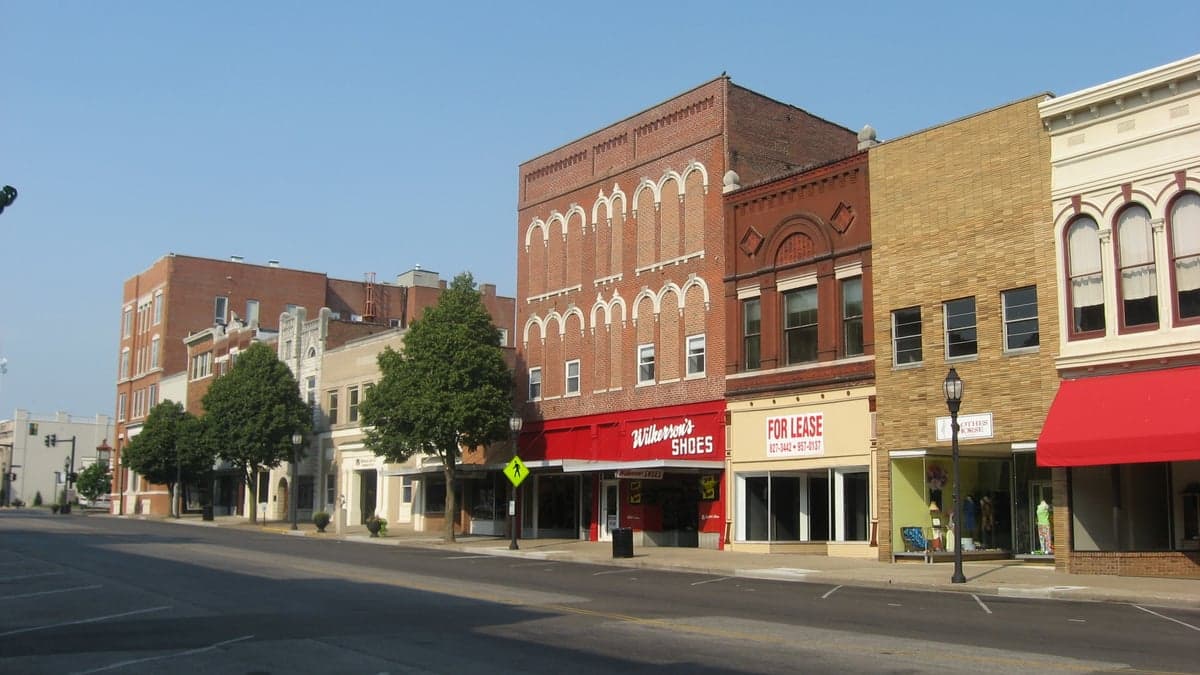
Henderson was founded in 1797 by the Transylvania Company, with the first wave of settlers being Anglo-American pioneers from Virginia, North Carolina, and Pennsylvania who came for fertile bottomland along the Ohio River. These early arrivals built the original town grid around what is now Downtown Henderson, centered on Main and Second Streets, where the county courthouse and riverfront warehouses still stand. By the 1830s, the city became a tobacco and river trade hub, drawing German and Irish immigrants who settled in the “South End” — the area south of Washington Street — where they worked in tobacco warehouses and on the river docks. A significant Black population arrived during and after the Civil War, many as freedmen seeking work in the tobacco and railroad industries, and they established a concentrated community in the “East End” around Alvasia Street and Martin Luther King Jr. Boulevard. The late 19th and early 20th centuries saw a wave of Italian and Eastern European immigrants, largely employed in the city’s new iron and steel foundries, who settled in the “West Side” near the railroad tracks and the Ohio River levee. By 1950, Henderson’s population had reached roughly 16,000, with a clear ethnic and racial geography: the East End remained predominantly Black, the South End was working-class white ethnic, and the West Side was a mix of newer immigrant groups.
Modern era (post-1965)
After the 1965 Hart-Cellar Act, Henderson saw virtually no new foreign-born immigration — the foreign-born share today is just 0.9% — so the city’s modern demographic story is one of domestic migration and suburbanization. The construction of the Audubon Parkway in the 1970s opened up the “North Side” (north of U.S. 60) for suburban-style subdivisions, attracting white families moving out of the older South End and Downtown. This area, including neighborhoods like Bentbrook and Woodland Hills, became the city’s growth corridor, with larger lots and newer schools. Meanwhile, the East End’s Black population remained stable but saw some out-migration to the North Side and to Evansville, while the Hispanic share began a slow increase from near zero in 1990 to 4.9% today, concentrated in the South End and West Side, where affordable rental housing and jobs in manufacturing (e.g., the Gibbs Die Casting plant) drew Mexican and Central American workers. The Asian population remains tiny at 0.4%, and the Indian-subcontinent population is effectively zero, reflecting Henderson’s lack of tech or professional sectors that attract these groups. The college-educated share of 18.2% is low, consistent with a city where the largest employers are manufacturing (Gibbs, Pratt Industries) and healthcare (Methodist Health), not white-collar industries.
The future
Henderson’s population is projected to remain flat or grow very slowly, as the city lacks the job growth or housing construction to attract significant in-migration. The Hispanic share is likely to continue its gradual increase, potentially reaching 7-8% by 2040, driven by family reunification and continued manufacturing employment, but the foreign-born share will remain below 2%. The Black population share is stable, with no major in-migration from other regions. The city is not tribalizing into distinct ethnic enclaves — rather, it is slowly homogenizing as older ethnic neighborhoods (the Italian West Side, the German South End) fade into a general white working-class identity, while the East End remains the most distinct Black-majority area. The North Side subdivisions will continue to attract the few newcomers, mostly white families from the Evansville metro area seeking lower taxes and quieter streets. For someone moving in now, Henderson offers a stable, low-diversity, family-oriented community where change is incremental and the population is aging slightly — the median age is 40.1 — but where housing costs remain among the lowest in the Ohio Valley.
Henderson is becoming a quieter, more homogenized version of its industrial past — a place where the children of factory workers stay local, and the few newcomers are drawn by affordability rather than opportunity. For a conservative-leaning family or individual, this means a predictable, low-crime environment with strong community ties, but also limited economic mobility and a population that is not growing or diversifying in any dramatic way.

* Values derived from national, state, county, city and local statistics and may differ in a specific area. Last updated: 2026-04-21T10:48:18.000Z
Narrative content on this page is AI-generated and may contain mistakes. Verify any details that matter before acting on them.
ReloMaps may earn a commission from affiliate links at no extra cost to you.

