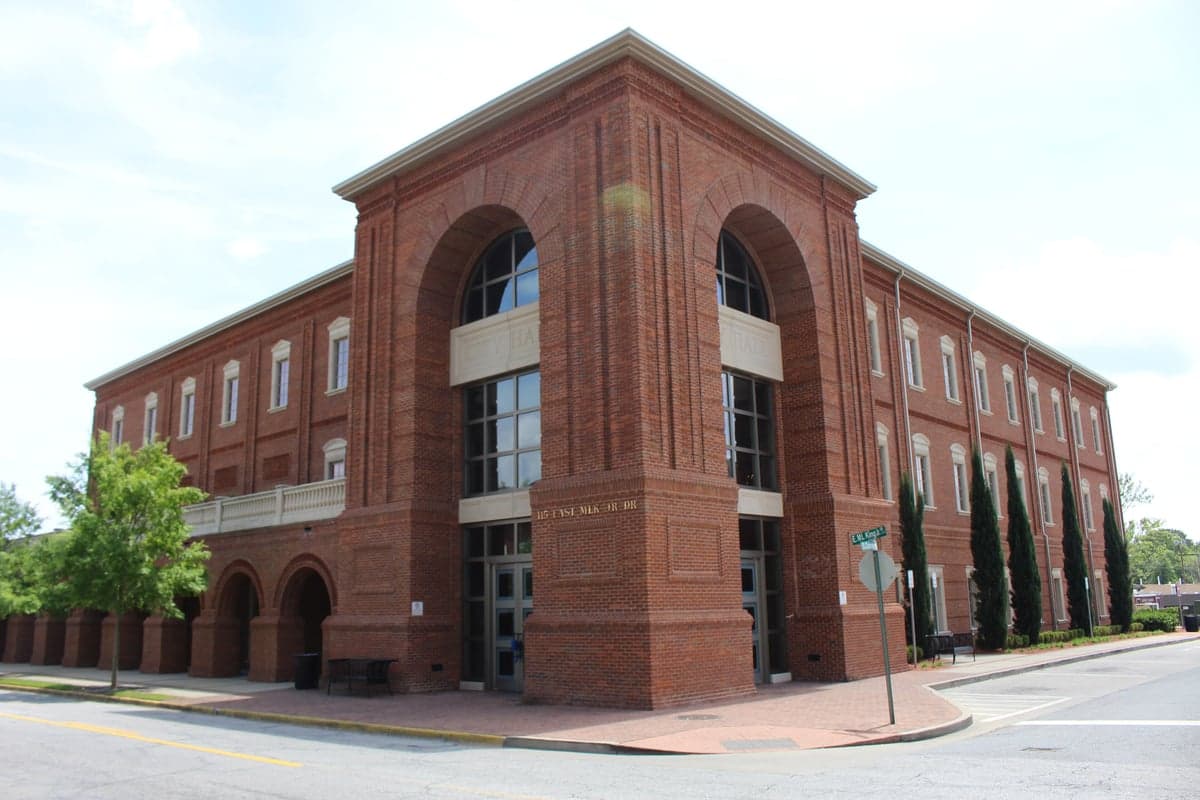
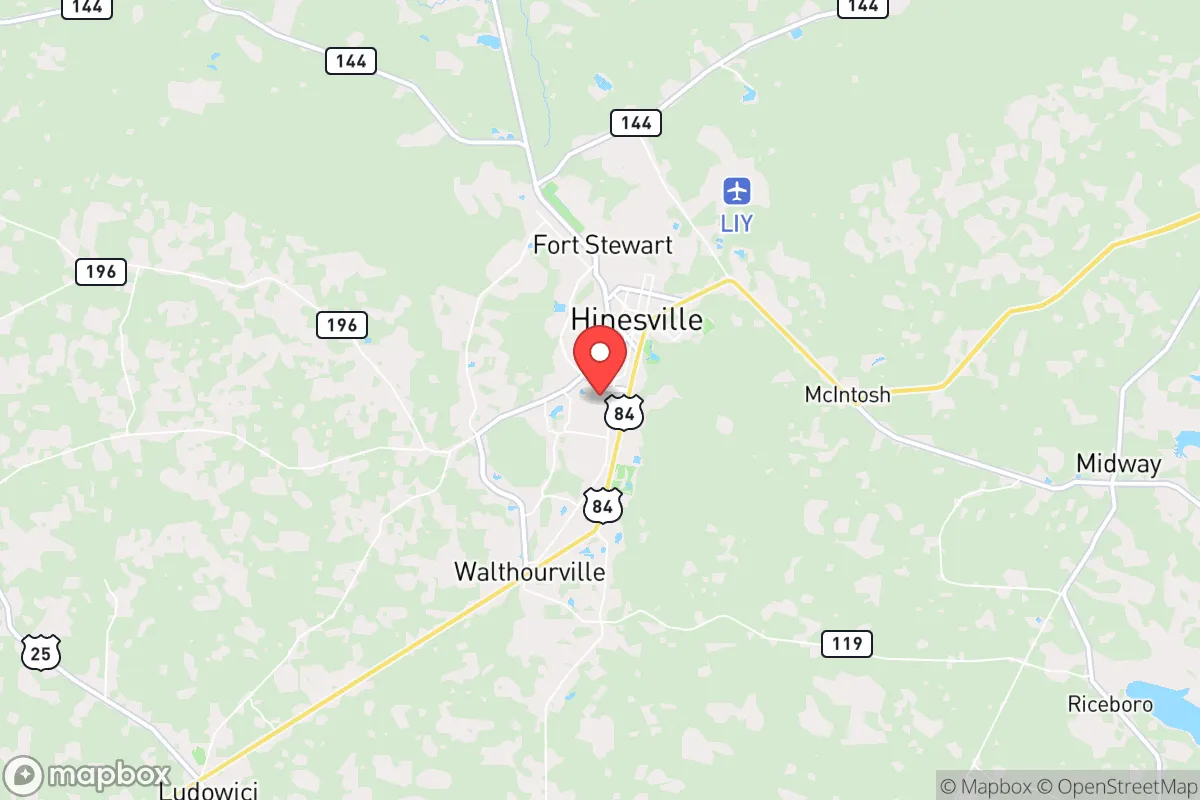
Photo: Wikipedia
Demographics of Hinesville, GA
Affluence Level in Hinesville, GA
A below-average socioeconomic profile. Incomes, home values, and educational attainment trail the U.S., with higher poverty and unemployment.
People of Hinesville, GA
Today, Hinesville, Georgia is a majority-Black city of 35,282 residents with a distinctly military-infused character, shaped overwhelmingly by its symbiotic relationship with Fort Stewart. The population is younger and less college-educated than the national average (20.7% hold a bachelor’s degree or higher), and the city’s racial and ethnic makeup — 46.4% Black, 30.4% White, 13.3% Hispanic, 1.3% East/Southeast Asian, and 1.1% Indian — reflects both Deep South roots and the rotating presence of active-duty soldiers and their families from across the country and globe.
How the city was settled and grew
Hinesville was founded in 1837 as a railroad stop on the Atlantic and Gulf Railroad, named after Charleston businessman Charlton Hines. Its early population was overwhelmingly White and rural, drawn by timber and turpentine industries and later by cotton farming. The city remained a small, sleepy county seat of Liberty County for over a century, with a population hovering around 1,000 as late as 1940. The first major demographic shift came with the establishment of Camp Stewart (later Fort Stewart) in 1940 as an anti-aircraft artillery training base. The base brought an influx of military personnel and civilian contractors, many of whom settled in the Historic Downtown area and along Oglethorpe Highway, where modest bungalows and boarding houses were built to accommodate them. The Black population, which had been largely rural and agricultural, began moving into town during the Great Migration, settling in the Fleming Heights and Riceboro Road corridors, areas that remain predominantly Black neighborhoods today.
Modern era (post-1965)
The post-1965 era transformed Hinesville from a small Southern town into a military boomtown. The Vietnam War buildup at Fort Stewart drove explosive growth: the city’s population tripled between 1960 and 1980, from 2,500 to over 11,000. This wave brought White and Black soldiers from across the country, as well as a growing number of Hispanic and East/Southeast Asian military families, many of whom settled in the Oak Forest and Sunbury subdivisions, built specifically to house the expanding base workforce. The 1990s and 2000s saw further diversification as Fort Stewart became a major deployment hub for the 3rd Infantry Division. Hispanic residents, many from Puerto Rico and Mexico, concentrated in the Fraser Drive area near the base’s main gate. The city’s Black population grew steadily through both military and civilian in-migration, reaching its current majority share. The Indian subcontinent population (1.1%) is a recent arrival, largely composed of military medical professionals and IT contractors working at Fort Stewart’s Winn Army Community Hospital, with a small cluster of families in the Briarwood neighborhood. The East/Southeast Asian community (1.3%) includes Filipino, Korean, and Vietnamese families, many with military ties, scattered across the city without a single concentrated enclave.
The future
Hinesville’s population is likely to continue growing modestly, driven by Fort Stewart’s status as a permanent, large-scale Army installation. The city is not homogenizing into a single demographic bloc; rather, it is tribalizing into distinct, income- and race-correlated neighborhoods. The Historic Downtown area is seeing reinvestment and a slight uptick in White, college-educated professionals, while Fleming Heights and Riceboro Road remain solidly Black and working-class. Hispanic growth is steady but not explosive, plateauing around 13-15% as military rotations bring in new families but others move on. The East/Southeast Asian and Indian populations are likely to remain small and transient, tied to specific military assignments rather than permanent settlement. The biggest unknown is the long-term effect of base realignment or force reductions — a major drawdown at Fort Stewart could reverse growth and accelerate out-migration, particularly among the White and Hispanic populations that are more closely tied to active-duty service. For now, Hinesville remains a military town first, a Black-majority city second, and a place where most residents are passing through rather than putting down deep roots.
For a conservative-leaning individual or family moving to Hinesville, the city offers a stable, family-oriented environment anchored by the military community, with lower housing costs than coastal Georgia and a strong sense of patriotism. The trade-off is a transient population, limited high-end retail and dining, and a public school system that struggles to retain experienced teachers. The city is becoming more diverse but not necessarily more integrated — newcomers should expect to find their social footing through the base, church, or specific neighborhood networks rather than a unified civic identity.

* Values derived from national, state, county, city and local statistics and may differ in a specific area. Last updated: 2026-04-30T15:27:58.000Z
Narrative content on this page is AI-generated and may contain mistakes. Verify any details that matter before acting on them.
ReloMaps may earn a commission from affiliate links at no extra cost to you.

