
Photo: Wikipedia
Political ClimatePolitical Climate in Hinesville, GA
District shown is the primary district for this city’s centroid. Cities may span multiple districts.
Local Political AnalysisPolitical Analysis of Hinesville, GA
Hinesville, Georgia, has long been a solidly conservative community, and the numbers back that up with a Cook PVI of R+8, meaning it votes about eight points more Republican than the national average. For decades, this area has been a place where folks value personal responsibility, limited government, and the right to live your life without a bunch of red tape or nanny-state nonsense. But like a lot of places in the South, you can feel a subtle shift in the air—not a full-blown political earthquake, but a slow creep that has some of us who’ve been here a while keeping a close eye on things.
How it compares
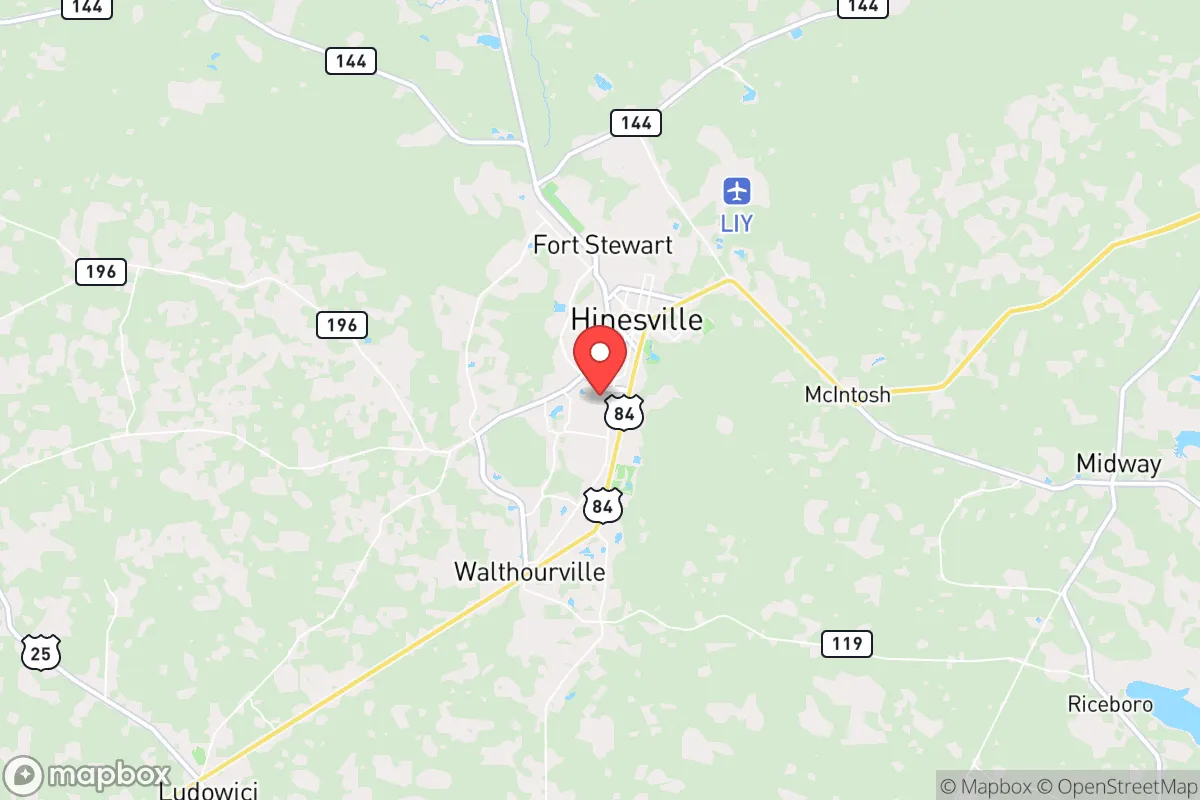
When you look at the political landscape around Hinesville, the contrast with nearby cities is pretty stark. Head east toward Savannah, and you’re stepping into a much more progressive environment—a place where local government has gotten a little too cozy with the idea of telling people what they can and can’t do with their property, their businesses, and even their speech. Savannah’s city council has flirted with zoning overhauls and public health mandates that would make a lot of Hinesville folks’ hair stand on end. Meanwhile, smaller towns like Ludowici or Jesup to the west and south are even more reliably conservative, with a “keep your hands off my stuff” attitude that feels like home. Hinesville sits right in the middle—still conservative at its core, but with a growing military and transient population from Fort Stewart that sometimes brings in more progressive ideas about everything from taxes to social policies. It’s not a crisis yet, but it’s a trend worth watching.
What this means for residents
For the average Hinesville resident, the political climate means you still have a lot of breathing room compared to bigger cities. Property taxes are manageable, and there’s not a lot of government overreach into your daily life—no one’s coming after your gas stove or telling you how to run your small business. But the concern is that as the area grows, there’s pressure to adopt the kind of “progressive” policies that have wrecked affordability and freedom in places like Atlanta or Savannah. You see it in local school board meetings, where debates about curriculum and parental rights are heating up. The good news is that the R+8 lean means most elected officials still get the message: keep government small, protect the Second Amendment, and don’t mess with people’s paychecks. But if you’re not paying attention, a few bad elections could tip the balance toward more regulation and less liberty.
One thing that sets Hinesville apart is its strong military culture, thanks to Fort Stewart. That brings a certain discipline and respect for tradition, but it also means a lot of folks come and go, bringing outside ideas. The local GOP is still strong, but there’s a quiet worry that the next wave of transplants might not share the same deep-rooted commitment to personal freedoms. If you’re thinking of moving here, know that you’ll find a community that still believes in the old-school values of self-reliance and common sense—but don’t take it for granted. The fight to keep Hinesville from sliding into the kind of overreach you see in blue cities is real, and it’s going to take folks who are willing to speak up at town halls and at the ballot box.

State Political ClimatePolitical Climate in Georgia
State Political AnalysisPolitical Environment in the State
Georgia has shifted from a reliably Republican stronghold to a true battleground state over the past 20 years, with its current partisan lean sitting at roughly a 50-50 split in statewide races. The state’s political coalition is now defined by a rapidly growing, diverse metro Atlanta area that leans Democratic, balanced against deeply conservative rural and exurban counties that still turn out heavily for Republicans. The 2020 election saw Joe Biden win Georgia by just under 12,000 votes, and the 2022 Senate runoff gave Democrats another win, but the 2024 presidential race tightened again, with Donald Trump carrying the state by a narrow margin—signaling that Georgia remains fiercely contested and far from settled.
Urban vs. rural divide
The political map of Georgia is a study in contrasts. Metro Atlanta, encompassing Fulton, DeKalb, Cobb, Gwinnett, and Clayton counties, drives the Democratic vote—these five counties alone delivered over 1.5 million votes for Biden in 2020. Inside the Perimeter (ITP) neighborhoods like Buckhead, Midtown, and Decatur are heavily progressive, while outer suburbs like Marietta and Lawrenceville have flipped from red to purple over the last decade. Meanwhile, rural south Georgia—places like Valdosta, Albany, and Waycross—vote overwhelmingly Republican, often by 70% or more. The exurban counties north of Atlanta, such as Forsyth and Cherokee, remain deep red and are growing fast. The divide isn’t just geographic; it’s cultural. Rural voters see Atlanta as a separate country, and many feel their values are increasingly sidelined by the state’s dominant metro region.
Policy environment
Georgia’s policy landscape is a mixed bag for conservatives. The state has a flat income tax rate of 5.49%, which is competitive but not as low as Florida or Tennessee. Property taxes are relatively moderate, though they vary widely by county—Forsyth County has some of the lowest rates, while DeKalb County is among the highest. The regulatory environment is generally business-friendly, with right-to-work laws and limited union influence. On education, Georgia has a robust school choice program, including the Georgia Special Needs Scholarship and a new Education Savings Account (ESA) program signed in 2024, which allows parents to use state funds for private school or homeschooling. However, the state’s public schools in metro Atlanta are increasingly influenced by progressive curriculum mandates, including critical race theory and LGBTQ+ inclusive materials, which has sparked parental pushback. Election laws were tightened after 2020 with SB 202, which added voter ID requirements for absentee ballots and limited drop boxes—a move conservatives praised for security but progressives called suppression. Healthcare policy remains a sore spot: Georgia did not expand Medicaid, but the state’s private option, Georgia Pathways, has low enrollment and is seen by many as a half-measure.
Trajectory & freedom
Georgia’s trajectory on personal freedom is a tug-of-war. On the positive side for conservatives, the state passed constitutional carry (permitless carry) in 2022, allowing law-abiding citizens to carry a firearm without a license. Parental rights were strengthened with the passage of HB 1178 in 2023, which requires schools to notify parents of any changes to a student’s mental, emotional, or physical health—effectively banning secret gender transitions at school. The state also passed a heartbeat abortion law (HB 481) in 2019, banning most abortions after six weeks, which was upheld by the Georgia Supreme Court in 2022. However, there are concerning trends. The state’s medical autonomy took a hit with the expansion of vaccine mandates for healthcare workers during COVID, and some local governments in metro Atlanta have pushed mask and vaccine requirements. Property rights are generally strong, but the state’s use of eminent domain for the proposed Atlanta BeltLine and other transit projects has raised eyebrows. On speech, Georgia has no anti-SLAPP law, making it easier for wealthy individuals to sue critics into silence—a gap that needs closing. Overall, Georgia is becoming more free on gun rights and parental control, but less free on medical choice and local governance, as Atlanta’s progressive policies often clash with state preemption laws.
Civil unrest & political movements
Georgia has seen its share of political flashpoints. The 2020 election cycle brought massive protests in Atlanta, including the summer of 2020’s racial justice demonstrations that turned violent in parts of downtown and Buckhead. The “Stop Cop City” movement, opposing the construction of a police training facility in DeKalb County, has led to repeated clashes between activists and law enforcement, with some protesters labeled as domestic terrorists by state officials. Immigration politics are heated: Georgia passed HB 87 in 2011, one of the toughest anti-sanctuary laws in the country, but metro Atlanta counties like Clayton and Gwinnett have adopted sanctuary-like policies, refusing to fully cooperate with ICE. Election integrity remains a live issue—the 2020 audit and hand recount in Fulton County was marred by allegations of mismanagement, and the 2024 election saw lawsuits over absentee ballot processing in DeKalb. On the right, the Georgia Republican Party has seen internal battles between establishment figures like Governor Brian Kemp and Trump-aligned challengers, leading to a fractured but still dominant conservative base in rural areas. A new resident in Athens or Savannah would notice the political polarization in local news and community meetings, but daily life remains peaceful outside of Atlanta’s core.
Projection
Over the next 5-10 years, Georgia is likely to become more competitive, with the Democratic vote share slowly rising as metro Atlanta continues to grow and diversify. The state’s population is projected to increase by 1.5 million by 2030, with most of that growth in the Atlanta suburbs and the Augusta and Savannah areas. This in-migration includes many from blue states like California and New York, who bring progressive voting habits. However, the exurban and rural counties are also growing, and the state’s Republican legislature is likely to continue passing laws that lock in conservative policies—like further abortion restrictions, expanded school choice, and election security measures—before the demographic shift becomes irreversible. The wildcard is the 2026 governor’s race: if a Democrat wins, expect a rapid push for Medicaid expansion, gun control, and progressive tax hikes. For now, Georgia remains a state where conservative values still hold sway in the legislature and most counties, but the cultural and electoral momentum is slowly shifting toward the center-left. A new resident moving to Macon or Columbus will find a more stable conservative environment than someone settling in Decatur or Sandy Springs.
For a conservative relocating to Georgia, the bottom line is this: you can find a community that matches your values, especially in the exurbs and rural areas, but you’ll need to be strategic about where you land. The state’s tax and regulatory climate is favorable, and recent laws on guns, parental rights, and abortion are strong. But the political winds are shifting, and the influence of metro Atlanta’s progressive machine is growing. If you’re a parent, prioritize counties with strong school choice options and conservative school boards—places like Forsyth, Cherokee, or Oconee near Athens. If you’re single and value freedom, the state’s constitutional carry and low taxes are a draw, but be prepared for the cultural battle that’s coming. Georgia is still a good bet for conservatives, but it’s no longer a sure thing—and the next decade will determine whether it stays red or turns purple for good.
* Values derived from national, state, county, city and local statistics and may differ in a specific area. Last updated: 2026-04-30T15:27:58.000Z
Narrative content on this page is AI-generated and may contain mistakes. Verify any details that matter before acting on them.
ReloMaps may earn a commission from affiliate links at no extra cost to you.

