
Photo by Laura Peruchi on Unsplash
Demographics of Hyde Park, VT
Affluence Level in Hyde Park, VT
An upper-middle-class area. Household wealth, education levels, and homeownership run ahead of national benchmarks.
People of Hyde Park, VT
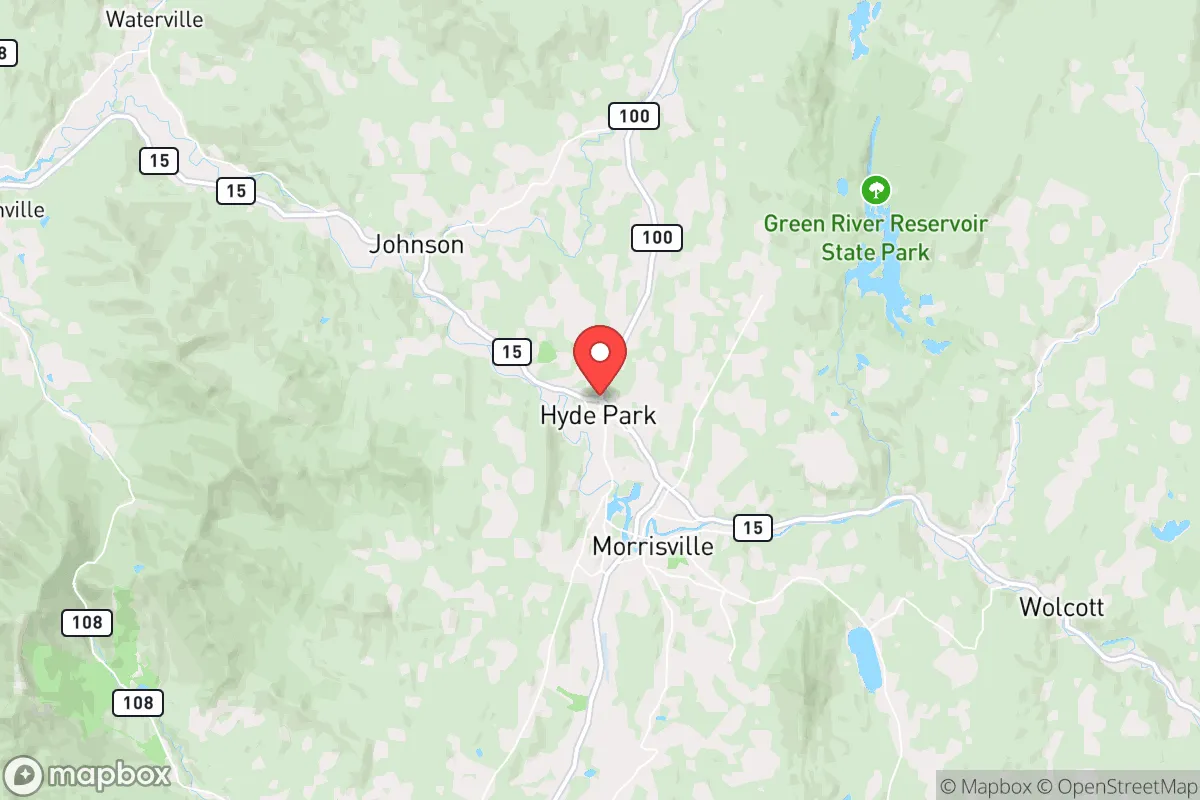
Hyde Park, Vermont, is a small, tight-knit village of 434 residents that remains overwhelmingly white (97.0%) and native-born, with a foreign-born population of just 0.2%. The community is characterized by a strong sense of local identity, a high proportion of college-educated residents (45.2%), and a quiet, rural character that has changed little over the past century. For those considering a move, Hyde Park represents a stable, culturally homogeneous enclave where family roots run deep and the pace of life is deliberately slow.
How the city was settled and grew
Hyde Park’s human history begins with the original land grants of the 1780s, awarded to Revolutionary War veterans and speculators from southern New England. The village was chartered in 1781 and named after a prominent landholder, Jedediah Hyde. The first permanent settlers were primarily of English and Scottish descent, arriving from Massachusetts and Connecticut to clear the forested Lamoille River valley for farming. The village core, known as Hyde Park Village, grew around the river’s mill sites, with sawmills and gristmills drawing a modest population of farmers and tradesmen. By the mid-19th century, the arrival of the Vermont Central Railroad in 1849 spurred a second wave of settlement, bringing Irish laborers who built the rail line and later settled in a small cluster near the depot, an area still referred to locally as Depot Hill. These Irish families, along with a handful of French-Canadian migrants who came for seasonal farm work, formed the village’s working-class backbone through the early 1900s. The population peaked around 1,200 in the 1850s before declining as industry shifted away, leaving Hyde Park as a quiet agricultural and administrative center for Lamoille County.
Modern era (post-1965)
The post-1965 period saw no significant immigration-driven change in Hyde Park. The 1965 Hart-Cellar Act, which reshaped many U.S. communities, had virtually no effect here: the foreign-born population today is 0.2%, and the village remains 97.0% white. Instead, the modern era has been defined by domestic in-migration from other parts of Vermont and the Northeast. Beginning in the 1970s, a small wave of back-to-the-land homesteaders—often college-educated and seeking a simpler life—bought up old farmhouses in the outlying areas, particularly along Pleasant Valley Road and near the Lamoille River corridor. These newcomers, while culturally distinct from the established farming families, integrated into the village’s civic life without altering its racial or ethnic composition. The Hispanic population (2.1%) and East/Southeast Asian population (0.9%) are very small, likely consisting of a few individuals employed in local healthcare or education, with no identifiable ethnic enclave. The village’s Black population is 0.0%, and there are no recorded residents of Indian subcontinent ancestry. The most notable demographic shift has been the aging of the population, as younger adults leave for larger job markets and older retirees move in for the quiet, low-crime environment.
The future
Hyde Park’s population is heading toward continued stability with a slight decline. The village is not homogenizing further—it is already as homogeneous as a Vermont community can be—but it is also not tribalizing into distinct enclaves. The small Hispanic and Asian populations are dispersed and assimilating into the broader white community, with no signs of growth or concentration. The most likely demographic trend over the next 10–20 years is a gradual aging of the existing population, as the village lacks the job base or housing stock to attract significant numbers of young families. The village center around Main Street will likely see a slow turnover of homes to retirees and remote workers, while the outlying rural neighborhoods along the river may see more second-home buyers from out of state. No new immigrant communities are expected to form, given the village’s remote location and limited economic opportunities.
For someone moving in now, Hyde Park is becoming an increasingly quiet, older, and more insular place—ideal for those seeking a safe, predictable, and culturally stable environment, but unlikely to offer the diversity or dynamism found in larger Vermont towns like Burlington or Stowe. The village’s future is one of preservation, not transformation.

* Values derived from national, state, county, city and local statistics and may differ in a specific area. Last updated: 2026-05-04T02:42:45.000Z
Narrative content on this page is AI-generated and may contain mistakes. Verify any details that matter before acting on them.
ReloMaps may earn a commission from affiliate links at no extra cost to you.

