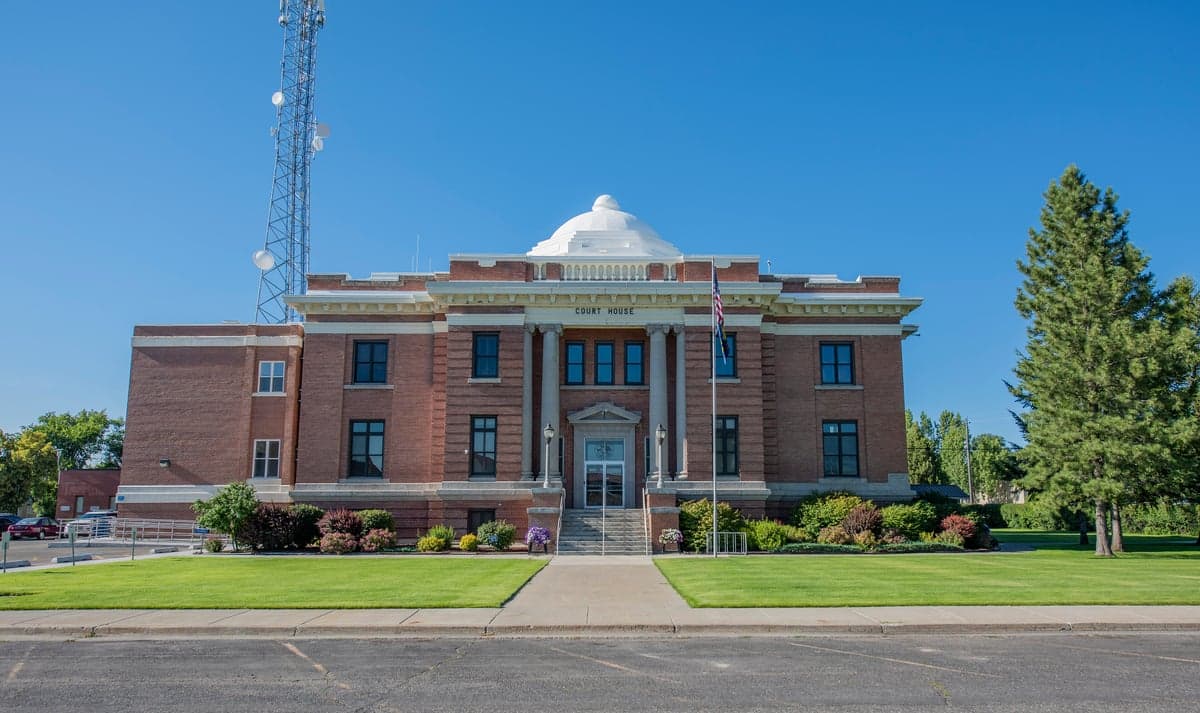
Photo: Wikipedia
Personal Sovereignty in Fremont County
Moderate friction. Expect trade-offs in some aspect of personal liberty and independence.
What does Personal Sovereignty tell us?
Personal Sovereignty measures your capacity for self-reliance and independence with minimal government friction. Higher scores mean fewer barriers between you and the way you want to live... but it assumes you have the space you need and good neighbors.
What does this tell us?
Personal Sovereignty measures your capacity for self-reliance and independence with minimal government friction. Higher scores mean fewer barriers between you and the way you want to live... but it assumes you have the space you need and good neighbors.
State Policy
Energy independence: Importer (25% of energy produced in-state)
Personal Liberty
Homesteading

Personal Liberty Analysis
Fremont County, Idaho, offers one of the strongest personal sovereignty environments in the Intermountain West, largely because its rural character and low population density have kept government overreach at arm’s length. Unlike the increasingly restrictive corridors of Boise or Kootenai County, this region still operates on a frontier ethos where your property, your family, and your decisions are largely your own business. For single individuals and parents who view the accelerating erosion of personal freedoms elsewhere as a red line, Fremont County represents a deliberate retreat into a jurisdiction where the state’s footprint remains light and local culture prizes self-determination over compliance.
Tax burden and regulatory posture: How Fremont County compares to Idaho’s more restrictive areas
Fremont County’s tax burden is among the lightest in the state, with property tax rates hovering around 0.6% of assessed value—roughly half what you’d pay in Ada County. There is no county-level income tax, and Idaho’s flat income tax rate of 5.8% (as of 2025) applies uniformly, but the county’s low property valuations keep the effective bite minimal. The regulatory posture here is distinctly hands-off. Towns like St. Anthony, the county seat, and Ashton operate with minimal zoning enforcement compared to urbanized areas; building permits are straightforward, and there is no county-wide planning department that aggressively audits unpermitted structures. Island Park, however, is a notable exception—its proximity to Yellowstone and seasonal tourism has led to stricter short-term rental regulations and more active code enforcement, so if you’re looking to avoid any bureaucratic friction, the southern half of the county (around Parker and Teton) is far more permissive. The county commission has consistently opposed new state-level land-use mandates, and local officials publicly frame their role as facilitators, not gatekeepers. For anyone fleeing the regulatory creep of blue-state jurisdictions, Fremont County’s posture is a deliberate, low-tax, low-rule alternative.
Self-defense and gun law specifics: What the Second Sanctuary status means for residents
Fremont County is a certified Second Amendment Sanctuary, meaning local law enforcement has formally pledged not to enforce any federal or state gun control measures deemed infringing. This isn’t just symbolic—the sheriff’s office in St. Anthony has a track record of refusing to cooperate with federal firearms background check expansions or magazine capacity bans. Idaho itself is a constitutional carry state, so no permit is required to carry a concealed firearm for anyone 18 or older who can legally possess a weapon. The county’s gun culture is deeply ingrained; you’ll see open carry in grocery stores and at public meetings without a second glance. For parents, this translates to a community where firearm safety education is normalized—local 4-H programs and church groups routinely offer hunter safety courses, and there is no stigma around teaching children responsible gun ownership from a young age. The practical reality is that in a county where the nearest state police barracks is 45 minutes away in Rexburg, self-defense is understood as a personal responsibility, not a government service. If you’re coming from a state with red-flag laws or waiting periods, Fremont County feels like a deliberate reset to pre-2000s norms of individual armed autonomy.
Self-reliance and homesteading viability: Lot sizes, zoning, and off-grid feasibility across the county
Homesteading and off-grid living are not just possible in Fremont County—they are the default lifestyle for a significant portion of the population. The county’s zoning code is minimal: outside of incorporated town limits, there are no minimum square footage requirements for dwellings, no restrictions on alternative energy systems, and no county-wide ban on composting toilets or rainwater collection. Lot sizes vary dramatically by area. In the agricultural flats around Parker and Teton, you can find 5- to 40-acre parcels for under $3,000 per acre, with no HOA and no restrictive covenants. St. Anthony’s outskirts offer smaller 1- to 5-acre lots that still allow livestock, chickens, and detached workshops without permits. Island Park, again, is the outlier—its subdivision covenants often require grid-tied power and prohibit permanent off-grid structures, and the Forest Service controls large swaths of land there, limiting private development. For serious off-grid feasibility—solar arrays, well drilling, septic installation—the southern and eastern parts of the county are ideal. The county health department inspects septic systems but does not require engineered designs for standard gravity-fed setups, keeping costs under $5,000. Water rights are senior and relatively inexpensive; a domestic well permit costs under $100 and is issued without a waiting period. For parents wanting to raise children with hands-on skills and minimal dependence on fragile supply chains, Fremont County’s land-use freedom is a deliberate, practical foundation.
Personal liberties: Parental rights, medical autonomy, speech, and property protections
Fremont County’s culture of personal sovereignty extends directly into parental rights and medical autonomy. The local school district (Fremont County School District 215) has a policy of not enforcing state-level mask or vaccine mandates without a specific county health order—which has not been issued since 2021. Parents have successfully challenged curriculum materials they deemed inappropriate, and the school board meetings are routinely attended by residents who openly discuss opting children out of any program they find objectionable. Medical autonomy is similarly respected: the county’s two small clinics in St. Anthony and Ashton do not participate in any state vaccine registry beyond what is federally required, and there are no county-level restrictions on alternative or holistic medicine. Free speech is robust—public comment periods at commission meetings are uncensored, and there is no local ordinance restricting political signage or assembly. Property rights are protected by Idaho’s “private property protection” laws, which require the government to compensate landowners for any regulatory taking; this has effectively halted any county-level attempts at downzoning or conservation easements without landowner consent. For those who see the federal government’s increasing reach into family and medical decisions as a direct threat, Fremont County offers a jurisdiction where local officials actively resist that encroachment.
Overall, Fremont County ranks among the top 10% of U.S. counties for personal sovereignty, according to independent liberty-index analyses. Its combination of low taxes, minimal zoning, constitutional carry, and a local government that treats citizens as sovereign individuals rather than subjects places it in the same tier as northern Idaho’s Boundary County or Montana’s Beaverhead County. For single individuals and parents who view the current trajectory of federal overreach as unsustainable, this is not just a relocation option—it is a deliberate strategic move into a jurisdiction that still respects the line between government and personal autonomy. The trade-off is distance from urban amenities and a harsh winter climate, but for those prioritizing freedom over convenience, Fremont County delivers what most of the country has already surrendered.

* Values derived from national, state, county, city and local statistics and may differ in a specific area. Last updated: 2026-05-28T05:34:40.000Z
Narrative content on this page is AI-generated and may contain mistakes. Verify any details that matter before acting on them.
ReloMaps may earn a commission from affiliate links at no extra cost to you.

