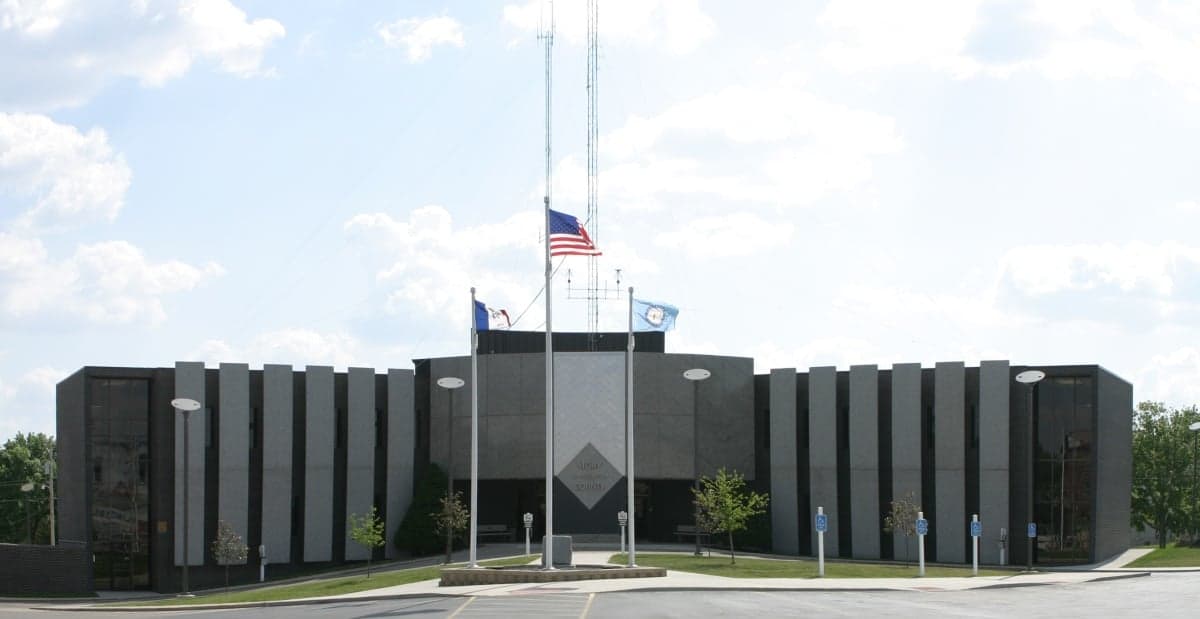
Photo: Wikipedia
Demographics of Story County
Affluence Level in Story County
A middle-class area roughly in line with national averages across income, home values, education, and employment.
People of Story County
Story County, Iowa, is home to roughly 98,600 residents, a population shaped by a distinct blend of a historic, predominantly white, agricultural and academic foundation with a growing, highly educated, and increasingly diverse modern influx. The county’s character is defined by the presence of Iowa State University in Ames, which drives a population that is 53.3% college-educated—far above state and national averages—and attracts a notable share of international students and professionals, particularly in East/Southeast Asian and Indian communities. This creates a unique tension: a deeply rooted, conservative-leaning rural and small-town identity in places like Nevada, Story City, and Gilbert, coexisting with a more transient, globally-connected, and liberal academic hub in Ames. The result is a county that feels both quintessentially Iowan and surprisingly cosmopolitan, with a population that is 81.4% white, 5.0% Hispanic, 5.0% East/Southeast Asian, 2.6% Black, and 1.7% Indian, and a foreign-born share of 5.3%.
Settlement & growth (pre-1960)
Before American settlement, the area now known as Story County was part of the homeland of the Sauk and Meskwaki (Fox) nations, who used the prairies and woodlands along the Skunk River for seasonal hunting and farming. The first permanent American settlers arrived in the 1840s and 1850s, primarily Yankees from New England and upstate New York, drawn by the promise of cheap, fertile land under the Preemption Act and later the Homestead Act of 1862. These early settlers founded the county seat, Nevada (pronounced "Nuh-VAY-duh"), in 1853, and other early towns like Ames (1864), Cambridge (1856), and Maxwell (1856). The population was overwhelmingly of English, Scottish, and Northern Irish (Scots-Irish) descent, and they brought with them a culture of small-town governance, Protestant church life, and agricultural enterprise.
A second major wave arrived in the 1870s and 1880s, consisting of German and Scandinavian immigrants—particularly Swedes and Norwegians—who were recruited by railroad companies and land agents to farm the remaining prairie. These groups concentrated in rural areas and founded or heavily populated towns like Story City (originally a Norwegian settlement called "Fairview"), Huxley, and Slater. German farmers settled around Colo and Zearing. This wave solidified the county's agricultural character and its strong Lutheran and Catholic religious presence. The establishment of the Iowa Agricultural College (now Iowa State University) in Ames in 1858 began to shift the county's economic and demographic center, attracting faculty and students from across the Midwest, but the population remained overwhelmingly white and native-born through the 1960s.
The Dust Bowl and Great Depression of the 1930s brought a small number of "Okie" and "Arkie" migrants from Oklahoma and Arkansas, but their impact was minor compared to the Great Plains states further west. The post-World War II era saw a modest suburbanization around Ames, as returning GIs used the GI Bill to attend Iowa State and settle in new housing developments, but the county's population growth remained steady rather than explosive, reaching about 50,000 by 1960.
Modern era (post-1965)
The 1965 Hart-Cellar Act fundamentally reshaped Story County's demographics, though the effects were slower to arrive than in coastal regions. The primary driver of post-1965 change has been Iowa State University's growth as a research institution, which began actively recruiting international graduate students and faculty in the 1970s and 1980s. The first significant non-European group was a wave of East/Southeast Asian students and professionals—primarily from China, South Korea, and Taiwan—who came for engineering and science programs. Many stayed after graduation, forming a small but visible community concentrated in Ames, particularly in the Campustown and Somerset neighborhoods. Today, East/Southeast Asians make up 5.0% of the county's population, with a strong professional and academic profile.
A second, more recent wave of Indian subcontinent immigrants (1.7% of the population) began arriving in the 1990s and accelerated after 2000, drawn by Iowa State's strong programs in computer science, engineering, and business, as well as by employment at major employers like John Deere's Ames Technology Center and the USDA's National Animal Disease Center. This community is heavily concentrated in Ames, with a growing presence in newer subdivisions on the city's west and south sides. Unlike many Midwestern counties, Story County's Hispanic population (5.0%) is not primarily composed of recent immigrants from Mexico or Central America; instead, it includes a mix of long-established families in the agricultural towns of Nevada, Story City, and Colo, along with a smaller number of newer arrivals working in construction, food processing, and service industries. The Black population (2.6%) is largely composed of African American professionals and graduate students at Iowa State, as well as a smaller number of families who moved from Chicago and other Midwestern cities for jobs in the 2000s and 2010s.
Domestic migration has been a quieter story. The county has not experienced the explosive Sun Belt growth of Texas or Florida, but it has seen a steady trickle of in-migration from other parts of Iowa and the Midwest, particularly from rural counties losing population. This domestic inflow is predominantly white and tends to settle in the smaller towns—Nevada, Story City, Huxley, Gilbert—where housing is cheaper and the pace of life slower than in Ames. The result is a county that is becoming more polarized: Ames grows more diverse and liberal with each passing decade, while the outlying towns remain overwhelmingly white and culturally conservative.
The future
Story County's population is projected to grow modestly, likely reaching 105,000-110,000 by 2040, driven almost entirely by Ames and its immediate suburbs (Gilbert, Huxley, and the unincorporated areas around Iowa State). The foreign-born share will continue to rise, probably to 8-10%, as Iowa State's international recruitment remains strong and as Indian and East/Southeast Asian professionals increasingly settle permanently rather than returning home. The Hispanic share is likely to grow slowly, reaching 7-8%, as families in the smaller towns have higher birth rates. The white share will decline gradually, but the county will remain majority white for the foreseeable future, likely still above 75% in 2040.
The key demographic trend is not homogenization but tribalization into distinct enclaves. Ames will become more diverse, more liberal, and more culturally disconnected from the rest of the county. The smaller towns—Nevada, Story City, Colo, Maxwell—will remain overwhelmingly white, older, and more conservative, with little new immigration. The Indian and East/Southeast Asian communities will continue to concentrate in Ames, forming self-sustaining ethnic enclaves with their own grocery stores, religious centers, and social networks. The Hispanic population will remain more dispersed but will grow most in the agricultural towns where housing is affordable and work is available. The cultural identity of the county will become increasingly bifurcated: a globally-connected, multiethnic university town surrounded by a traditional, white, agricultural hinterland.
For a conservative-leaning individual or family moving to Story County today, the choice is clear. Living in Ames means embracing a diverse, highly educated, and politically liberal environment where your neighbors may be from India, China, or South Korea. Living in Nevada, Story City, Gilbert, or Huxley means joining a community that is still overwhelmingly white, Christian, and culturally conservative, with a strong sense of local identity and a slower pace of life. The county as a whole is not becoming a melting pot; it is becoming a mosaic of distinct communities, each with its own character and trajectory. The bottom line: Story County offers two very different Americas within a 20-minute drive, and the decision of where to live will largely determine the kind of community you experience.

* Values derived from national, state, county, city and local statistics and may differ in a specific area. Last updated: 2026-05-20T11:39:32.000Z
Narrative content on this page is AI-generated and may contain mistakes. Verify any details that matter before acting on them.
ReloMaps may earn a commission from affiliate links at no extra cost to you.

