
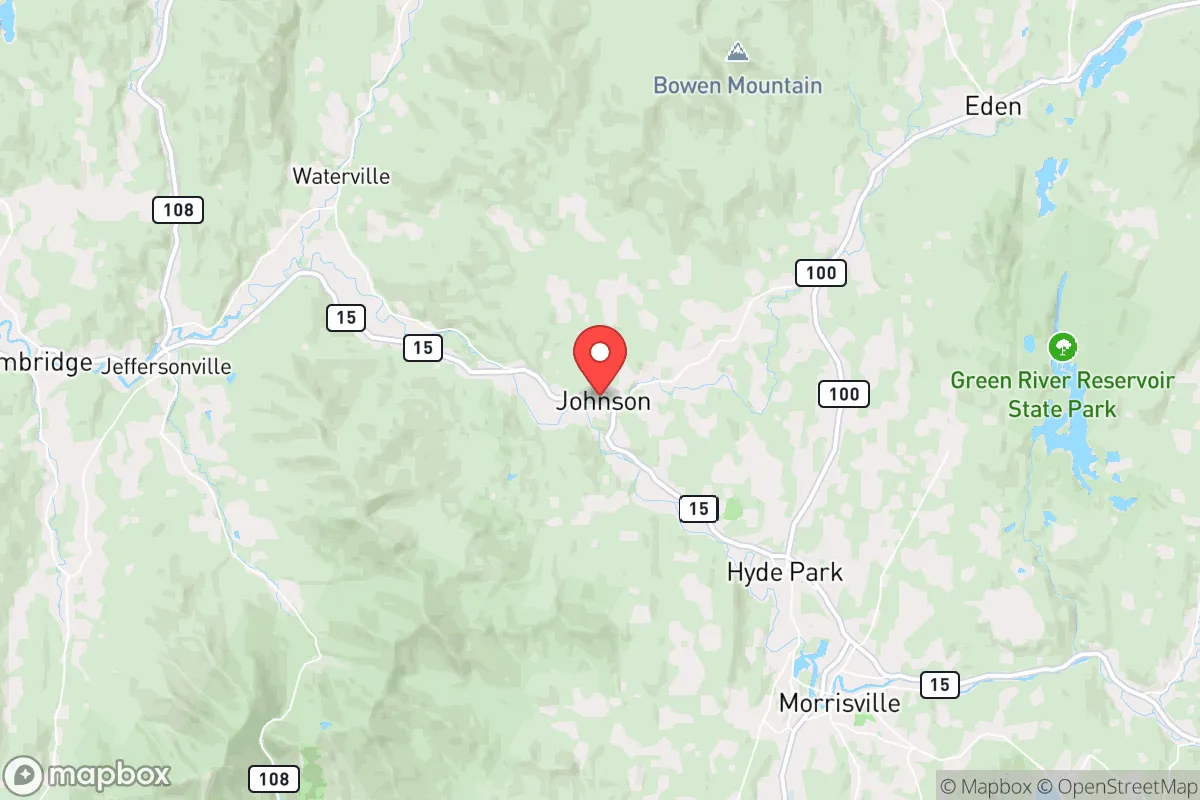
Photo: Wikipedia
Personal Sovereignty in Johnson, VT
Moderate friction. Expect trade-offs in some aspect of personal liberty and independence.
What does Personal Sovereignty tell us?
Personal Sovereignty measures your capacity for self-reliance and independence with minimal government friction. Higher scores mean fewer barriers between you and the way you want to live... but it assumes you have the space you need and good neighbors.
What does this tell us?
Personal Sovereignty measures your capacity for self-reliance and independence with minimal government friction. Higher scores mean fewer barriers between you and the way you want to live... but it assumes you have the space you need and good neighbors.
State Policy
Energy independence: Importer (15% of energy produced in-state)
Personal Liberty
Homesteading

Personal Liberty Analysis
Johnson, Vermont offers a mixed bag for those prioritizing personal sovereignty. While the town itself maintains a quiet, rural character that supports self-reliant living, it operates under Vermont’s increasingly progressive state-level framework, which imposes notable constraints on gun rights, tax burdens, and medical autonomy. For a conservative-leaning individual or family seeking maximum freedom from government overreach, Johnson represents a trade-off: strong local community resilience and homesteading potential, but a state government that actively limits certain personal liberties. Understanding these specific dynamics is critical before relocating.
Tax burden and regulatory posture: How Vermont’s state policies affect your wallet and freedom
Vermont’s tax burden is among the highest in the nation, and Johnson residents feel this directly. The state imposes a progressive income tax with rates ranging from 3.35% to 8.75%, and property taxes are notoriously steep, averaging around 1.8% of assessed home value—one of the highest effective rates in the country. For a $300,000 home, that’s roughly $5,400 annually in property taxes alone, funding a state government that has expanded its regulatory reach into land use, energy mandates, and building codes. The state’s Act 250 land-use law, for example, can complicate even modest development projects, requiring permits for subdivisions or commercial construction that would be routine in less regulated states. Sales tax is 6%, but there is no local sales tax in Johnson. The regulatory posture leans heavily toward environmental and social governance, meaning anything from installing a wood stove to building a new shed can trigger state-level oversight. For the prepper or survivalist, this translates into less freedom to modify property without bureaucratic hurdles, and a significant portion of income diverted to a state whose policies may not align with personal values.
Self-defense and gun law specifics: What Vermont’s restrictions mean for your right to carry and own firearms
Vermont was once a bastion of gun freedom, but recent legislation has shifted the landscape dramatically. As of 2024, the state now requires universal background checks for all firearm sales, including private transactions, and has enacted a “red flag” law allowing courts to temporarily confiscate firearms from individuals deemed a risk. Magazine capacity is limited to 10 rounds for long guns and 15 for handguns, and the state bans the carrying of firearms in certain public spaces, including schools and government buildings. While Vermont remains a “shall issue” state for concealed carry permits, the process now includes a mandatory training course. Open carry is still legal without a permit, but the practical reality is that law enforcement and local culture in Johnson—a town with a strong college presence (Johnson State College, now part of Northern Vermont University)—may not look favorably on visible firearms. For the prepper, this means stockpiling standard-capacity magazines is illegal, and the red flag law creates a vulnerability: a neighbor’s complaint or a domestic dispute could lead to temporary disarmament without a criminal conviction. Self-defense rights are further constrained by the state’s “duty to retreat” doctrine in public spaces, meaning you cannot use deadly force unless you have no safe avenue of escape. This is a significant departure from the “stand your ground” laws in more liberty-oriented states.
Self-reliance and homesteading viability: Lot sizes, zoning, and off-grid feasibility in Johnson
Johnson’s rural zoning and relatively affordable land make it a viable location for homesteading, but with caveats. Minimum lot sizes in the town’s rural districts are typically 2 to 5 acres, which is sufficient for a substantial garden, small livestock (chickens, goats, a family cow), and even a modest orchard. The town’s zoning bylaws do not explicitly prohibit off-grid living, but state building codes require compliance with the Vermont Residential Building Energy Standards, which can complicate fully independent systems. Solar panels are permitted, but net metering rules require grid connection for any system over 10 kW, and battery storage is not yet fully incentivized. Rainwater collection is legal for non-potable uses, but potable water must come from a permitted well or municipal source. Wood heating is common and legal, but new wood stove installations must meet EPA emissions standards. The biggest hurdle for the serious prepper is the state’s Act 250, which can trigger a permit for any development that impacts more than 10 acres or involves substantial earthmoving. For a family wanting to build a self-sufficient compound with multiple structures, this could mean months of permitting delays and public hearings. Still, compared to more densely populated states, Johnson offers a realistic path to semi-self-reliance, especially if you buy land with existing infrastructure and avoid major new construction.
Personal liberties: Parental rights, medical autonomy, speech, and property in Vermont
Vermont’s stance on personal liberties is a double-edged sword for conservatives. On the positive side, parental rights in education are relatively strong—the state allows homeschooling without onerous reporting requirements, and school choice is available through public school open enrollment and limited voucher programs for low-income families. However, the state mandates comprehensive sex education that includes LGBTQ+ content, and parents cannot opt their children out of specific lessons, only the entire curriculum. Medical autonomy is severely limited: Vermont has legalized assisted suicide and recreational marijuana, but it also mandates childhood vaccinations for school attendance (with only medical exemptions) and has some of the strictest COVID-19 vaccine mandates for healthcare workers in the nation. The state’s “informed consent” laws for abortion are minimal, and there is no parental notification requirement for minors seeking the procedure. Free speech is protected under the First Amendment, but Vermont’s public accommodation laws have been used to compel speech in commercial contexts, such as requiring bakers to create cakes for same-sex weddings. Property rights are constrained by Act 250 and local zoning, as noted, and the state’s estate tax kicks in at $5 million, which can affect multigenerational land holdings. For the conservative seeking maximum personal sovereignty, these policies represent significant government overreach into family and medical decisions.
Overall, Johnson, Vermont offers a unique but imperfect sovereignty profile. The town’s rural character, affordable land, and community resilience provide a foundation for self-reliant living that is increasingly rare in the Northeast. However, the state-level tax burden, gun restrictions, and erosion of medical and parental autonomy mean that Johnson is not a sanctuary for those seeking maximum freedom from government overreach. Compared to states like New Hampshire or Idaho, Vermont falls short on nearly every metric of personal sovereignty. For the prepper or conservative family willing to navigate higher taxes and regulatory hurdles in exchange for a beautiful, low-crime rural setting with strong homesteading potential, Johnson can work—but only if you are prepared to fight for your liberties at the local level and accept that the state government will remain an active, often adversarial, presence in your life.

* Values derived from national, state, county, city and local statistics and may differ in a specific area. Last updated: 2026-10-10T16:27:48.000Z
Narrative content on this page is AI-generated and may contain mistakes. Verify any details that matter before acting on them.
ReloMaps may earn a commission from affiliate links at no extra cost to you.

