Photo: Wikipedia
Demographics of Kingsport, TN
Affluence Level in Kingsport, TN
A middle-class area roughly in line with national averages across income, home values, education, and employment.
People of Kingsport, TN
The people of Kingsport, Tennessee today number 55,807, forming a predominantly white (88.9%) and native-born community where only 1.3% of residents are foreign-born. The city’s population is notably less diverse than the national average, with a Hispanic share of 3.0%, a Black share of 3.3%, and small East/Southeast Asian (0.7%) and Indian subcontinent (0.5%) communities. Kingsport’s identity is shaped by its origins as a planned industrial city, a place where successive waves of workers—first Appalachian farmers, then Northern engineers, and later regional retirees—built a community that remains culturally conservative, family-oriented, and deeply tied to manufacturing and healthcare employment.
How the city was settled and grew
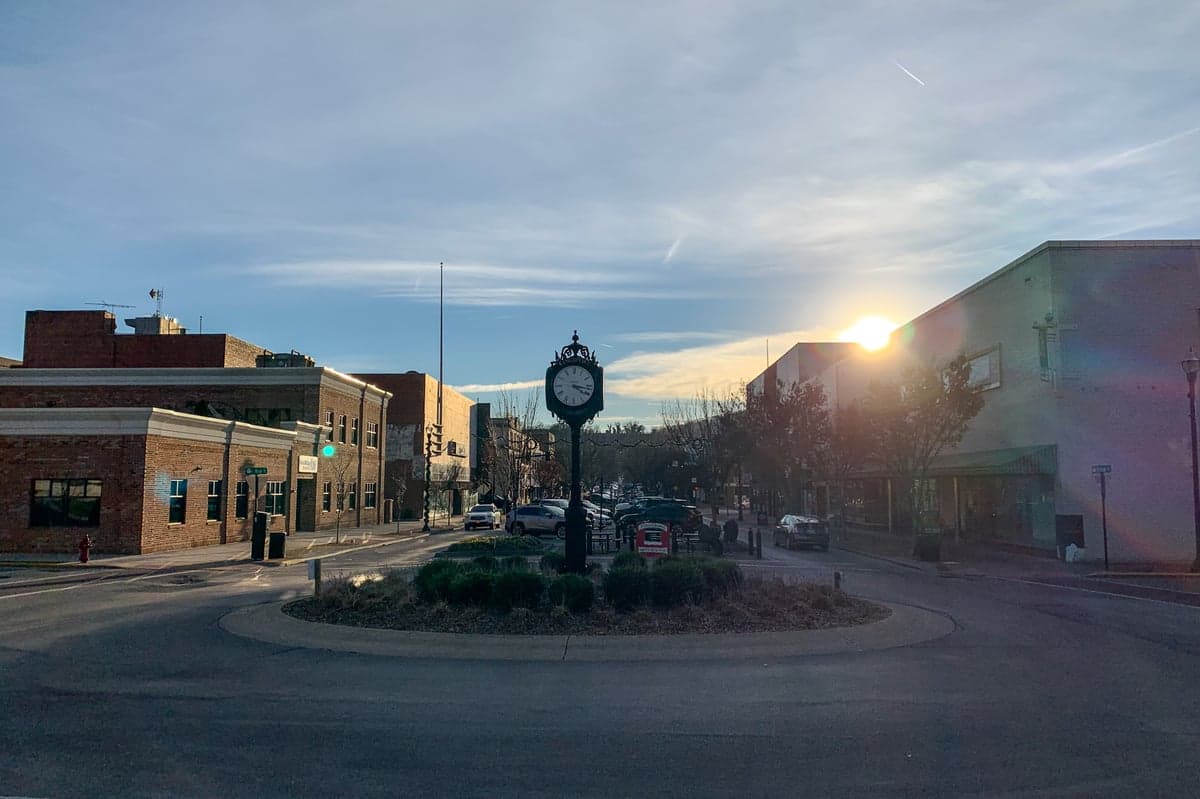
Kingsport is a genuinely post-1900 planned city, not a colonial settlement. Its founding population arrived after 1915, when the Kingsport Improvement Company (backed by the Carolina, Clinchfield and Ohio Railway) laid out a model industrial town on former farmland. The original wave consisted of white Appalachian migrants from surrounding rural counties in East Tennessee and Southwest Virginia, drawn by jobs at the Kingsport Press (a major printing plant) and the Tennessee Eastman chemical plant (later Eastman Chemical Company). These workers settled in Riverview, a neighborhood built by the company for skilled laborers, and in Preston Forest, where foremen and mid-level managers lived. A second wave in the 1920s and 1930s brought Northern engineers and chemists—many from New York, Pennsylvania, and Ohio—recruited by Eastman and the Mead Corporation. They built homes in Fairmount, a leafy district of Craftsman bungalows and Tudor Revivals near the city center. A smaller but notable group of Black workers arrived during World War II to work at the Holston Ordnance Works (a munitions plant), settling in the Riverview area, which became Kingsport’s historic African American neighborhood. By 1950, Kingsport’s population had reached roughly 28,000, overwhelmingly white and native-born, with a small Black community concentrated in Riverview.
Modern era (post-1965)
After the 1965 Hart-Cellar Act, Kingsport saw minimal immigration compared to larger Southern cities. The foreign-born share remained below 2% through the 1990s and stands at just 1.3% today. Instead, the post-1965 story is one of domestic in-migration and suburbanization. From the 1970s through the 1990s, white families moved from older neighborhoods like Riverview and Fairmount into newer subdivisions such as Colonial Heights (annexed in the 1960s) and Rock Springs, drawn by larger lots and newer schools. The Black population, which peaked at roughly 6% in the 1970s, declined to 3.3% by 2020 as many families left for larger cities like Knoxville or Charlotte. The Hispanic population grew slowly, from under 1% in 1990 to 3.0% today, concentrated in the Lynn Garden area, where a small number of Mexican and Central American workers found jobs in construction and landscaping. The East/Southeast Asian community (0.7%) is primarily composed of Vietnamese and Korean families who arrived in the 1980s and 1990s, many working at Eastman Chemical or in healthcare; they are scattered across the city, with no single ethnic enclave. The Indian subcontinent community (0.5%) is even smaller, mostly professionals at Eastman or at the local hospital, living in Colonial Heights and Preston Forest.
The future
Kingsport’s population is slowly homogenizing. The white share has remained stable at roughly 88-89% since 2010, while the Black share has declined slightly. The Hispanic share is growing, but slowly—from 2.1% in 2010 to 3.0% in 2020—and is unlikely to reach 5% by 2030 given low immigration rates and the city’s limited economic pull for new arrivals. The East/Southeast Asian and Indian subcontinent communities are plateauing, as Eastman Chemical’s workforce ages and fewer new professionals relocate from abroad. The city is not tribalizing into distinct ethnic enclaves; rather, it is becoming more uniformly white and native-born, with the small Hispanic and Asian populations assimilating into predominantly white neighborhoods. The most significant demographic trend is aging: the median age rose from 38.5 in 2010 to 42.3 in 2020, as young adults leave for college and careers in Knoxville, Nashville, or Charlotte, while retirees from Florida and the Northeast move in for lower costs and slower pace. The population is projected to remain flat or decline slightly (55,000-56,000) through 2040, barring a major new employer.
For someone moving in now, Kingsport is becoming a stable, aging, predominantly white community with a strong manufacturing and healthcare base, low crime, and conservative social values. The population is not diversifying rapidly; it is consolidating around its historic character. New residents will find a place where neighborhoods like Fairmount and Colonial Heights remain family-oriented and safe, but where the city’s future depends on retaining young families and attracting new industries beyond Eastman Chemical.

* Values derived from national, state, county, city and local statistics and may differ in a specific area. Last updated: 2026-04-20T18:54:44.000Z
Narrative content on this page is AI-generated and may contain mistakes. Verify any details that matter before acting on them.
ReloMaps may earn a commission from affiliate links at no extra cost to you.

