Photo: Wikipedia
Demographics of Livingston, MT
Affluence Level in Livingston, MT
A middle-class area roughly in line with national averages across income, home values, education, and employment.
People of Livingston, MT
The people of Livingston, Montana, today form a predominantly white, tight-knit community of 8,635 residents, characterized by a strong sense of independence and a deep connection to the surrounding landscape. With a foreign-born population of just 0.4% and a 93.4% white demographic, the city remains one of the most ethnically homogeneous in the state, a fact that shapes its cultural and social identity. Residents often describe the town as a place where "everyone knows everyone," and the population density of roughly 1,800 people per square mile fosters a neighborly, low-crime atmosphere. The city’s identity is distinctly Montanan—rooted in ranching, railroad history, and outdoor recreation—with a notable 35.1% of adults holding a college degree, reflecting a blend of working-class heritage and a growing cohort of remote professionals.
How the city was settled and grew
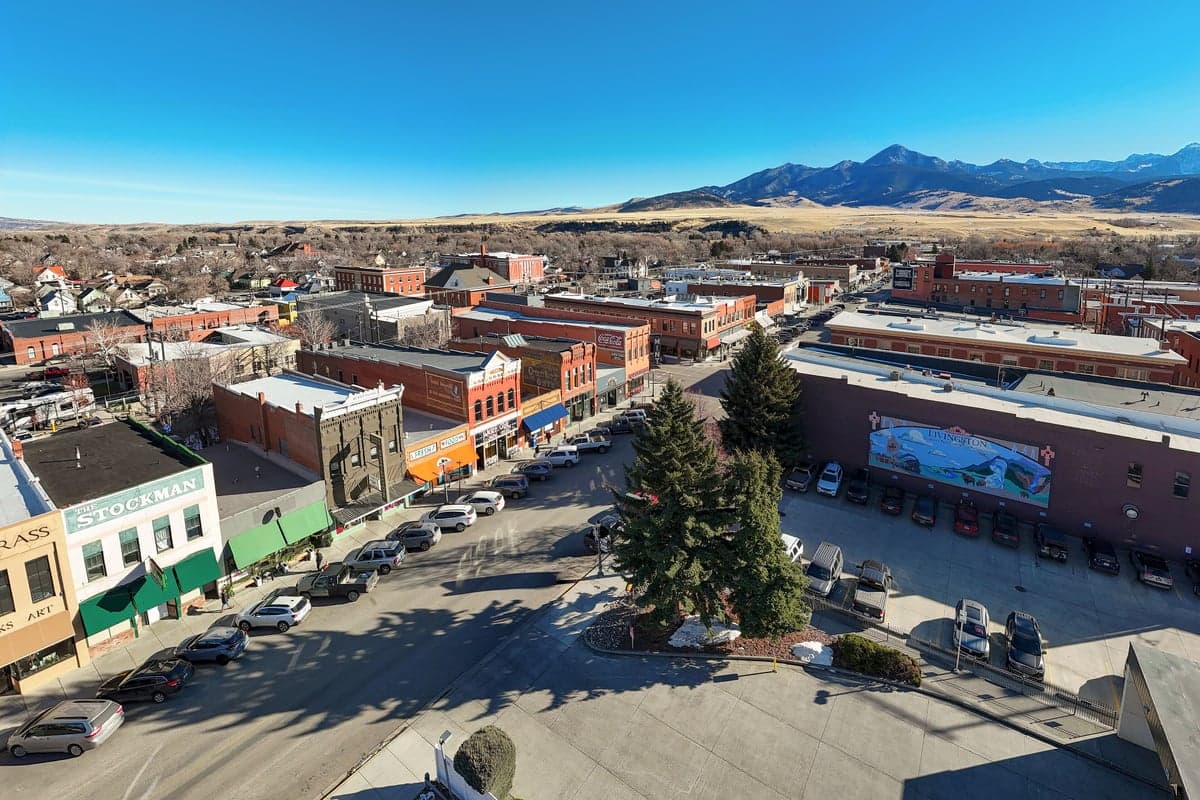
Livingston was founded in 1882 as a railroad town, a direct product of the Northern Pacific Railway’s push through the Yellowstone Valley. The original population was overwhelmingly drawn from European immigrant groups—primarily Irish, German, and Scandinavian laborers who built the rail yards and the iconic Livingston Depot. These workers settled in what is now the Historic District around Main Street, where modest worker cottages and boarding houses still stand. A second wave arrived in the early 1900s, driven by the expansion of the nearby copper mines in Butte and the establishment of the Livingston Roundhouse, which became the largest railroad repair facility in the Northwest. This period brought a smaller influx of Italian and Eastern European families, who concentrated in the East Side neighborhood, an area of bungalows and small lots east of the Yellowstone River. By 1920, the population had reached roughly 6,000, and the town’s character was firmly set as a blue-collar, railroad-centric community. No significant non-white settlement occurred during this era; the city’s demographic homogeneity was established early and has persisted.
Modern era (post-1965)
After the 1965 Hart-Cellar Act, Livingston saw virtually no increase in foreign-born immigration. The city’s 0.4% foreign-born share today is among the lowest in Montana, and the Hispanic population (2.1%) and East/Southeast Asian population (0.2%) remain negligible. Instead, the major demographic shift post-1965 has been domestic in-migration from other parts of Montana and the Pacific Northwest. The decline of railroad employment in the 1970s and 1980s led to a population dip, but the 1990s brought a new wave: retirees and second-home buyers drawn to the area’s fly-fishing and proximity to Yellowstone National Park. These newcomers largely settled in the Spring Creek subdivision, a newer development on the city’s west side featuring larger lots and modern homes. A smaller but notable group of artists and writers—attracted by low property prices and mountain views—moved into the North Side neighborhood, an area of older Victorians and Craftsman homes near the depot. The Black population remains at 0.0%, and the Indian subcontinent population is 0.1%, reflecting no sustained immigration from those regions. The city’s racial composition has remained virtually unchanged since the 1960s.
The future
Looking ahead, Livingston’s population is likely to continue its slow, steady growth—projected to reach roughly 9,500 by 2040—driven almost entirely by domestic migration. The city is not homogenizing further, as it is already nearly as homogeneous as possible, but it is tribalizing along economic lines: long-time working-class residents in the East Side and Historic District increasingly face pressure from wealthier newcomers buying up properties in Spring Creek and the newer River View Estates subdivision. The immigrant communities are not growing, plateauing, or assimilating in any meaningful sense; the foreign-born share is expected to remain below 1% for the foreseeable future. The Hispanic population may inch upward slightly (to perhaps 3-4%) as agricultural and service-sector jobs attract families from other parts of the state, but this will not alter the city’s overall character. The next 10-20 years will likely see Livingston become a more economically stratified community, with a growing divide between the "old guard" in the historic core and the "new money" in the suburban-style subdivisions.
For someone moving in now, Livingston is becoming a place where the population is stable in its racial and ethnic makeup but increasingly divided by wealth and lifestyle. The city offers a safe, predictable environment with strong community ties, but newcomers should expect a population that is overwhelmingly white, native-born, and culturally conservative. The bottom line: Livingston is not diversifying; it is solidifying its identity as a white, middle-to-upper-class enclave where the biggest demographic story is not who arrives, but who can afford to stay.

* Values derived from national, state, county, city and local statistics and may differ in a specific area. Last updated: 2026-04-30T00:18:01.000Z
Narrative content on this page is AI-generated and may contain mistakes. Verify any details that matter before acting on them.
ReloMaps may earn a commission from affiliate links at no extra cost to you.

