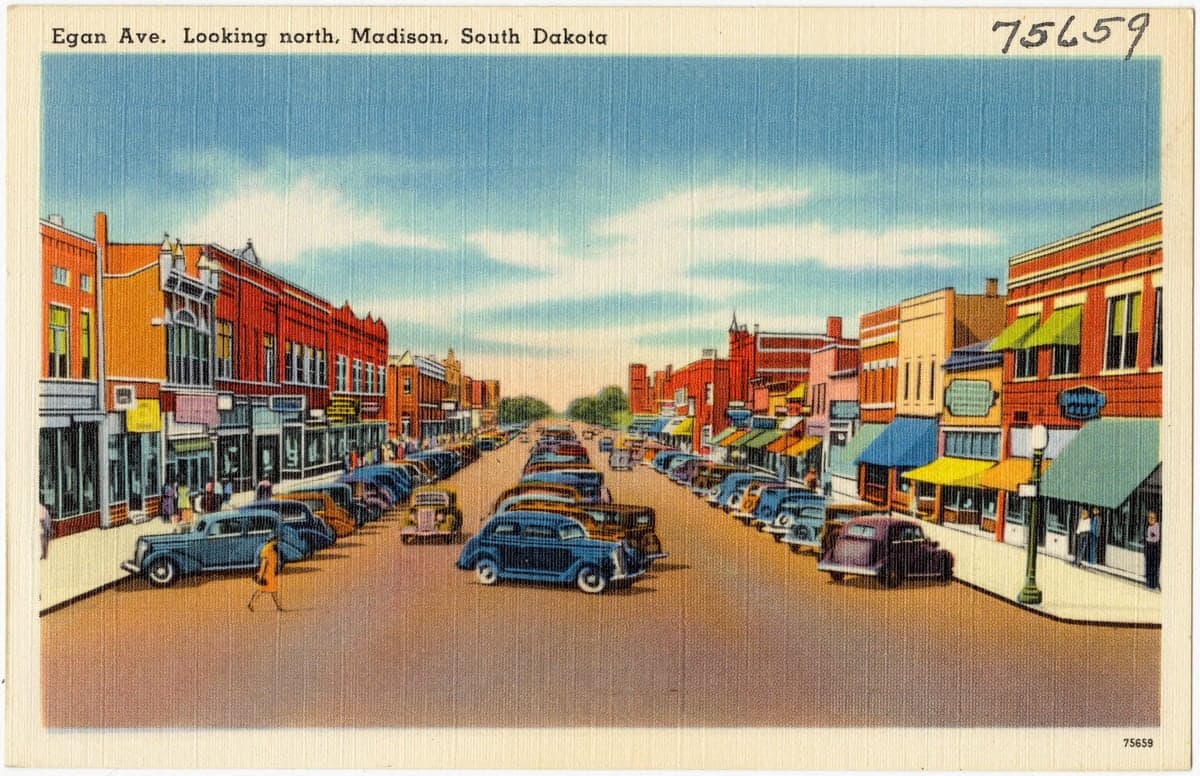
Photo: Wikipedia
Personal Sovereignty in Madison, SD
Viable for self-reliance. Generally workable, though some barriers may limit total independence.
What does Personal Sovereignty tell us?
Personal Sovereignty measures your capacity for self-reliance and independence with minimal government friction. Higher scores mean fewer barriers between you and the way you want to live... but it assumes you have the space you need and good neighbors.
What does this tell us?
Personal Sovereignty measures your capacity for self-reliance and independence with minimal government friction. Higher scores mean fewer barriers between you and the way you want to live... but it assumes you have the space you need and good neighbors.
State Policy
Energy independence: Importer (35% of energy produced in-state)
Personal Liberty
Homesteading

Personal Liberty Analysis
Madison, South Dakota offers a notably high degree of personal sovereignty, particularly when viewed through the lens of limited government interference and individual autonomy. In an era of expanding federal and state mandates, Madison stands out as a community where the default posture is one of personal responsibility rather than bureaucratic oversight. For those seeking to minimize government overreach into daily life—whether in business, family decisions, or self-defense—this small city in Lake County provides a legal and cultural environment that prioritizes individual choice over collective compliance. The state’s constitutional protections and legislative track record create a foundation where residents can largely live as they see fit, provided they respect the rights of others.
Tax burden and regulatory posture: How South Dakota’s policies protect your wallet and choices
South Dakota’s tax structure is a cornerstone of its sovereignty appeal. There is no state income tax, no personal property tax, and no inheritance or estate tax, meaning Madison residents keep more of what they earn without the state taking a cut of wages, investments, or inheritances. The state sales tax is 4.5%, with Lake County adding a local option of 2% for a combined 6.5%—modest compared to many states. Property taxes in Madison average around 1.2% of assessed value, which is reasonable for the region. More importantly, the regulatory climate is intentionally lean. South Dakota operates under a “right-to-work” law, meaning no one can be forced to join a union as a condition of employment. Business licensing is straightforward, and there are no state-level mandates for paid family leave, sick time, or minimum wage increases beyond the federal floor of $7.25. For a prepper or survivalist, this means less government intrusion into how you earn, save, and spend your money. The state’s approach is simple: low taxes, minimal red tape, and a presumption that adults can manage their own affairs without a bureaucrat’s permission.
Self-defense and gun law specifics: Constitutional carry and stand-your-ground protections
South Dakota is a strong Second Amendment state, and Madison reflects that reality. The state has permitless (constitutional) carry for both open and concealed firearms for anyone 18 or older who can legally possess a firearm. No permit, training, or fee is required to carry a handgun in public. For those who want a permit for reciprocity with other states, a concealed carry permit is available through the local sheriff’s office with a simple background check and a small fee. South Dakota also has a “stand your ground” law, meaning there is no duty to retreat before using deadly force in self-defense if you are lawfully present. Castle doctrine protections extend to your home, vehicle, and workplace. There are no state-level magazine capacity restrictions, no “assault weapon” bans, and no firearm registration requirements. The state preempts local gun ordinances, so Madison cannot pass its own stricter laws. For a survivalist, this means your right to keep and bear arms is as close to absolute as you’ll find in the continental U.S. You can stockpile ammunition, own suppressors (with federal paperwork), and train without fear of sudden legislative changes. The only notable restriction is that carrying a firearm into a school or government building is prohibited, but that’s standard nationwide.
Self-reliance and homesteading viability: Lot sizes, zoning, and off-grid feasibility in Madison
Madison’s zoning and land-use policies are generally favorable to self-reliance, though with some urban constraints. Within city limits, standard residential lots range from 6,000 to 10,000 square feet, and chickens are allowed with a permit, but larger livestock like goats or pigs are not permitted on standard residential parcels. However, the city’s extraterritorial zoning jurisdiction extends one mile beyond city limits, where agricultural uses are more flexible. For serious homesteading, the unincorporated areas of Lake County are where the real opportunity lies. Rural parcels of 5 to 40 acres are common within a 15-minute drive of downtown Madison, with prices ranging from $3,000 to $8,000 per acre as of 2026. There are no county-level restrictions on rainwater collection, composting, or gardening. Off-grid living is legally feasible: South Dakota has no state law prohibiting solar panels, wind turbines, or composting toilets, though you’ll need to comply with county building codes for structural safety. Well water and septic systems are permitted with standard health department approvals. The biggest practical challenge is winter—Madison averages 38 inches of snow annually and January lows hit 5°F—so a reliable heating source (wood, propane, or solar with battery backup) is essential. For those willing to invest in infrastructure, the regulatory environment won’t stop you from living largely independent of municipal utilities.
Personal liberties: Parental rights, medical autonomy, speech, and property protections
South Dakota has been a battleground for parental rights, and the current legal landscape strongly favors family autonomy. The state has a Parents’ Bill of Rights law that affirms parents’ authority over their children’s education, healthcare, and upbringing. This means no school can hide a child’s medical or mental health information from parents, and parents have the right to opt their children out of any curriculum they find objectionable. Medical autonomy is also robust: South Dakota does not have a vaccine mandate for adults or children, and there is no state-level requirement for employers to mandate COVID-19 or other vaccines. The state passed a law in 2023 prohibiting medical boards from disciplining doctors for prescribing ivermectin or hydroxychloroquine for off-label use, reflecting a broader skepticism of federal health guidance. Free speech protections are strong, with no hate speech laws that criminalize political or religious expression. Property rights are protected by a strong eminent domain statute that requires “public use” (not just “public benefit”) and full market-value compensation. For a conservative-leaning individual concerned about government overreach, Madison offers a legal environment where you can raise your children according to your values, make your own medical decisions, speak your mind without fear of prosecution, and keep your property without the threat of seizure for private development.
Compared to other regions of the country, Madison, SD ranks among the top tier for personal sovereignty. The combination of no income tax, constitutional carry, strong parental rights, and minimal zoning restrictions creates a legal framework that respects individual autonomy far more than states like California, New York, or Illinois. While no location is perfect—federal overreach still applies, and South Dakota’s reliance on sales tax means consumption is taxed—the state’s consistent legislative pattern is to leave citizens alone. For a survivalist or prepper, Madison offers a low-interference environment where you can prepare, provide, and protect without constantly looking over your shoulder for the next government mandate. It’s not a libertarian utopia, but it’s about as close as you’ll find in the modern United States.

* Values derived from national, state, county, city and local statistics and may differ in a specific area. Last updated: 2026-04-30T02:04:53.000Z
Narrative content on this page is AI-generated and may contain mistakes. Verify any details that matter before acting on them.
ReloMaps may earn a commission from affiliate links at no extra cost to you.

