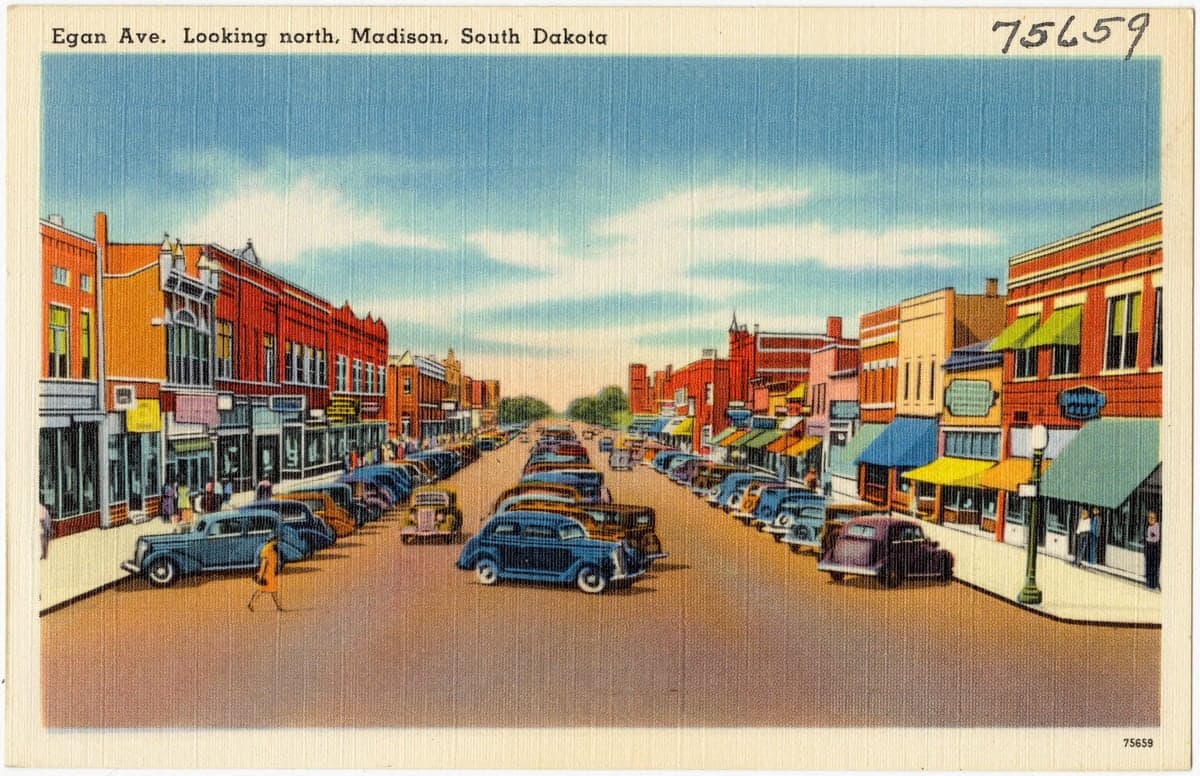
Photo: Wikipedia
Demographics of Madison, SD
Affluence Level in Madison, SD
A below-average socioeconomic profile. Incomes, home values, and educational attainment trail the U.S., with higher poverty and unemployment.
People of Madison, SD
Madison, South Dakota, is a predominantly white, college-educated community of 6,158 residents where 92.4% of the population identifies as non-Hispanic white, and the foreign-born share is a negligible 0.2%. The city’s identity is shaped by its role as the home of Dakota State University, a strong Norwegian and German Lutheran heritage, and a quiet, family-oriented character that attracts conservative-leaning families and retirees from the surrounding agricultural region. With a Hispanic population of 5.3% and very small Black (0.9%), East/Southeast Asian (0.3%), and Indian-subcontinent (0.1%) communities, Madison remains one of the least ethnically diverse cities in the Upper Midwest, a fact that reflects both its historical settlement patterns and its limited recent in-migration.
How the city was settled and grew
Madison was founded in 1873 as a railroad town on the Chicago, Milwaukee & St. Paul line, drawing its first wave of settlers from the Upper Midwest—primarily Norwegian and German immigrants seeking cheap farmland under the Homestead Act. The original townsite, platted around the intersection of what is now Main Street and 3rd Street, attracted merchants and tradesmen who built the early commercial core. By the 1880s, Norwegian Lutherans had established First Lutheran Church and concentrated in the North End neighborhood near the railroad depot, while German Catholics settled south of the tracks in what became South Madison, centered around St. Thomas Aquinas Church. The city’s growth accelerated after 1881 when the state legislature located the Eastern State Normal School (now Dakota State University) in Madison, drawing faculty and students from across the region and creating a distinct University District around the campus. A second wave came during the 1910s and 1920s as the dairy and poultry industries expanded, attracting more Scandinavian immigrants who filled the West Side neighborhood along Lake Madison. By 1930, the population had reached 3,500, and the city’s ethnic character was firmly set: overwhelmingly Northern European, Protestant, and politically conservative.
Modern era (post-1965)
The post-1965 period brought little demographic change to Madison. The Immigration and Nationality Act of 1965, which dramatically increased non-European immigration to the United States, had almost no effect here: the foreign-born population remains at 0.2% today. Domestic in-migration has been modest and largely internal—retirees from rural Lake County, university faculty from other Midwestern states, and a small number of Hmong and Vietnamese families who arrived in the 1980s through refugee resettlement programs. These East/Southeast Asian households, now numbering roughly 20 individuals, settled in the University District near campus, where they found rental housing and proximity to service jobs. The Hispanic population, now 5.3%, grew primarily in the 2000s and 2010s as a few dozen families moved from Texas and California to work at the Lake County Processing plant (a pork-processing facility) and in construction; they are concentrated in the South Madison neighborhood, near the industrial park. The Indian-subcontinent community (0.1%) consists of a handful of faculty families at Dakota State University, living in the University District. Suburbanization has been minimal: the Prairie Village subdivision, built in the 1990s on the city’s east side, attracted middle-class families but did not alter the city’s racial composition. Madison’s Black population (0.9%) is almost entirely composed of university students and a few military retirees; there is no established Black neighborhood.
The future
Madison’s population is projected to remain stable or grow slowly—perhaps reaching 6,500 by 2040—driven by Dakota State University’s expansion in cybersecurity and computer science programs, which attracts out-of-state students who sometimes stay after graduation. However, the city shows no signs of significant ethnic diversification. The Hispanic population may grow modestly as the Lake County Processing plant expands, but the foreign-born share is unlikely to exceed 1% given the lack of refugee resettlement programs and the high cost of housing relative to local wages. The East/Southeast Asian and Indian-subcontinent communities will remain small and tied to the university. The city is not tribalizing into distinct ethnic enclaves; rather, it is homogenizing further as older Scandinavian-descended residents age in place and younger families move to larger cities like Sioux Falls. The North End and South Madison neighborhoods are slowly depopulating as their historic housing stock ages, while the Prairie Village and University District areas absorb most new construction.
For a conservative-leaning individual or family moving to Madison today, the city offers a stable, safe, and culturally homogeneous environment where the population is aging but the university provides a steady influx of younger residents. The lack of ethnic diversity and the very low foreign-born share mean that newcomers will find a community where English is universal, traditional values are widely shared, and the pace of change is slow. This is a place where the past still shapes the present, and that is unlikely to shift in the next generation.

* Values derived from national, state, county, city and local statistics and may differ in a specific area. Last updated: 2026-04-30T02:04:53.000Z
Narrative content on this page is AI-generated and may contain mistakes. Verify any details that matter before acting on them.
ReloMaps may earn a commission from affiliate links at no extra cost to you.

