
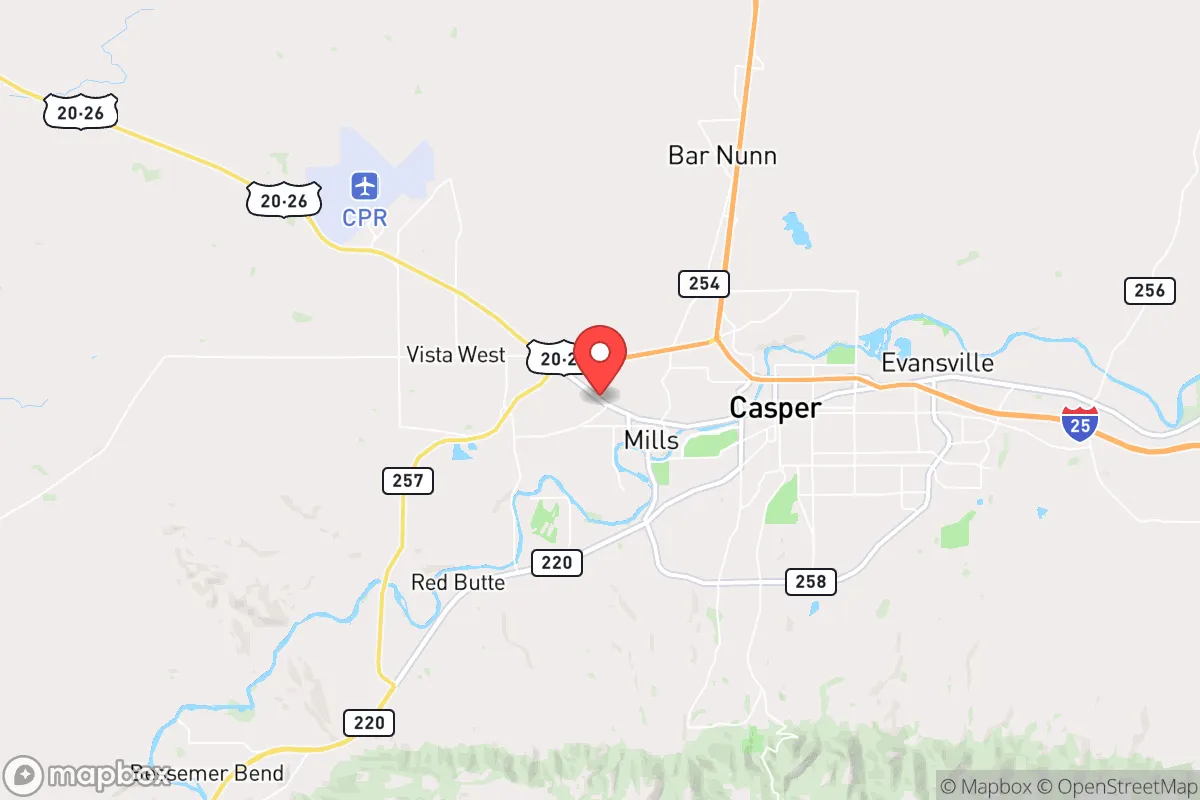
Photo: Wikipedia
Demographics of Mills, WY
Affluence Level in Mills, WY
A below-average socioeconomic profile. Incomes, home values, and educational attainment trail the U.S., with higher poverty and unemployment.
People of Mills, WY
The people of Mills, Wyoming, today form a small, predominantly white working-class community of 4,315 residents, marked by a significant Hispanic minority of 17.0% and a very low foreign-born population of just 3.9%. With only 12.1% holding a college degree, the city’s identity is rooted in blue-collar labor, family stability, and a quiet, suburban feel along the North Platte River. Distinct from the more transient energy-boom towns of the state, Mills projects a settled, insular character where multi-generational families are common and newcomers are often drawn by affordable housing and proximity to Casper.
How the city was settled and grew
Mills was not a pioneer-era settlement but a 20th-century industrial offshoot of Casper. Founded in 1919 as a company town for the Standard Oil refinery, the city’s original population was almost entirely white, native-born laborers and their families who moved from the Midwest and other parts of Wyoming to work in the booming oil and refining industries. The earliest residential core, now known as Old Town Mills (the grid of streets immediately south of the refinery), was built by the company to house these workers in modest, single-family homes. A second wave arrived during the post-World War II economic expansion of the 1940s and 1950s, when the refinery expanded and the city incorporated. This era saw the development of West Mills, a neighborhood of ranch-style homes built for a growing class of supervisors and skilled tradesmen. The population remained overwhelmingly white and native-born through the mid-20th century, with no significant immigrant enclaves forming.
Modern era (post-1965)
The post-1965 period brought the first notable demographic shift to Mills, driven not by international immigration but by domestic migration from the southwestern United States. The city’s Hispanic population, now 17.0%, began to grow in the 1970s and 1980s as families moved north from New Mexico and Colorado for refinery and construction jobs. These new residents concentrated in the Riverbend area, a cluster of older, more affordable homes along the North Platte River south of the railroad tracks. Unlike many Western towns, Mills did not see significant Asian or Indian-subcontinent immigration; the data shows both groups at 0.0%. The Black population remains minimal at 1.1%. The city’s white population, while still the majority at 75.8%, has aged in place, with younger white families often moving to newer subdivisions in Casper or Evans. The Mills Estates neighborhood, a small development of 1990s-era homes near the city’s eastern edge, has become a destination for Hispanic families seeking newer housing stock, while Parkview, a quiet cul-de-sac district near the city park, remains predominantly white and older.
The future
The population of Mills is likely to remain stable or shrink slightly over the next decade, as the city lacks the land or economic dynamism to attract large-scale in-migration. The Hispanic share is expected to grow gradually through natural increase and continued domestic migration from the Southwest, but the city is not tribalizing into distinct ethnic enclaves; rather, Hispanic and white residents are increasingly integrated across neighborhoods like Riverbend and Mills Estates. The foreign-born population, already low at 3.9%, is unlikely to rise significantly, as Mills offers few of the entry-level service jobs or ethnic networks that attract international immigrants to larger cities. The white population will continue to age, with younger adults often leaving for college or jobs in Casper or out of state. The city is homogenizing in terms of class—remaining solidly working-class—but slowly diversifying ethnically as the Hispanic cohort grows. For a conservative-leaning newcomer, this means moving into a community that is stable, family-oriented, and culturally traditional, but with a gradually changing face that reflects broader Western demographic trends.
Mills is becoming a more Hispanic-influenced but still predominantly white, blue-collar suburb of Casper, where affordability and a quiet, slow pace of life outweigh any prospect of rapid growth or cosmopolitan change. For someone moving in now, the city offers a predictable, safe environment with a strong sense of local identity, but little ethnic or economic diversity beyond the growing Hispanic presence.

* Values derived from national, state, county, city and local statistics and may differ in a specific area. Last updated: 2026-05-04T02:46:35.000Z
Narrative content on this page is AI-generated and may contain mistakes. Verify any details that matter before acting on them.
ReloMaps may earn a commission from affiliate links at no extra cost to you.

