
Photo: Wikipedia
Political ClimatePolitical Climate in Grenada County
Showing district-level results — no local-only data available.
Local Political AnalysisPolitical Analysis of Grenada County
Grenada County, Mississippi, is a place where the political landscape has historically been a bit of an outlier in the Magnolia State, but the winds of change are blowing in a direction that gives a lot of us longtime residents pause. With a Cook Partisan Voting Index (PVI) of D+11, the county leans significantly more Democratic than the rest of Mississippi, which sits at a solid R+11. That 22-point gap is a big deal, and it means the politics here feel different than in, say, the Jackson suburbs or the Gulf Coast. For years, this was a stronghold for conservative Democrats, but the shift toward progressive ideology in the national party is making that old alignment feel increasingly uncomfortable for many of us who value limited government and personal freedoms.
How it compares
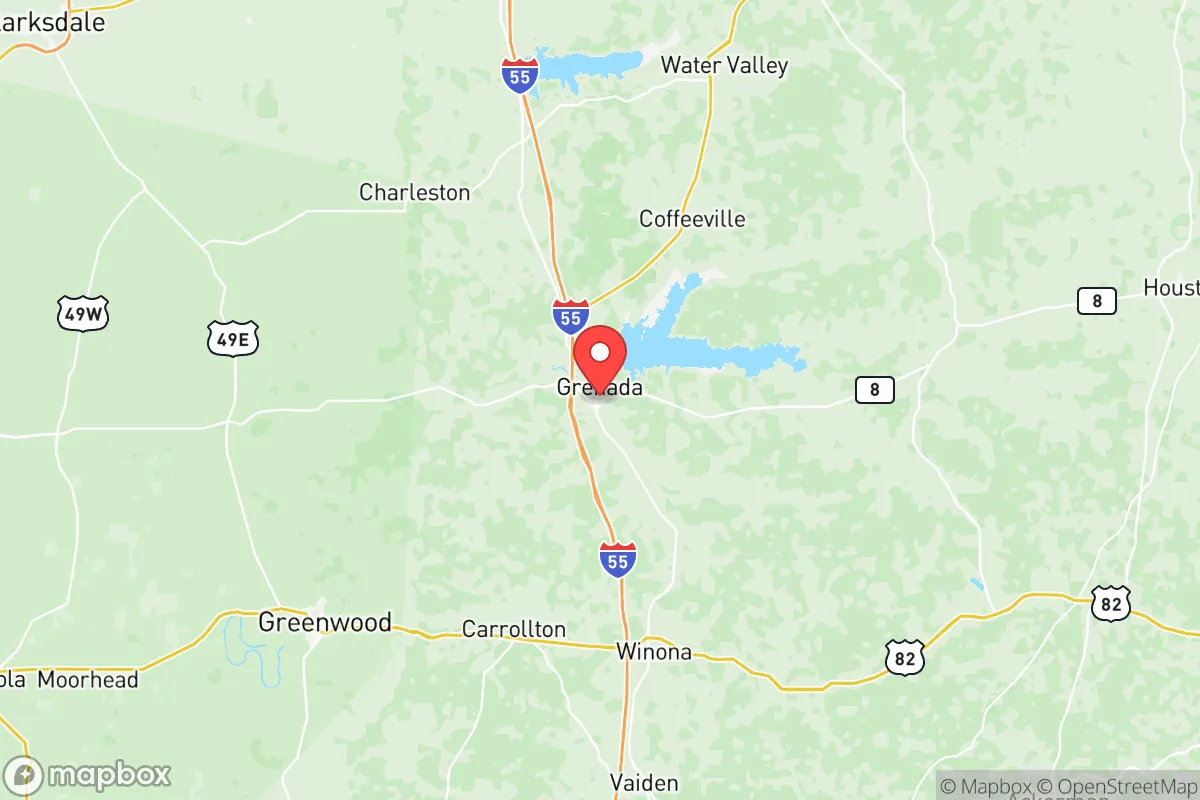
The contrast between Grenada County and the rest of Mississippi is stark, but it’s not a simple city-vs-country split. The county seat, Grenada, is the main hub where you’ll find the bulk of the Democratic-leaning voters, especially in precincts around the downtown area and near the university. However, drive just a few miles out to Gore Springs or Holcomb, and the political vibe shifts hard to the right. These rural communities are where you’ll see Trump signs still up from 2020, and where folks are deeply skeptical of government overreach—whether it’s vaccine mandates, zoning restrictions, or new gun laws. The swing precincts are often around Oxberry and Elliott, where a mix of working-class families and small farmers can tip an election. While the county as a whole votes blue on paper, the reality is that a lot of us here feel like our values—personal responsibility, low taxes, and the right to live without the government breathing down our necks—are increasingly at odds with the national Democratic platform.
What this means for residents
For those of us who lean conservative, living in a D+11 county means we’re constantly fighting an uphill battle on local issues. School board decisions, property tax levies, and even zoning laws can feel like they’re driven by a progressive agenda that doesn’t reflect the common sense of the folks out in the county. It’s concerning to see how quickly things can change—like when the county board considered adopting stricter environmental regulations that would have hurt local farmers and small businesses. That kind of government overreach is a red flag, and it’s why many of us are paying closer attention to local elections than ever before. The good news is that the state-level R+11 lean provides a check on some of the worst impulses, but it’s a constant tug-of-war.
One thing that sets Grenada County apart from the rest of Mississippi is its cultural history. This area was a stronghold for the old-school, fiscally conservative Democrats who believed in balanced budgets and personal liberty. That tradition is fading, replaced by a more progressive tilt that worries me. You see it in the push for more government-funded programs and the slow erosion of Second Amendment protections in local ordinances. For a long-time resident like me, it feels like the county is losing its identity. The best advice I can give is to get involved in the local GOP or conservative groups—places like Grenada still have a strong backbone of folks who remember what real freedom looks like, and we’re working to keep it that way. But if you’re thinking of moving here, just know that the political climate is a mixed bag, and the fight for conservative values is real and ongoing.

State Political ClimatePolitical Climate in Mississippi
State Political AnalysisPolitical Environment in the State
Mississippi is one of the most reliably Republican states in the nation, with a Cook PVI of R+11 that has held steady for over a decade. The state’s political DNA is deeply conservative, driven by a strong evangelical Christian base, a rural economy rooted in agriculture and energy, and a cultural resistance to federal overreach. Over the last 20 years, the GOP has solidified control at every level—every statewide office, both U.S. Senate seats, and a supermajority in the legislature—while Democrats have retreated to a handful of majority-Black counties and the urban core of Jackson. The shift has been gradual but decisive: as late as 2008, Mississippi voted for John McCain by 13 points; by 2020, Donald Trump carried it by 16.5 points. The state is not trending leftward, and the political culture remains one where personal liberty, gun rights, and local control are the default assumptions.
Urban vs. rural divide
The political map of Mississippi is a textbook study in the urban-rural split. The state’s only reliably Democratic stronghold is the Jackson metro area (Hinds County), which voted for Joe Biden by 40 points in 2020. But that’s an island in a red sea. The Gulf Coast cities—Biloxi, Gulfport, and Ocean Springs—are competitive but lean Republican, with Harrison County going +12 for Trump. The DeSoto County suburbs of Memphis (like Southaven and Olive Branch) are deeply red, routinely voting +30 or more for GOP candidates. The northeastern corner, anchored by Tupelo (Lee County), is reliably conservative, while the Delta region—places like Greenville and Clarksdale—remain Democratic due to high Black populations but have little statewide influence. The real engine of Republican dominance is the sprawling rural and small-town landscape: counties like Rankin, Madison, Lamar, and Jones routinely deliver 70-80% GOP margins. If you’re moving to Mississippi, your political experience will depend heavily on which county you choose—but outside of Jackson, you’ll find a conservative consensus that’s hard to miss.
Policy environment
Mississippi’s policy environment is unapologetically conservative. There is no state income tax on the horizon—the legislature passed a phased elimination plan in 2022 that will drop the top rate from 5% to 4% by 2026, with further cuts likely. Property taxes are among the lowest in the nation, and the state has a right-to-work law that keeps union influence minimal. On education, Mississippi has embraced school choice: the state’s Education Scholarship Account program, expanded in 2023, allows parents to use public funds for private school tuition, tutoring, or homeschooling. The state also passed a Parents’ Bill of Rights in 2023, requiring schools to notify parents of any changes in a child’s health or well-being. Healthcare is a mixed bag: Mississippi did not expand Medicaid under the ACA, and the state has one of the highest uninsured rates in the country. But for conservatives, that’s a feature, not a bug—it keeps government out of medical decisions. Election laws are strict: voter ID is required, absentee voting is limited to specific excuses, and early voting was only introduced in 2024 (a single day of in-person absentee voting). The state has no ballot harvesting, no same-day registration, and a clean voter roll maintenance process that’s been praised by election integrity groups.
Trajectory & freedom
Mississippi is moving in a direction that expands personal freedom in most areas conservatives care about. The state has a constitutional carry law (permitless carry for handguns) that took effect in 2016, and in 2023, the legislature passed a law prohibiting local governments from enforcing federal gun restrictions—a direct nullification-style move. On medical freedom, Mississippi banned COVID-19 vaccine mandates for state employees and contractors in 2021, and in 2023, it passed a law prohibiting employers from requiring vaccines as a condition of employment. The state also has a strong religious freedom law (the Mississippi Religious Freedom Restoration Act of 2014) that protects individuals and businesses from being forced to participate in activities that violate their religious beliefs. On the downside, the state still has a medical marijuana program (passed by initiative in 2020, implemented in 2023), which some conservatives view as a step toward recreational use. But overall, the trajectory is toward more liberty: lower taxes, fewer mandates, and stronger protections for parental rights and gun ownership. The state’s motto, “By the people, for the people,” is taken seriously here.
Civil unrest & political movements
Mississippi has not seen the kind of large-scale civil unrest that has hit other states. The 2020 Black Lives Matter protests in Jackson were relatively small and localized, and the state’s rural character means that political activism tends to be grassroots and church-based rather than street-level. The most visible political movements are on the right: the Mississippi Republican Party is dominated by the Mississippi Freedom Caucus, a group of hardline conservatives who have pushed for school choice, tax cuts, and anti-abortion legislation. The state’s abortion ban (trigger law that took effect in 2022) is one of the strictest in the nation, with no exceptions for rape or incest. Immigration politics are muted because Mississippi has a very small foreign-born population (about 2.5%), but the state passed a law in 2023 requiring all state agencies to verify immigration status for benefits. There is no sanctuary city movement; in fact, the legislature preempted any local sanctuary policies in 2019. Election integrity controversies have been minimal—the state’s 2020 election was smooth, and there’s broad trust in the system. The only real flashpoint is the ongoing debate over the state flag (changed in 2020 to remove the Confederate emblem), which still rankles some traditionalists but has largely faded from public discourse.
Projection
Over the next 5-10 years, Mississippi will likely become even more conservative. The state is experiencing modest in-migration from other Southern states, particularly from Louisiana and Texas, driven by lower taxes and a lower cost of living. The population is aging and becoming slightly more white (the Black population share has declined from 37% in 2010 to 36% in 2024), which could further entrench GOP dominance. The biggest demographic wildcard is the growth of the Gulf Coast and DeSoto County, both of which are attracting families and retirees who are fleeing higher-tax states. The Delta will continue to lose population, reducing Democratic turnout. The state’s political future looks like a continuation of the present: low taxes, limited government, strong gun rights, and a culture that values personal responsibility. The only potential shift is if the state’s medical marijuana program expands to recreational use, which could create a libertarian-conservative split. But for now, Mississippi is a safe bet for anyone looking for a state that respects individual freedom and pushes back against federal overreach.
Bottom line for a new resident: If you’re moving to Mississippi, you’re moving to a state where the government largely stays out of your life. You can carry a gun without a permit, send your kids to the school of your choice, and keep more of your paycheck. The politics are stable, the culture is traditional, and the trajectory is toward more freedom. Just know that outside of Jackson, you’ll be surrounded by like-minded neighbors who value the same things. It’s not a perfect state—no place is—but for a conservative looking for a place to live, work, and raise a family, Mississippi delivers on its promises.
* Values derived from national, state, county, city and local statistics and may differ in a specific area. Last updated: 2026-06-01T07:49:32.000Z
Narrative content on this page is AI-generated and may contain mistakes. Verify any details that matter before acting on them.
ReloMaps may earn a commission from affiliate links at no extra cost to you.

