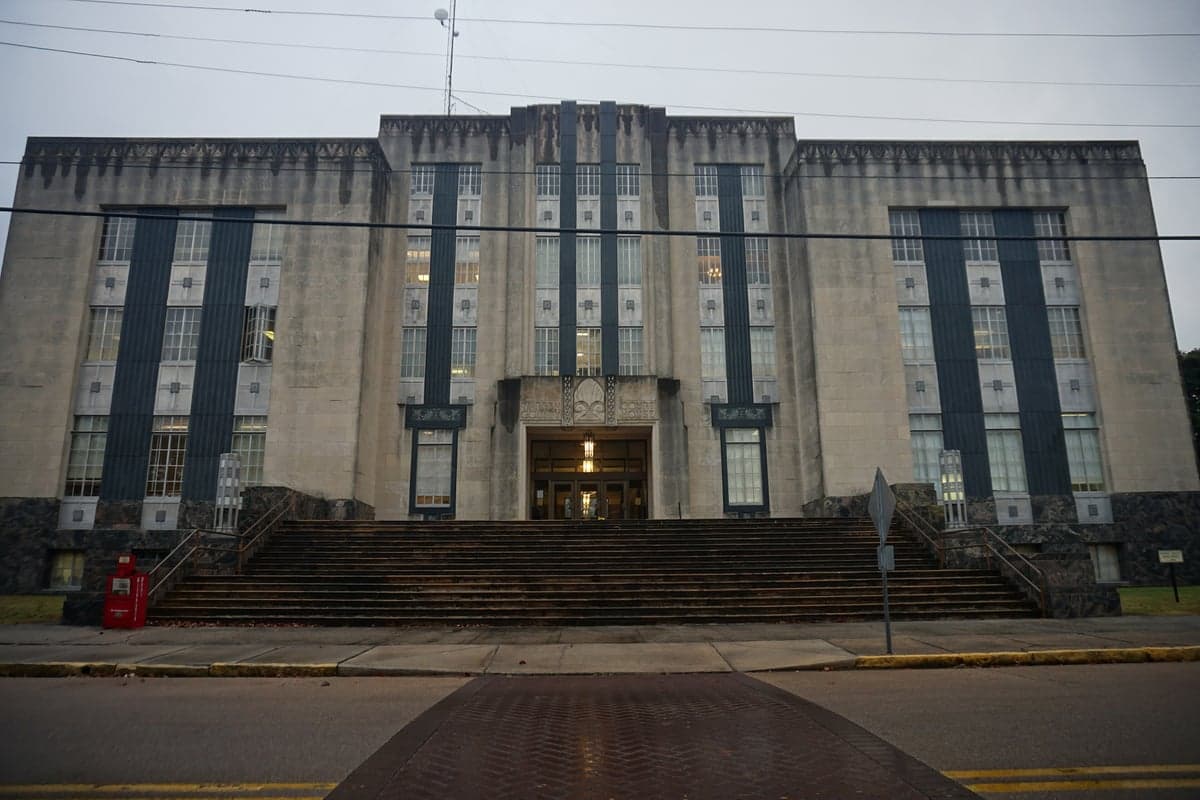
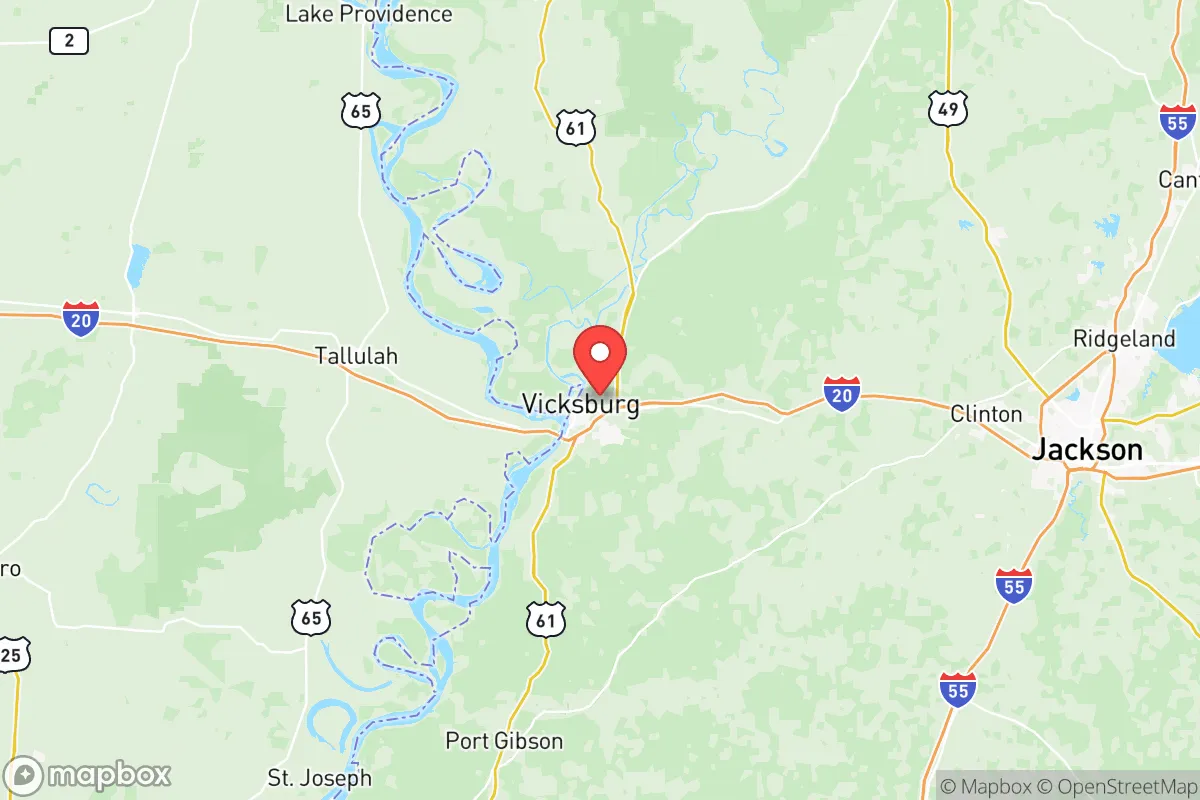
Photo: Wikipedia
Demographics of Warren County
Affluence Level in Warren County
A below-average socioeconomic profile. Incomes, home values, and educational attainment trail the U.S., with higher poverty and unemployment.
People of Warren County
The people of Warren County, Mississippi, today form a nearly evenly split biracial community of 43,623 residents, where Black (48.8%) and white (46.5%) populations coexist with a very small Hispanic (2.1%) and East/Southeast Asian (0.4%) presence. The county is overwhelmingly native-born — only 0.6% of residents are foreign-born — and its character is defined by the Mississippi River, the historic port city of Vicksburg, and a deep-rooted sense of place that has resisted the rapid demographic change seen in much of the Sun Belt. This is a community shaped by centuries of river commerce, Civil War legacy, and a post-industrial economy that has kept population growth modest and cultural identity stable.
Settlement & growth (pre-1960)
Long before European contact, the area that is now Warren County was home to the Natchez people, a Mississippian culture society with a complex chiefdom system centered on mound-building and agriculture. The Natchez occupied several villages along the bluffs overlooking the Mississippi River, including the Grand Village of the Natchez near present-day Vicksburg. French explorers and traders arrived in the late 17th century, establishing Fort Saint-Pierre (1718) on the Yazoo River, but conflict with the Natchez — culminating in the Natchez War of 1729 — led to the near-total destruction of the tribe and the French abandonment of the area for decades.
After the Louisiana Purchase (1803), American settlers began filtering into the region. Warren County was formally established in 1809, named for Revolutionary War hero Joseph Warren. The city of Vicksburg was founded in 1811 on a high bluff at the Mississippi River's bend, and its strategic location made it a magnet for cotton planters and river traders. The first major wave of American settlers were Anglo-American planters from Virginia, the Carolinas, and Georgia, who arrived in the 1810s–1830s, bringing enslaved Black laborers with them. By 1840, Warren County had a Black majority — a pattern that has persisted, with brief interruptions, to the present day. The county's economy was built on cotton, shipped downriver to New Orleans, and Vicksburg became the second-largest cotton market in the South by the 1850s.
The Civil War brought the defining event of the county's history: the 47-day Siege of Vicksburg (1863), after which the city surrendered to Ulysses S. Grant, splitting the Confederacy. The war's devastation — and the subsequent emancipation of enslaved people — reshaped the population. Freedmen remained in the county in large numbers, working as sharecroppers and tenant farmers, and by 1870 Black residents made up roughly 65% of the population. The post-Reconstruction era saw the rise of Jim Crow laws, disenfranchisement, and racial violence, including the 1919 Vicksburg race riot. Despite these pressures, the Black community maintained a strong presence, centered in Vicksburg's Southside and the historic neighborhood of Oak Ridge.
The early 20th century brought a modest influx of Italian and Lebanese immigrants, who arrived between 1890 and 1920 to work as merchants, grocers, and dockworkers. These groups settled primarily in Vicksburg's downtown and the Washington Street corridor, establishing small businesses that served the river trade. The Great Migration (1910–1970) saw tens of thousands of Black Mississippians leave the state for northern industrial cities, but Warren County's Black population remained relatively stable, as the river economy provided steady work on the docks and in the railroad yards. The 1930s–1950s brought a small number of white migrants from the Dust Bowl and rural Mississippi, who settled in the county's unincorporated areas like Redwood and Bovina, working in timber and agriculture.
Modern era (post-1965)
The 1965 Hart-Cellar Act, which dramatically expanded immigration from Asia and Latin America, had almost no impact on Warren County. The county's foreign-born population today is just 0.6%, compared to 13.7% nationally. This is not a destination for new immigrant communities; instead, the county's demographic story since 1965 has been one of domestic migration, suburbanization, and racial stability.
The most significant post-1965 shift has been the growth of Vicksburg's suburbs. The city of Vicksburg itself has lost population — from a peak of 29,000 in 1960 to roughly 21,000 today — while unincorporated areas like Beechwood, Waltersville, and the area around Highway 61 South have grown. This is a classic pattern of white flight and Black suburbanization: middle-class families of both races have moved to newer subdivisions outside the city limits, leaving an older, poorer, and more heavily Black urban core. The county's overall population has been essentially flat since 1970, hovering between 43,000 and 49,000.
The economy has shifted away from agriculture and river commerce toward manufacturing, healthcare, and government. Major employers include the U.S. Army Corps of Engineers (the Vicksburg District is a major employer of engineers and technicians), the Vicksburg Medical Center, and several industrial plants along the river. The Ergon refinery and International Paper facility in nearby Redwood provide blue-collar jobs. The county's college-educated share is 26.5%, below the national average of 33%, reflecting the industrial and service-oriented economy.
The Hispanic population, while small at 2.1%, has grown from near-zero in 1990, driven by Mexican and Central American laborers working in construction, poultry processing, and agriculture. These families are concentrated in Vicksburg's southern neighborhoods and the unincorporated community of Yokena. The East/Southeast Asian population (0.4%) is tiny and consists mostly of Vietnamese and Filipino families who arrived in the 1980s–1990s, many connected to the military or the river industry. The Indian-subcontinent population (0.3%) is even smaller, primarily professionals working at the Corps of Engineers or the medical center.
The future
Warren County's population is projected to remain flat or decline slightly over the next 20 years, as out-migration of young adults to larger cities offsets any natural increase. The county is not homogenizing into a single cultural identity; rather, it is tribalizing along racial lines, with Black and white residents living in distinct neighborhoods and attending separate social institutions. The small Hispanic and Asian communities are likely to grow slowly, but they will remain tiny enclaves rather than reshaping the county's character.
The most significant demographic trend is aging. The median age in Warren County is 39.5, above the national median of 38.5, and the share of residents over 65 is growing. Young people — especially college graduates — tend to leave for Jackson, the Mississippi Gulf Coast, or out of state, a pattern that has persisted for decades. The county's future is one of stability, not transformation: the same families, the same racial divisions, the same economic challenges that have defined it for generations.
For someone moving in now, Warren County offers a deeply rooted, slow-paced community with a strong sense of history and place. The cost of living is low, the riverfront is scenic, and the schools — particularly the Vicksburg Warren School District — are adequate but not exceptional. The trade-off is limited economic opportunity, a shrinking young population, and a social landscape that remains sharply divided by race. This is not a place of demographic dynamism or cultural fusion; it is a place where the past is always present, and where newcomers will need to find their place within established patterns.

* Values derived from national, state, county, city and local statistics and may differ in a specific area. Last updated: 2026-05-21T01:03:08.000Z
Narrative content on this page is AI-generated and may contain mistakes. Verify any details that matter before acting on them.
ReloMaps may earn a commission from affiliate links at no extra cost to you.

