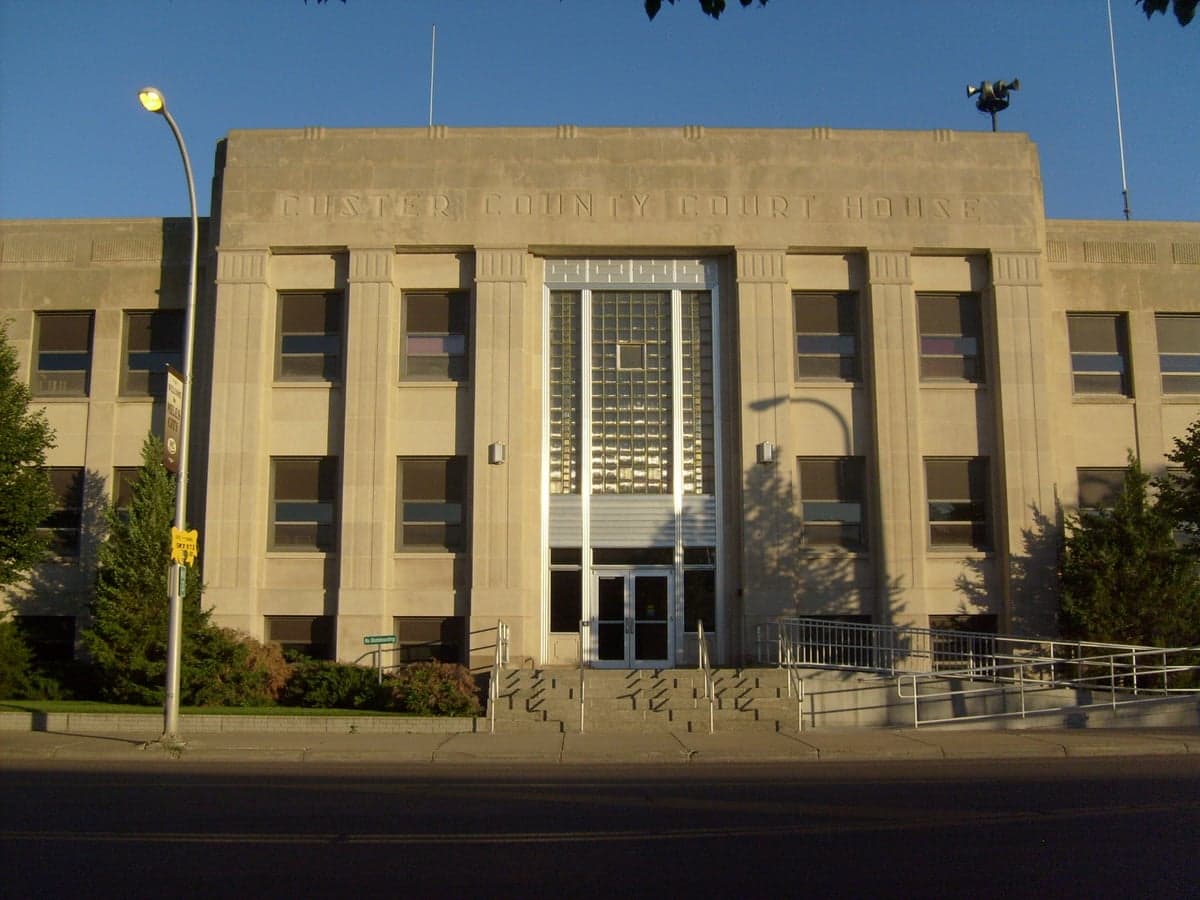
Photo: Wikipedia
Personal Sovereignty in Custer County
Viable for self-reliance. Generally workable, though some barriers may limit total independence.
What does Personal Sovereignty tell us?
Personal Sovereignty measures your capacity for self-reliance and independence with minimal government friction. Higher scores mean fewer barriers between you and the way you want to live... but it assumes you have the space you need and good neighbors.
What does this tell us?
Personal Sovereignty measures your capacity for self-reliance and independence with minimal government friction. Higher scores mean fewer barriers between you and the way you want to live... but it assumes you have the space you need and good neighbors.
State Policy
Energy independence: Net exporter (120% of energy produced in-state)
Personal Liberty
Homesteading

Personal Liberty Analysis
Custer County, Montana, offers one of the most uncompromising environments for personal sovereignty in the lower 48, a place where the ethos of self-rule isn't just a talking point but the operating system of daily life. For those looking to escape the creeping regulatory state and the erosion of individual rights seen in coastal population centers, this corner of southeastern Montana presents a stark contrast. Here, the distance between a citizen and the government is measured in miles and a deep-seated cultural resistance to outside control, making it a serious consideration for anyone prioritizing autonomy over convenience.
Tax burden and regulatory posture in Custer County
The financial and bureaucratic climate in Custer County is a direct reflection of Montana's broader constitutional commitment to limited government. There is no state sales tax, which means every dollar earned or spent stays in your pocket, a critical advantage for those building a self-sufficient lifestyle. Property taxes are levied at the county level and remain among the lowest in the nation, with agricultural and rural residential land carrying a particularly light burden. The regulatory posture is best described as "hands-off." Unlike states with aggressive building codes, environmental review boards, or occupational licensing hurdles, Custer County operates with a presumption of freedom. In towns like Miles City, the county seat, and smaller communities like Ismay or Kinsey, you will find minimal zoning restrictions and a county commission that views property rights as inviolable. The state's business climate is similarly friendly, with no corporate income tax and a flat individual income tax rate of 5.9%, a structure that rewards productivity rather than punishing it. For the prepper or survivalist, this means fewer layers of bureaucracy between you and your land, your projects, and your savings.
Self-defense and gun law specifics in Montana's Custer County
Montana is a constitutional carry state, and Custer County residents take that seriously. No permit is required to carry a concealed firearm, either openly or concealed, for any law-abiding individual over 18. This is not a privilege granted by the state; it is recognized as a pre-existing right. The county itself is a stronghold of Second Amendment culture, with local sheriff's offices in Miles City and Volborg consistently affirming their role as defenders of that right, not enforcers of federal overreach. There are no magazine capacity restrictions, no "assault weapon" bans, and no red flag laws on the books. Stand Your Ground laws are in full effect, with no duty to retreat in any place where a person is lawfully present. For those concerned about the ability to defend hearth and home without legal jeopardy, Custer County offers a legal framework that aligns with the principle that the individual is the first and final line of defense. The local culture in places like Powderville and Mizpah reinforces this, where firearm proficiency is a common skill and the idea of government-mandated waiting periods or background checks for private sales is viewed as an unconstitutional infringement.
Self-reliance and homesteading viability in Custer County
The viability of a self-reliant lifestyle in Custer County is exceptional, driven by land availability and a permissive zoning environment. Rural parcels outside of Miles City can be found in sizes ranging from 20 to 160 acres or more, often at prices that are a fraction of what similar land costs in western Montana or the Front Range. Zoning is virtually non-existent in unincorporated areas, meaning there are no county inspectors telling you how to build your home, where to place your septic, or whether you can keep livestock. Off-grid living is not just tolerated; it is the norm for many residents. Solar panels, wind turbines, rainwater catchment, and composting toilets are common sights. The county does not impose punitive regulations on alternative energy systems or water rights for domestic use, though it is wise to secure a water right for any significant agricultural use. Towns like Volborg and Ismay are particularly attractive for those seeking complete independence, as they offer the lowest population densities and the most freedom to develop land according to your own timeline and standards. The growing season is short, but with a greenhouse and proper planning, a family can produce a significant portion of its own food, reducing reliance on fragile supply chains.
Personal liberties in Custer County: parental rights, medical autonomy, and property
Personal liberties in Custer County extend well beyond the Second Amendment. Parental rights are strongly protected under Montana law, with a legal presumption that parents have the fundamental right to direct the upbringing, education, and healthcare of their children. School boards in the county, particularly in Miles City and the surrounding rural districts, are responsive to local values and resistant to federal or state mandates on curriculum or medical policies. Medical autonomy is another area where Custer County stands apart. There is no state-level vaccine mandate for adults or children, and the county's health department operates with a philosophy of individual choice rather than public health coercion. The right to refuse medical treatment, including experimental therapies, is firmly established. Property rights are treated as sacrosanct. Eminent domain abuse is rare, and the county's planning department is known for its deference to the landowner. In Kinsey and Mizpah, you can build a workshop, store supplies, or construct a bunker without needing a parade of permits. The legal climate is one where the burden of proof falls on the government to show why you cannot do something, not on the citizen to ask for permission.
When stacked against other regions of the country, Custer County, Montana, represents a rare pocket of genuine sovereignty. The combination of no sales tax, constitutional carry, minimal zoning, and a culture that prizes individual responsibility over collective compliance creates an environment where a person can live largely unbothered by the state. For the strategic relocator with a survivalist mindset, this is not just a place to live; it is a place to build a future on your own terms, with the law and the local culture on your side. The trade-offs are real—harsh winters, distance from major medical centers, and a sparse social fabric—but for those who value freedom above all else, the arithmetic is simple.

* Values derived from national, state, county, city and local statistics and may differ in a specific area. Last updated: 2026-06-02T14:49:56.000Z
Narrative content on this page is AI-generated and may contain mistakes. Verify any details that matter before acting on them.
ReloMaps may earn a commission from affiliate links at no extra cost to you.

