
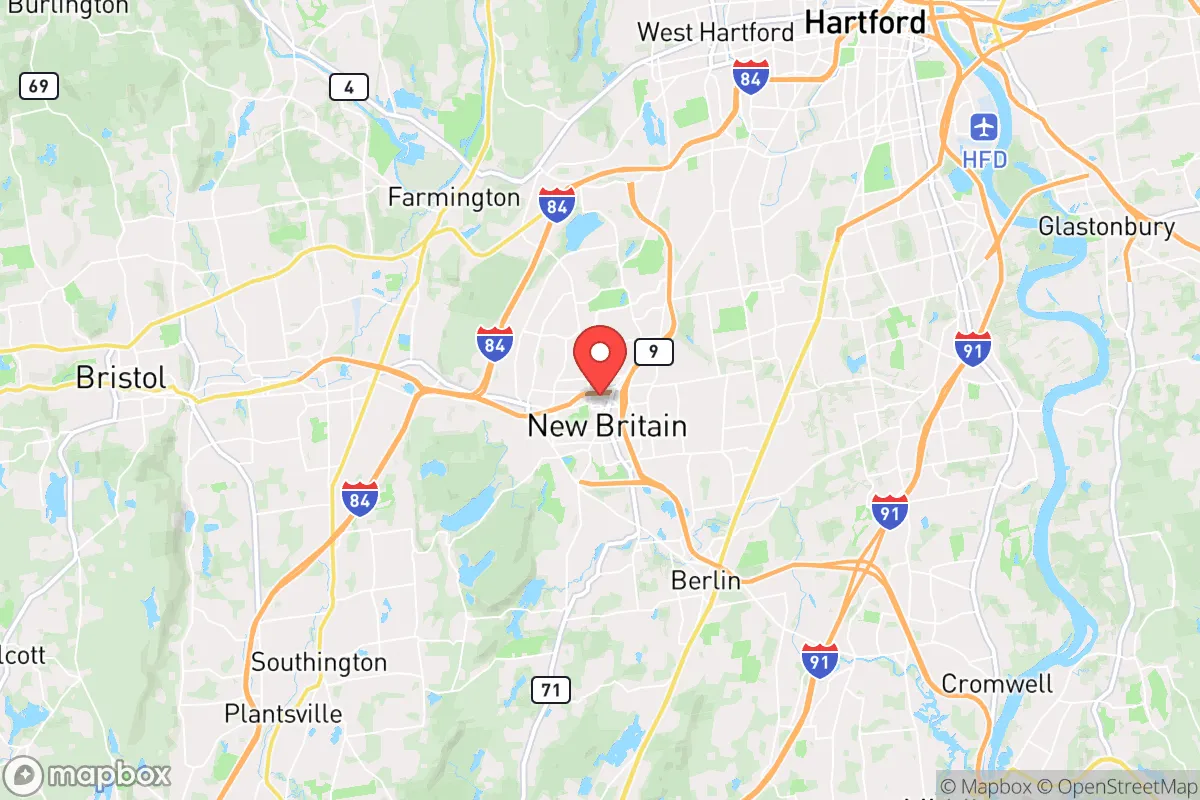
Photo: Wikipedia
Personal Sovereignty in New Britain, CT
Viable for self-reliance. Generally workable, though some barriers may limit total independence.
What does Personal Sovereignty tell us?
Personal Sovereignty measures your capacity for self-reliance and independence with minimal government friction. Higher scores mean fewer barriers between you and the way you want to live... but it assumes you have the space you need and good neighbors.
What does this tell us?
Personal Sovereignty measures your capacity for self-reliance and independence with minimal government friction. Higher scores mean fewer barriers between you and the way you want to live... but it assumes you have the space you need and good neighbors.
State Policy
Energy independence: Importer (5% of energy produced in-state)
Personal Liberty
Homesteading

Personal Liberty Analysis
For a conservative-leaning individual or family evaluating New Britain, Connecticut, through a lens of personal sovereignty, the immediate takeaway is that you are operating within a state that has systematically centralized authority in Hartford, leaving municipalities like New Britain with limited room to carve out a truly independent, low-regulation environment. While the city itself has a working-class, blue-collar character that values self-reliance, the legal and fiscal framework imposed by the state creates a significant headwind for anyone seeking maximum personal autonomy. The core tension here is between the gritty, independent spirit of the local population and the top-down control of Connecticut's government, which consistently ranks among the most restrictive in the nation for gun rights, tax burdens, and regulatory freedom. For a survivalist or prepper, this means your strategic focus must be on navigating state-level constraints rather than expecting local liberty to flourish.
Tax burden and regulatory posture: How Connecticut's fiscal grip limits local autonomy
The single largest assault on personal sovereignty in New Britain is the combined weight of state and local taxes. Connecticut has one of the highest combined state and local tax burdens in the country, and New Britain residents feel this acutely. The state income tax is progressive, with rates climbing to nearly 7%, and the state sales tax is 6.35%, with no local option to reduce it. Property taxes in New Britain are also a major factor; the mill rate is high relative to national averages, and the city's reliance on property tax revenue means that owning a home—a cornerstone of self-reliance—comes with a recurring, substantial cost to the state and municipality. From a regulatory standpoint, Connecticut is a "home rule" state, but the state legislature preempts local control on many fronts, including building codes, environmental regulations, and business licensing. This means that even if New Britain's local government were more libertarian-leaning, it has limited ability to offer meaningful tax relief or deregulation. For a prepper, this fiscal environment directly reduces the capital available for stockpiling supplies, land acquisition, or off-grid infrastructure, making it a significant strategic disadvantage compared to lower-tax states.
Self-defense and gun law specifics: Navigating Connecticut's restrictive firearms environment
For anyone prioritizing the right to keep and bear arms as a fundamental aspect of personal sovereignty, New Britain and Connecticut present a deeply challenging landscape. Connecticut has some of the most restrictive gun laws in the nation, including a ban on "assault weapons" (defined by a feature-based test), a 10-round magazine capacity limit, and a requirement for a permit to purchase any handgun or long gun, which involves a background check, a safety course, and a significant wait time. The state also has a "may-issue" concealed carry regime in practice, though a recent court ruling has shifted it toward "shall-issue"; however, the permitting process remains onerous and expensive. Open carry is technically legal with a permit, but it is highly discouraged by law enforcement and socially unusual. For a survivalist, this means that building a robust personal armory for worst-case scenarios is legally constrained, and the state maintains a registry of firearm purchases. Self-defense in the home is legally protected under the "castle doctrine," but Connecticut does not have a "stand your ground" law, imposing a duty to retreat in public spaces. This legal framework directly undermines the prepper's core assumption of being able to defend oneself and one's family without government permission or oversight.
Self-reliance and homesteading viability: Lot sizes, zoning, and off-grid feasibility in an urban setting
New Britain is a densely developed, older industrial city, and the feasibility of traditional homesteading or off-grid living within its borders is extremely low. Typical residential lot sizes are small—often less than a quarter-acre—and zoning is predominantly for single-family homes on small plots with strict setback requirements. The city's zoning code does not permit agricultural uses like keeping livestock (chickens, goats) in most residential zones, and there are no provisions for "urban homesteading" exemptions. Off-grid infrastructure is effectively illegal: the city requires connection to municipal water and sewer systems, and building codes mandate grid-tied electrical service. Solar panels are permitted but must be grid-tied, and rainwater collection for potable use is heavily regulated by the state Department of Public Health. For a prepper seeking to reduce dependency on centralized systems, New Britain offers almost no legal pathway to do so. The realistic strategy here is not to homestead within the city limits but to use New Britain as a base of operations—perhaps a secure urban dwelling for work and community—while acquiring rural land elsewhere in Connecticut or a neighboring state for a more autonomous retreat. The city's proximity to less-dense towns in Litchfield County (a 30-45 minute drive) does offer some potential for a two-property strategy, but the legal and financial barriers to true self-reliance within New Britain itself are formidable.
Personal liberties: Parental rights, medical autonomy, speech, and property in a blue state context
On the broader spectrum of personal liberties, Connecticut's state-level policies consistently prioritize government authority over individual or parental discretion. Parental rights in education are significantly curtailed: the state mandates comprehensive sex education that includes LGBTQ+ content, and parents do not have a blanket right to opt their children out of specific lessons, only from the entire curriculum. Medical autonomy is also heavily restricted; Connecticut has strict vaccine mandates for school attendance, with very narrow religious or medical exemptions, and the state has enacted laws that protect access to gender-affirming care for minors, overriding parental consent in some interpretations. Free speech is constitutionally protected, but the state has enacted laws targeting "hate speech" and disinformation that, while likely constitutional, create a chilling effect for those expressing dissenting views on controversial topics. Property rights are constrained by the state's strong environmental regulations, including wetlands protections and historic district commissions that can block renovations or land use changes. For a conservative individual, these policies represent a systematic erosion of the traditional spheres of family and local control. New Britain's local government, while more moderate than the state capital, has limited power to push back against these mandates, meaning that personal liberty in these areas is largely determined by the state legislature in Hartford, not by local votes or community standards.
In the final analysis, New Britain offers a mixed but ultimately constrained environment for personal sovereignty. The city's blue-collar, self-reliant culture is a genuine asset, and the lower cost of living relative to other Connecticut cities provides some financial breathing room. However, the overarching state-level tax burden, restrictive gun laws, prohibitive zoning for self-sufficiency, and top-down mandates on education and medical autonomy create a system that is fundamentally at odds with a survivalist or prepper mindset. Compared to states like New Hampshire, Texas, or Idaho, New Britain and Connecticut as a whole rank poorly on nearly every metric of personal sovereignty. For a strategic relocation, this location is best viewed as a compromise—a place where one can maintain urban employment and community ties while fighting an uphill battle against state overreach. If maximum autonomy is the primary goal, the analysis strongly suggests looking elsewhere, as the structural barriers here are deeply embedded and unlikely to change in the near term.

* Values derived from national, state, county, city and local statistics and may differ in a specific area. Last updated: 2026-04-19T08:09:22.000Z
Narrative content on this page is AI-generated and may contain mistakes. Verify any details that matter before acting on them.
ReloMaps may earn a commission from affiliate links at no extra cost to you.

