Photo: Wikipedia
Demographics of New Iberia, LA
Affluence Level in New Iberia, LA
A below-average socioeconomic profile. Incomes, home values, and educational attainment trail the U.S., with higher poverty and unemployment.
People of New Iberia, LA
The people of New Iberia, Louisiana, today number 27,926, forming a nearly evenly split Black (43.7%) and White (43.6%) community with small Hispanic (5.3%) and East/Southeast Asian (2.0%) populations. The city is a deeply rooted, majority-minority community where the legacy of French Creole and Acadian settlement remains visible in its architecture, street names, and Catholic parish life. With only 1.3% foreign-born residents and a college attainment rate of 17.4%, New Iberia is a stable, working-class city where generational ties to the land and local industry run strong.
How the city was settled and grew
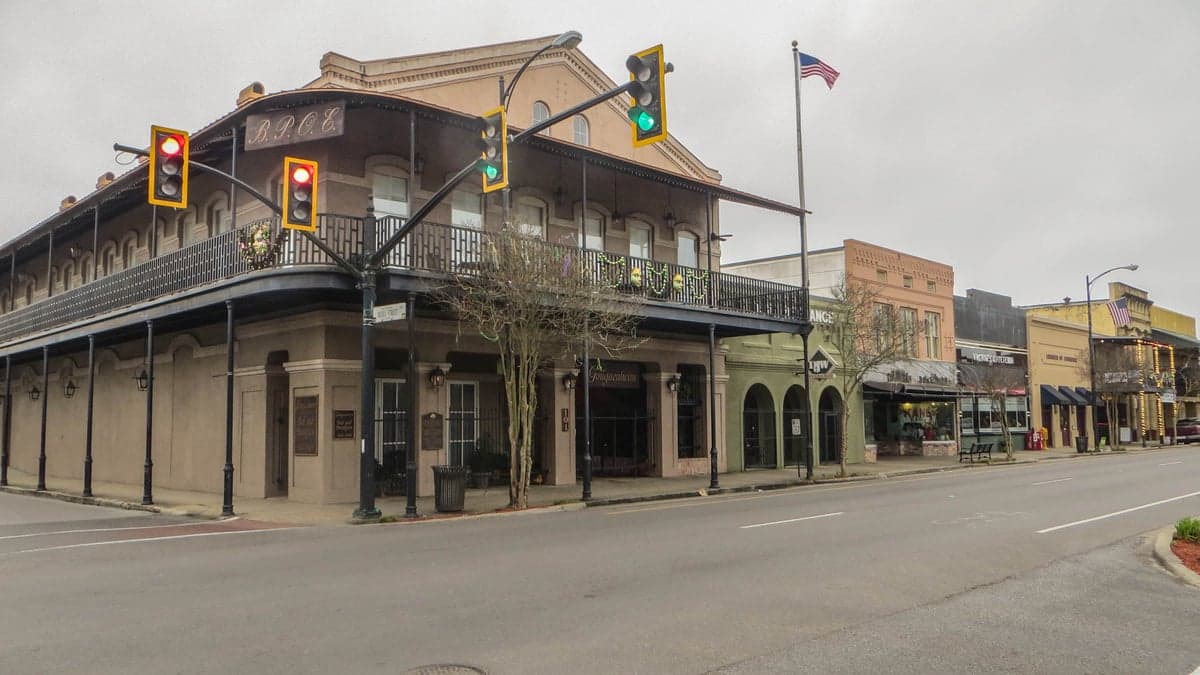
New Iberia was founded in 1779 by Spanish colonists from Málaga, who named it after the Iberian Peninsula. The original settlement clustered around the Bayou Teche, and the Historic District (roughly bounded by Main, St. Peter, and Weeks streets) still contains the early Spanish and French Creole homes built by these first families. The city’s early economy was built on sugar cane plantations, which drew enslaved Africans and later freed Black laborers into the area. By the 1830s, Acadian refugees from Nova Scotia had arrived, settling along the bayou in what is now the Bayou Teche Corridor, establishing a French-speaking Catholic culture that persisted well into the 20th century. The post-Civil War era brought a wave of Italian immigrants, who worked as merchants and farmers and concentrated in the South Side neighborhood near the railroad depot. The early 1900s saw the arrival of a small number of Chinese immigrants, who operated grocery stores and laundries, forming a tiny enclave along Main Street. By 1950, New Iberia was a segregated, biracial city of roughly 15,000, with White families in the North Side and Black families concentrated in the West End and Broussard Addition neighborhoods.
Modern era (post-1965)
The 1965 Hart-Cellar Act had minimal direct impact on New Iberia, as the city’s foreign-born share remains negligible at 1.3%. The major demographic shift came from domestic migration: the Great Migration of Black families from rural Louisiana parishes into the city continued through the 1970s, swelling the Black population from roughly 35% in 1960 to 43.7% today. These families settled primarily in the West End and Broussard Addition, which remain predominantly Black neighborhoods today. White flight to suburban subdivisions like Bayou Vista and Loreauville accelerated after school desegregation in the 1970s, hollowing out the historic North Side. The Hispanic population grew slowly from 1.2% in 2000 to 5.3% today, driven by Mexican and Central American workers in the sugar cane fields and oilfield service industries; they are scattered across the city but have a small cluster near the East Main Street corridor. The East/Southeast Asian community (2.0%) is almost entirely Vietnamese, descendants of refugees who arrived after 1975 and found work in the seafood and shrimp industries; they are concentrated in the South Side near the Tabasco plant and the Port of Iberia. The Indian subcontinent population is effectively zero, reflecting the city’s lack of tech or medical sectors that typically attract that group.
The future
New Iberia’s population is aging and slowly declining, with a median age of 37 and a 2.5% population drop since 2020. The city is not homogenizing; rather, it is consolidating into distinct racial enclaves. The White population is shrinking (down from 52% in 2010) as younger families leave for Lafayette or Baton Rouge, while the Black population is stable but aging. The Hispanic share is growing slowly but remains too small to reshape the city’s character. The Vietnamese community is plateauing, with younger generations moving to larger Gulf Coast cities. No major immigrant gateway is forming. The next 10-20 years will likely see continued slow decline, with the city becoming older, poorer, and more racially polarized between the West End (Black) and Bayou Vista (White) neighborhoods.
For a conservative-leaning mover today, New Iberia offers a low-cost, deeply traditional community where family ties and church attendance are the norm, but economic opportunity is limited and racial divisions remain visible in daily life. It is a place for those who value stability and heritage over growth and diversity.

* Values derived from national, state, county, city and local statistics and may differ in a specific area. Last updated: 2026-05-01T06:07:30.000Z
Narrative content on this page is AI-generated and may contain mistakes. Verify any details that matter before acting on them.
ReloMaps may earn a commission from affiliate links at no extra cost to you.

