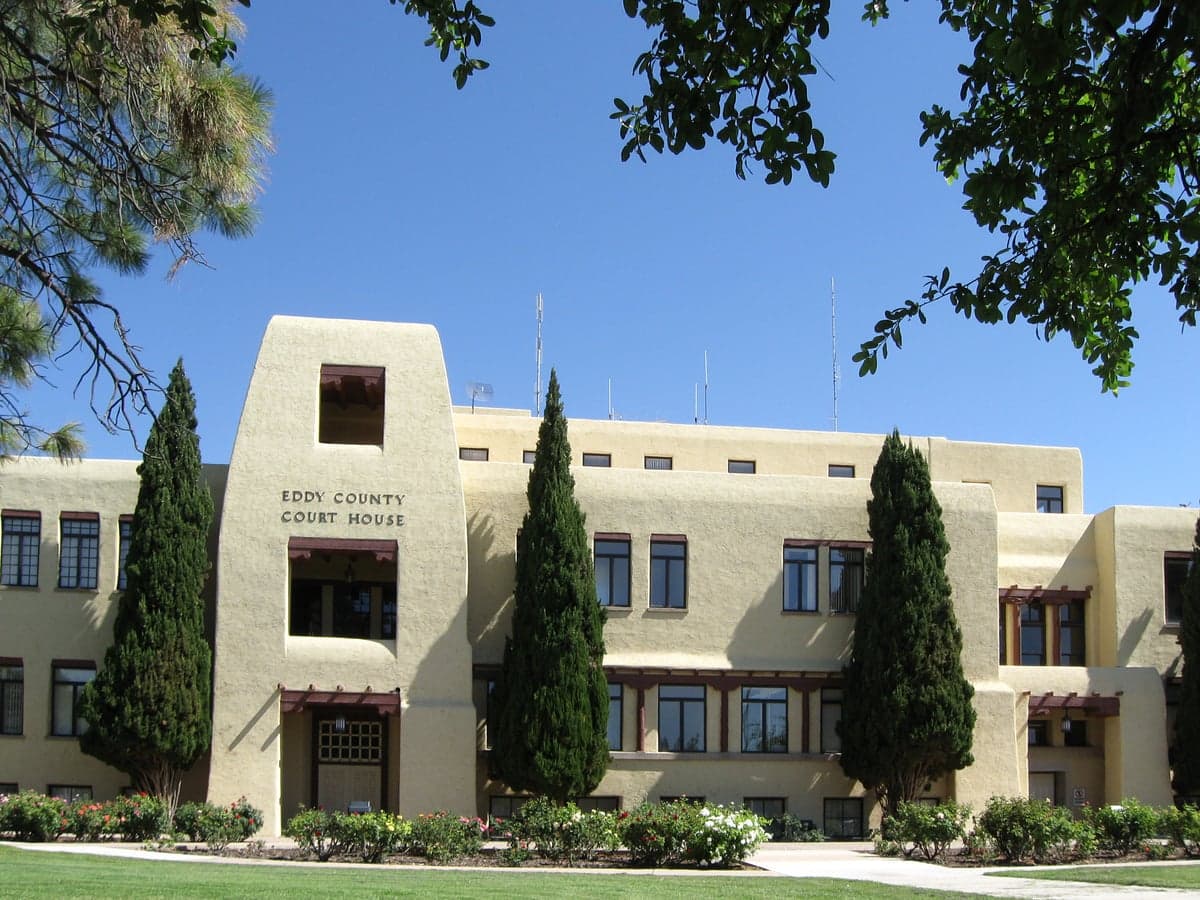
Photo: Wikipedia
Political ClimatePolitical Climate in Eddy County
Showing district-level results — no local-only data available.
Local Political AnalysisPolitical Analysis of Eddy County
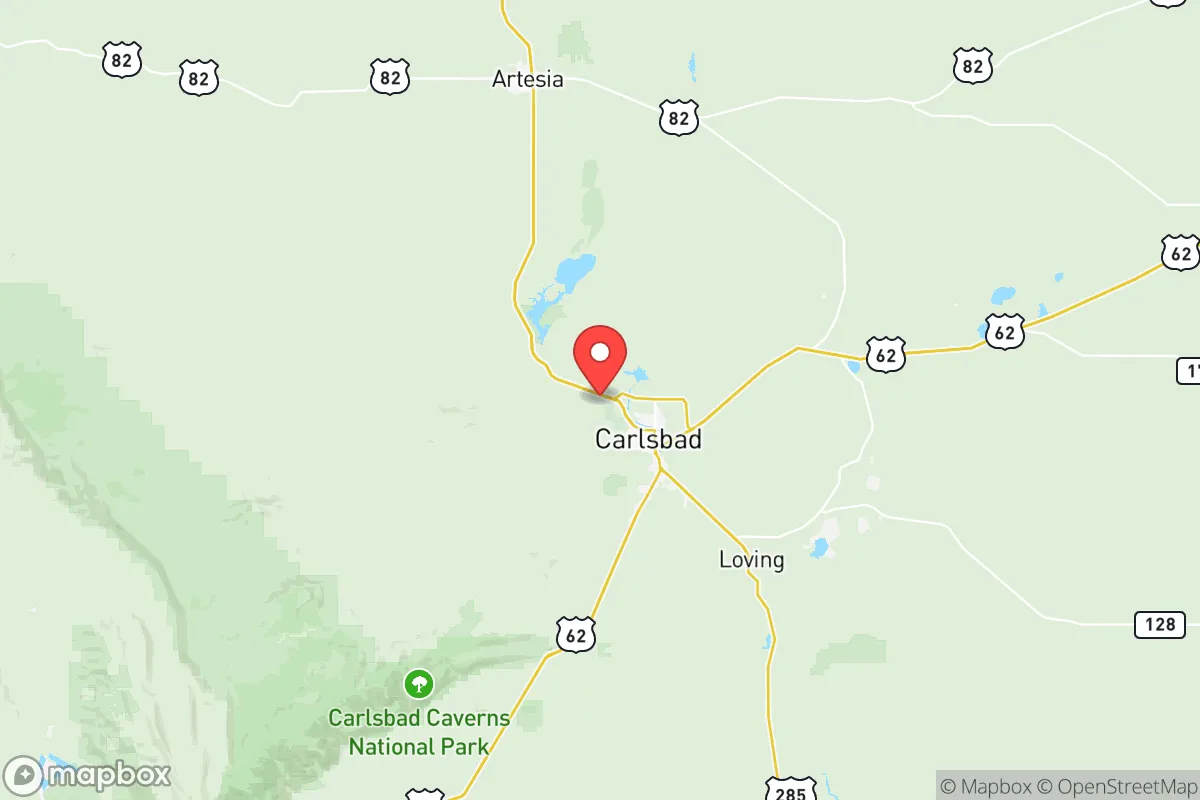
Eddy County, New Mexico, is a political outlier in a state that leans Democratic, with a Cook PVI of EVEN that makes it a true battleground county in a state rated D+3. The county has trended rightward in recent presidential cycles, with Donald Trump winning it by 38 points in 2020 and by a similar margin in 2024, driven by the oil and gas economy of the Permian Basin. This Republican lean is concentrated in the county seat of Carlsbad and the smaller towns of Artesia and Loving, while the city of Carlsbad itself shows some moderate pockets, particularly around the downtown and newer subdivisions near the Pecos River.
How it compares
Eddy County’s EVEN rating is a stark contrast to New Mexico’s D+3 statewide lean, meaning the county is about 3 points more Republican than the state as a whole. In practice, this means that while New Mexico consistently votes for Democratic presidential candidates—Biden won it by 11 points in 2020—Eddy County is a reliable Republican stronghold at the county level. The political divide within the county is subtle: Carlsbad’s precincts near the hospital and the college lean slightly more moderate, while Artesia and the rural areas east of the Pecos River are deeply conservative. The swing precincts are in the newer subdivisions of Carlsbad’s west side, where oilfield workers and their families often split tickets between local Republicans and moderate Democrats in state races.
What this means for residents
For conservative residents, Eddy County feels like a safe haven in a blue state—local offices are held by Republicans, and the county commission consistently votes for limited government and pro-energy policies. Liberal residents, however, are a small but vocal minority, concentrated in Carlsbad’s historic downtown and near the university, where they find community through local Democratic clubs and environmental advocacy groups. The practical effect is that policy debates in Eddy County are dominated by oil and gas regulation, water rights, and school funding, with little of the social-issue polarization seen in other parts of the state. Both sides agree on the importance of the Permian Basin economy, but they clash over environmental oversight and public land use, especially around the Carlsbad Caverns National Park and the Guadalupe Mountains.
Culturally, Eddy County is more akin to West Texas than to Santa Fe or Albuquerque—church attendance is high, hunting and off-roading are popular, and the local cuisine leans toward Tex-Mex and barbecue. The county’s policy distinctions include a strong local push for oil and gas tax breaks, a countywide ban on recreational cannabis dispensaries (despite state legalization), and a school board that has resisted progressive curriculum changes. For newcomers, the political climate means that conservative values are the default in most social and business settings, but liberal residents can find their niche in Carlsbad’s arts scene and environmental nonprofits. The trajectory is toward further Republican consolidation as the oil boom attracts more conservative workers from Texas, but the county’s EVEN rating suggests it could still swing in a close statewide race if Democratic turnout in Carlsbad’s moderate precincts spikes.

State Political ClimatePolitical Climate in New Mexico
State Political AnalysisPolitical Environment in the State
New Mexico is a genuine swing state in the sense that its statewide partisan lean is only D+3, but in practice it has voted Democratic in every presidential election since 2004, and the state legislature has been under Democratic control for most of the last decade. The dominant coalition is a mix of urban liberals in Albuquerque and Santa Fe, Hispanic voters in the northern counties and the southern Rio Grande valley, and a growing number of out-of-state transplants in the Santa Fe area. Over the last 20 years, the state has shifted from a competitive purple state to a solidly blue one at the statewide level, though the margin has narrowed in the last two cycles — Biden won by 11 points in 2020, down from Clinton’s 8 points in 2016 and Obama’s 15 points in 2008. The state’s rural and exurban areas, particularly in the eastern plains and the southwestern bootheel, have moved sharply right, creating a stark urban-rural split that defines nearly every election.
Urban vs. rural divide
The political map of New Mexico is essentially a story of three islands of blue surrounded by a sea of red. Bernalillo County (Albuquerque) alone accounts for roughly a third of the state’s population and delivers a 15-20 point Democratic margin in most statewide races. Santa Fe County is the bluest in the state, routinely voting 2-to-1 Democratic, driven by a mix of government workers, artists, and wealthy retirees from California and Colorado. Doña Ana County (Las Cruces) is a swing county that has trended blue in recent cycles, thanks to the growing Hispanic electorate and the influence of New Mexico State University. Outside those three population centers, the state is deeply Republican. The eastern plains — Lea County (Hobbs), Roosevelt County (Portales), and Curry County (Clovis) — are oil-and-agriculture country that vote 70-80% Republican. The southwestern bootheel, including Hidalgo County and Luna County (Deming), is more mixed but trending red as the rural Hispanic population becomes more conservative on social issues. The northern counties like Taos and Rio Arriba are reliably blue but with a distinct local flavor — more libertarian on land use and water rights, more skeptical of federal land management.
Policy environment
New Mexico’s policy environment is a study in contrasts. The state has a progressive income tax with rates from 1.7% to 5.9%, and a gross receipts tax (essentially a sales tax on services and goods) that can push 8-9% in some municipalities. Property taxes are among the lowest in the country — about 0.55% of assessed value on average — which is a genuine draw for homeowners. The regulatory posture is mixed: the state has a relatively business-friendly attitude toward oil and gas extraction (the Permian Basin extends into southeastern New Mexico), but it has aggressively expanded renewable energy mandates and tightened emissions rules. Education policy is a flashpoint: the state has a $4 billion-plus education budget but ranks near the bottom nationally in reading and math scores, and the legislature has resisted school choice measures like vouchers or charter expansion. Healthcare is dominated by the state’s Medicaid expansion, which covers roughly 40% of the population, and the state has a public option health insurance plan that launched in 2024. Election laws are among the most accessible in the country: same-day voter registration, automatic voter registration at the DMV, no-excuse absentee voting, and a 28-day early voting period. There is no voter ID requirement beyond a signature match, which has been a source of controversy among conservatives.
Recent policy direction
The last five years have seen a clear leftward shift on several fronts. In 2021, the legislature passed a recreational cannabis legalization bill (HB 2), which took effect in April 2022 and has generated over $300 million in annual sales. In 2023, the state enacted a red flag law (SB 116) allowing courts to temporarily seize firearms from individuals deemed a risk to themselves or others, and in 2024 it passed a universal background check law (HB 129) covering private sales. On abortion, the state repealed a pre-Roe ban in 2021 and passed the Reproductive and Gender-Affirming Health Care Act (HB 7) in 2023, which prohibits local governments from restricting access to abortion or gender-affirming care. On education, the state expanded universal free school meals (SB 4) in 2023 and created a state-funded pre-K program for all 4-year-olds. On property rights, the state has not passed any significant eminent domain or land-use reforms, but the Water Rights Protection Act (HB 200) in 2024 tightened rules on groundwater pumping in the Middle Rio Grande basin. On voting, the state passed the New Mexico Voting Rights Act (SB 144) in 2023, which expanded same-day registration and required counties to offer at least one drop box per 10,000 voters. For a conservative relocator, the key takeaway is that the state has moved decisively left on guns, abortion, and education, but remains relatively hands-off on property taxes and oil and gas extraction.
Civil unrest & political movements
New Mexico has a history of low-boil political conflict rather than large-scale protests. The most visible flashpoint in recent years has been the Oñate statue controversy in Albuquerque and Española, where protests over the Spanish conquistador’s legacy led to the removal of a statue in Albuquerque in 2020 and a counter-protest by Hispanic heritage groups. Immigration politics are a constant undercurrent: the state has a sanctuary state law (HB 40, passed in 2019) that prohibits state and local law enforcement from cooperating with federal immigration authorities, and the border crossing at Santa Teresa (near El Paso) has seen periodic surges in migrant crossings. The New Mexico Civil Guard, a militia group, has conducted armed patrols in the border region, drawing both support and condemnation. Election integrity has been a persistent issue: the 2020 and 2022 elections saw allegations of voter roll irregularities in Doña Ana County and Bernalillo County, though no widespread fraud was found. The New Mexico Republican Party has filed multiple lawsuits over ballot access and drop box security, and the state’s lack of voter ID remains a rallying issue for conservatives. On the left, the Dine (Navajo) Nation has been active in protests over uranium mining cleanup and water rights in the Four Corners region, particularly around Shiprock and Farmington. The overall political temperature is lower than in states like Oregon or Texas, but the underlying divisions are real and visible in local elections and county commission meetings.
Projection
Over the next 5-10 years, New Mexico is likely to remain a Democratic-leaning state, but the margin could narrow further. The key demographic driver is the Hispanic population, which makes up about 50% of the state and is trending more conservative, especially among younger men and rural voters. The in-migration from California and Colorado into Santa Fe and the Albuquerque foothills is adding progressive voters, but it’s a relatively small flow — about 10,000 net new residents per year. The oil and gas boom in the Permian Basin is bringing conservative workers to Lea and Eddy counties, which are already deep red. The wild card is Albuquerque’s growth: if the city continues to attract remote workers and tech investment (Sandia National Laboratories is a major employer), it could offset rural reddening. The state’s water scarcity will become a defining political issue — the Rio Grande is under severe stress, and fights over groundwater pumping and acequia rights will likely intensify, cutting across party lines. A conservative moving in now should expect the state to remain blue at the top of the ticket, but with more competitive down-ballot races, especially in the southern and eastern parts of the state. The policy environment will likely continue leftward on social issues, but the state’s fiscal dependence on oil and gas revenue (about 40% of the general fund) will constrain any major anti-energy moves.
For a new resident, the practical implications are straightforward. If you lean conservative, you’ll find your views well-represented in the eastern plains and the oil patch, but you’ll be in the minority in Santa Fe, Albuquerque, and most of the northern counties. You’ll pay low property taxes but relatively high gross receipts taxes on everyday purchases. You’ll have easy access to voting and cannabis, but you’ll need to navigate a state that has moved left on guns and education. If you lean liberal, you’ll find a state that matches your values on most social and environmental issues, but you’ll be frustrated by the persistent low rankings in education and economic opportunity. Either way, the state’s political reality is one of managed tension — a blue state with a red rural backbone, held together by a shared dependence on federal spending, oil revenue, and a stubbornly independent culture that doesn’t fit neatly into national partisan boxes.
* Values derived from national, state, county, city and local statistics and may differ in a specific area. Last updated: 2026-06-11T03:51:53.000Z
Narrative content on this page is AI-generated and may contain mistakes. Verify any details that matter before acting on them.
ReloMaps may earn a commission from affiliate links at no extra cost to you.

