 Popular
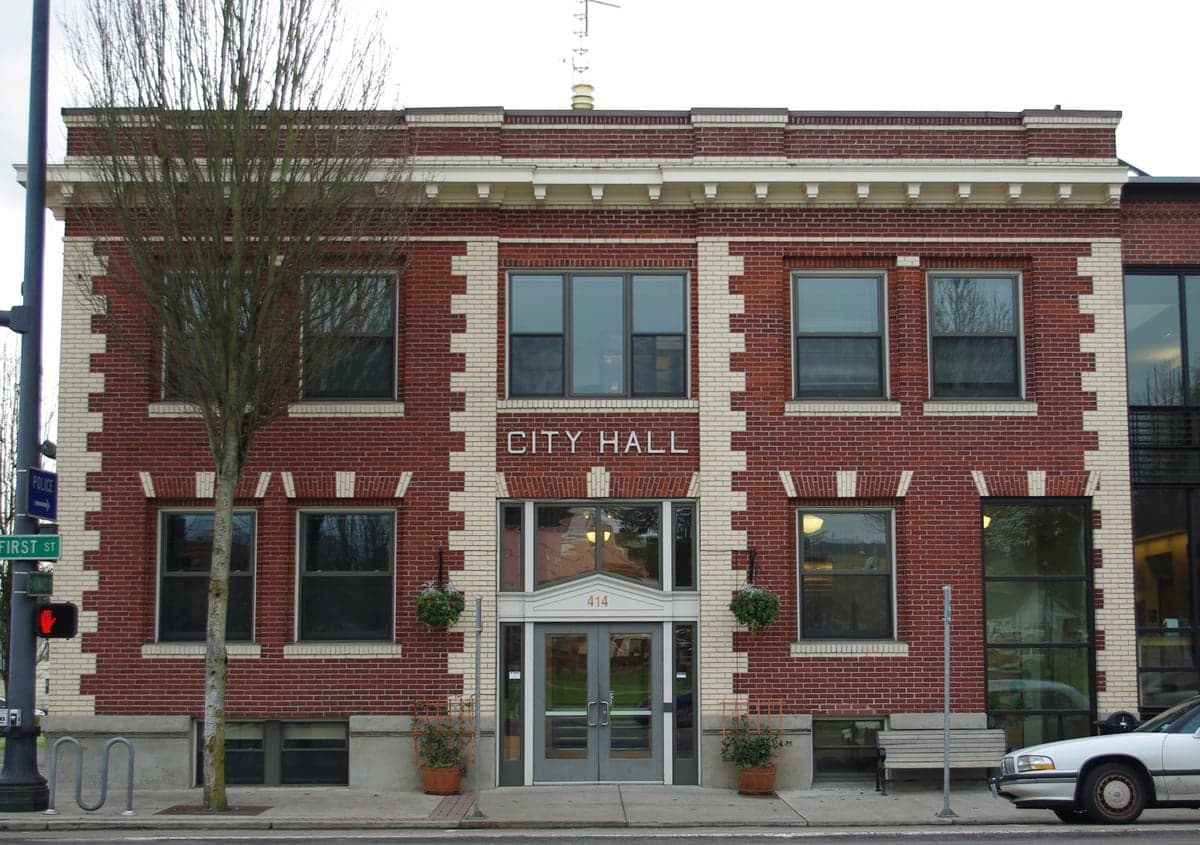
Photo: Wikipedia
Demographics of Newberg, OR
Affluence Level in Newberg, OR
A middle-class area roughly in line with national averages across income, home values, education, and employment.
People of Newberg, OR
The people of Newberg, Oregon, today number 25,622 and form a predominantly white, family-oriented community with a strong evangelical Christian and conservative identity, anchored by George Fox University. The city is notably less diverse than the Portland metro area it borders, with a white population of 73.5% and a Hispanic population of 15.7% that represents the largest minority group. Foreign-born residents make up just 4.2% of the population, and the college-educated share stands at 35.2%, reflecting the university's influence. Newberg's character is shaped by its Quaker founding, its role as a wine-country hub, and a population that is older and more politically conservative than neighboring Yamhill County towns.
How the city was settled and grew
Newberg's human history begins with the Kalapuya people, who inhabited the Willamette Valley for thousands of years before European contact. The first permanent white settlers arrived in the 1840s via the Oregon Trail, drawn by the Donation Land Claim Act of 1850, which granted 320 acres to married couples. Among them was Elisha L. Smith, who filed a claim in 1851 on land that would become downtown Newberg. The city's distinctive identity was forged in 1875 when Quaker missionaries from Indiana established a meetinghouse, attracting a wave of Midwestern Quaker families who valued pacifism, education, and temperance. These settlers built the Historic Quaker District around what is now Hancock and Sherman Streets, where many of the original 19th-century homes still stand. The arrival of the Oregon Electric Railway in 1908 spurred a second wave of growth, bringing Portland commuters and small-business owners to neighborhoods like Springbrook, a streetcar suburb of Craftsman bungalows built between 1910 and 1920. By 1920, Newberg's population had reached roughly 2,000, and the founding of Pacific College (later George Fox University) in 1891 had already established the city as a regional center for conservative Christian education.
Modern era (post-1965)
The post-1965 period brought gradual demographic change, though Newberg remained overwhelmingly white. The Immigration and Nationality Act of 1965 had little immediate effect here; the city's foreign-born share today is just 4.2%, far below the national average. Instead, domestic in-migration drove growth. The expansion of the Oregon wine industry in the 1970s and 1980s drew middle-class professionals to the surrounding Dundee Hills, and many settled in Newberg's newer subdivisions. The Ewing Young neighborhood, developed in the 1980s and 1990s off Highway 240, absorbed many of these white-collar newcomers, while North Valley, a master-planned community built in the 2000s, attracted families seeking larger lots and newer schools. The Hispanic population grew from negligible levels in 1980 to 15.7% today, driven by agricultural labor demand in the nearby vineyards and nurseries. These families concentrated in the South Industrial corridor along Highway 99W and in older rental stock near the city's core, forming a distinct but geographically integrated community. The Asian population, at 2.1%, is primarily East and Southeast Asian (Chinese, Korean, Vietnamese, Filipino) and is largely tied to faculty and staff at George Fox University, with clusters near the campus in the College District. The Indian-subcontinent population is 0.4%, a small presence of professionals and academics. The Black population remains minimal at 0.7%, reflecting the broader lack of diversity in rural Yamhill County.
The future
Newberg's population is heading toward modest diversification, but the pace is slow. The Hispanic share is likely to continue growing, driven by natural increase and continued agricultural labor demand, though the city's housing costs—median home values above $500,000—may push younger Hispanic families into more affordable outlying areas like Dayton or St. Paul. The white population, while still dominant, is aging; the median age is 37.5, and many retirees are selling homes to younger families from the Portland metro area seeking lower taxes and a conservative social environment. This in-migration is reinforcing the city's political character—Newberg voted 58% for Donald Trump in 2020—and is unlikely to produce significant racial or ethnic integration. The Asian and Indian populations will likely remain small and tied to the university, while the Black population shows no signs of growth. The city is not tribalizing into distinct ethnic enclaves; rather, it is slowly becoming a slightly more Hispanic version of its current self, with the geographic divide between older white neighborhoods and newer Hispanic areas persisting but not hardening.
For someone moving to Newberg now, the bottom line is this: you are joining a stable, predominantly white, conservative Christian community that is slowly becoming more Hispanic but remains culturally and politically homogeneous. The city offers a safe, family-oriented environment with strong schools and a clear identity, but it is not a place of rapid demographic change or ethnic diversity. If you value a predictable, traditional small-city atmosphere with a wine-country backdrop, Newberg fits that mold. If you seek racial or cultural variety, you will find it limited.

* Values derived from national, state, county, city and local statistics and may differ in a specific area. Last updated: 2026-05-04T23:07:19.000Z
Narrative content on this page is AI-generated and may contain mistakes. Verify any details that matter before acting on them.
ReloMaps may earn a commission from affiliate links at no extra cost to you.

