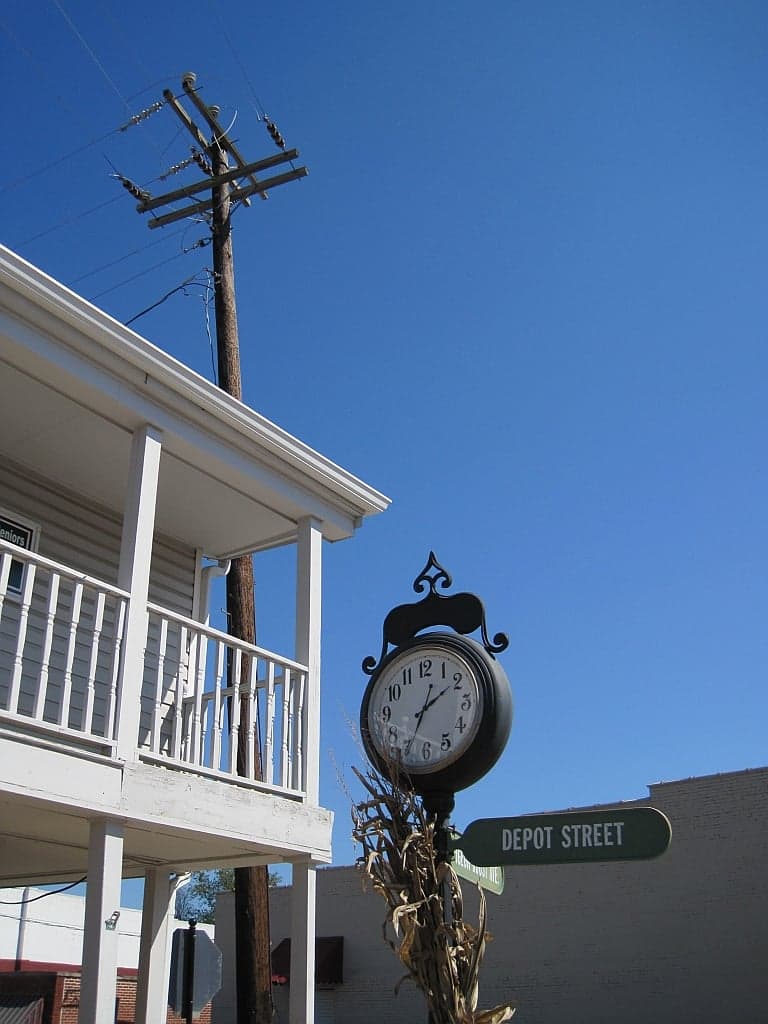
Photo: Wikipedia
Strategic Assessment of Olive Branch, MS
Meaningful friction. Expect exposure to either population pressure, blast zones, or natural disaster risk. Consider buying a retreat property.
What does the Strategic Assessment tell us?
Our Strategic Assessment grades tactical survivability of an area. Major population centers, military targets, fallout zones, natural disasters, and border exposure all drive risk — lower exposure means a more defensible position in a crisis.
This is heavily inspired by Joel Skousen's Strategic Relocation book. Highly recommended you checkout the book ($)What does this tell us?
Our Strategic Assessment grades tactical survivability of an area. Major population centers, military targets, fallout zones, natural disasters, and border exposure all drive risk — lower exposure means a more defensible position in a crisis.
This is heavily inspired by Joel Skousen's Strategic Relocation book. Highly recommended you checkout the book ($)Strategic Pillars

Key Distances
Regional Safe Places
Below is our recommended "safe zones" in Mississippi and the surrounding area based on our strategic heuristics. For most people, it's unrealistic to live in a “safe zone” full-time due to work, family or other personal reasons. They tend to be more rural. However, many of these areas are perfect for second homes and retreat properties that double as a vacation home or even a short-term rental.
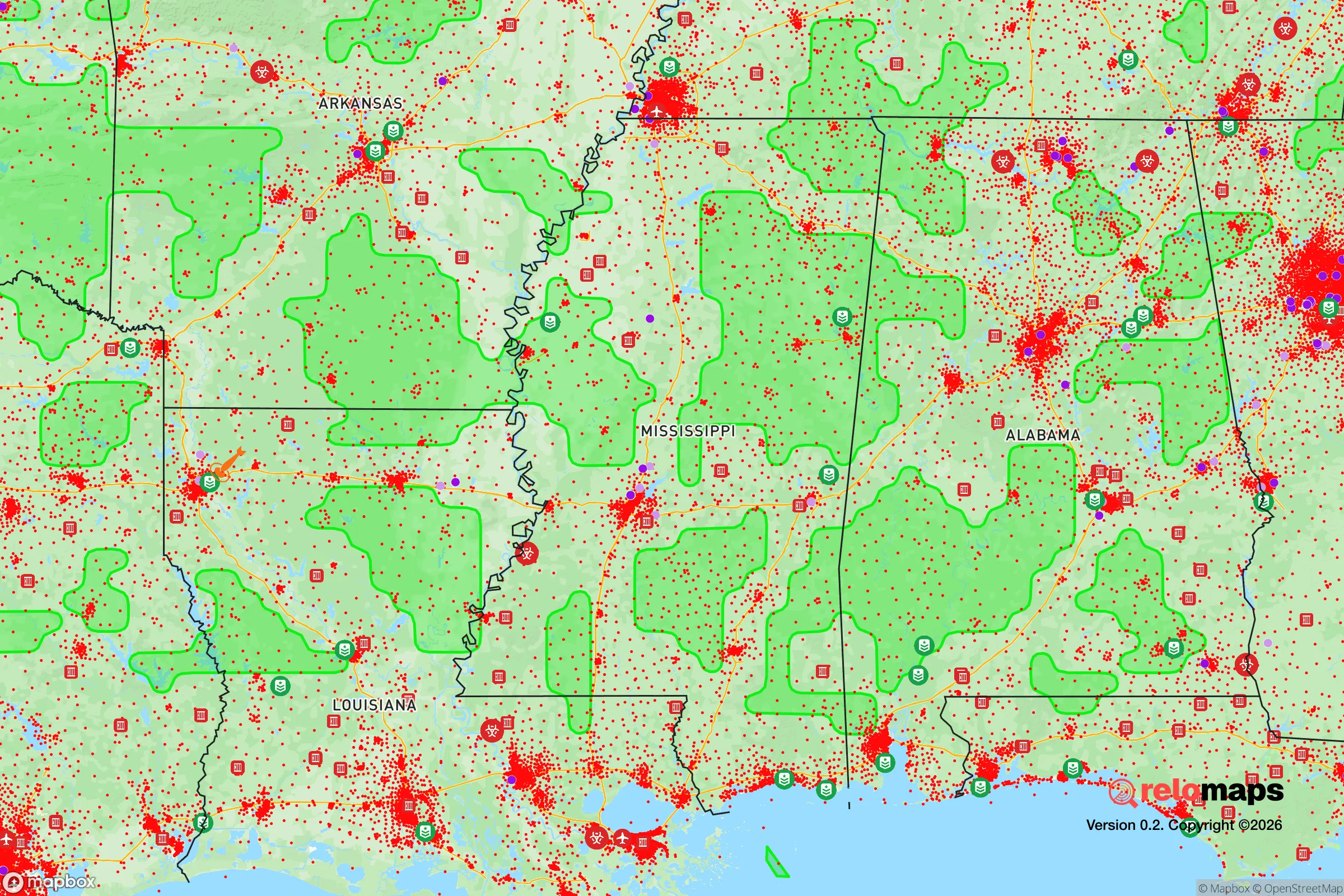
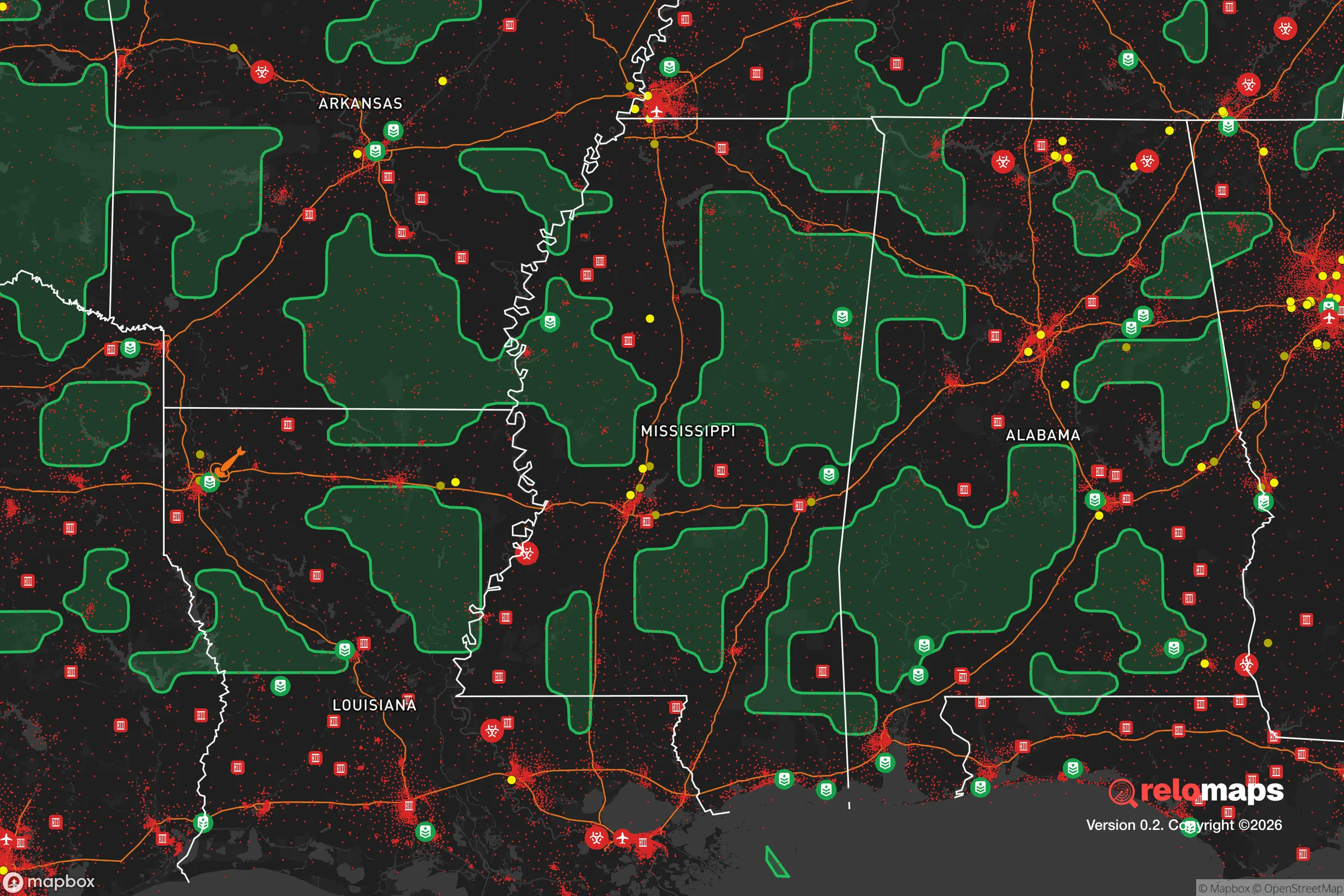


Important Note: For informational purposes only. This does not mean nothing bad ever happens in the green zones. Please use common sense. This is based on public data and modeled with AI. We tried to take a conservative approach but mistakes happen. We update this regularly as new information becomes available.
Solar Generator Recommendations
Backup power matters more here than in safer locations. We've picked three solar generators across budgets and capacity tiers — start with the budget unit if you only need a few essentials, or step up if you want to run a fridge and HVAC for days at a time.

Jackery Portable Power Station Explorer 300
Budget OptionPower on the Go: Weighing only 11 lbs, it's convenient to set up and store with book-sized foldable solar panels

BLUETTI Portable Power Station AC180
Designed for both indoor and outdoor scenarios, AC180 is highly capable as it has a robost capacity and continuous output power.

EF ECOFLOW DELTA Pro Ultra Power Station
Upgraded PickEcoFlow DELTA Pro Ultra is a whole-home energy system designed to grow with your family. Integrated with the Smart Home Panel 2, it scales to meet your evolving energy needs — keeping your home powered, intelligent, and secure through every stage of life.
We earn a commission, at no additional cost to you.
Strategic Assessment Analysis
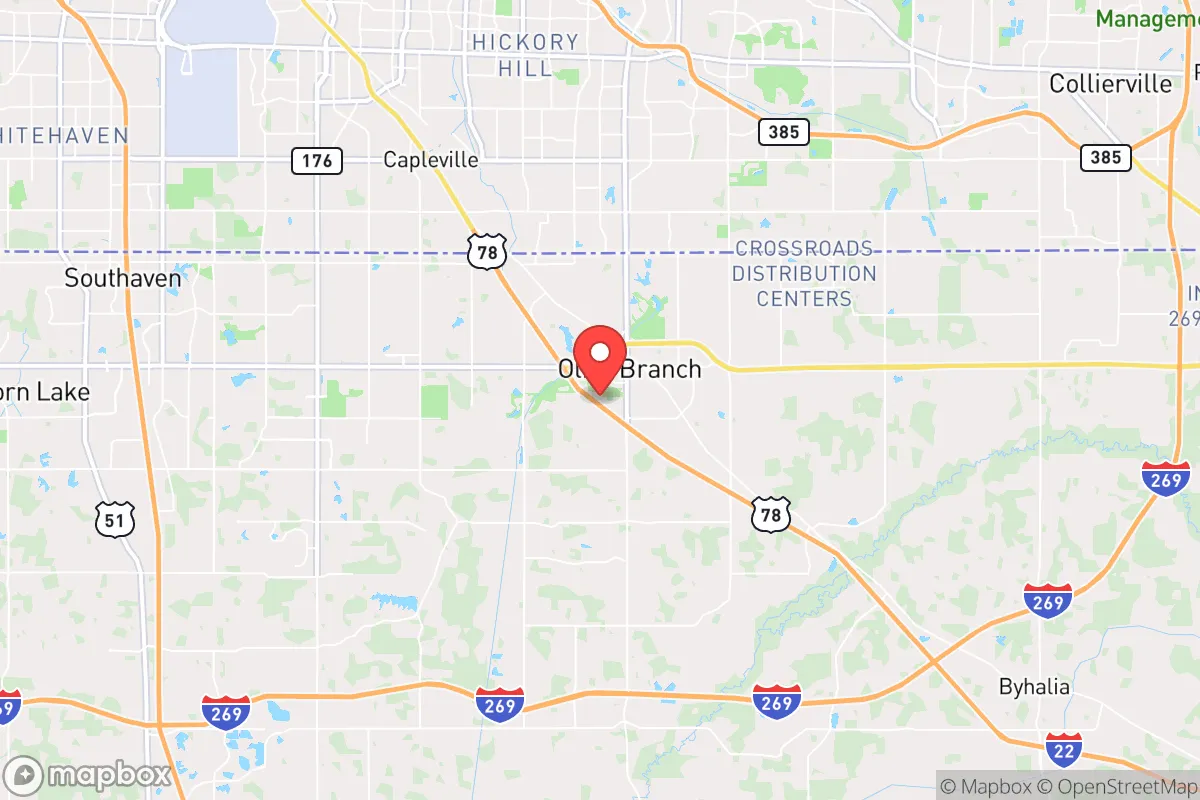
Olive Branch, Mississippi, sits in a strategic sweet spot that resilience-minded relocators should take seriously: far enough from Memphis to avoid the worst of urban collapse, yet close enough to monitor threats and access critical supplies. This DeSoto County suburb of roughly 40,000 offers a blend of suburban infrastructure and rural adjacency that makes it a viable base for those preparing for civic unrest, supply chain disruptions, or mass casualty events. Its position just south of the Tennessee state line puts it within the Memphis metro’s orbit, but its location in Mississippi—a state with looser regulations, lower taxes, and a more self-reliant culture—gives it a distinct edge for those who value preparedness over convenience.
Geographic position and natural advantages for long-term stability
Olive Branch’s geography is its first line of defense. Situated on the loess bluffs of the Mississippi Delta, the area sits above the flood-prone Mississippi River floodplain, reducing the risk of catastrophic flooding that plagues communities closer to the river. The terrain is gently rolling, with hardwood forests and agricultural land providing natural cover and resources. The climate is humid subtropical, with hot summers and mild winters—meaning no extreme cold snaps that could freeze pipes or halt transportation, but also no hurricane storm surge risk, as the Gulf Coast is over 200 miles south. The area’s natural water supply is robust: the Memphis Sand Aquifer, one of the largest and cleanest groundwater sources in the country, lies directly beneath Olive Branch. This aquifer supplies the entire region with high-quality drinking water, and for a prepper, that means a reliable, deep groundwater source that is less vulnerable to surface contamination than rivers or reservoirs. The local soil is fertile, supporting small-scale agriculture and gardening, which is a key consideration for long-term food security. The region’s relatively low population density—DeSoto County has about 190 people per square mile—means less competition for resources during a crisis compared to denser suburbs like Southaven or Horn Lake.
Risks, exposures, and proximity to fallout-relevant landmarks
No location is without vulnerabilities, and Olive Branch has several that a strategic relocator must weigh. The most obvious risk is its proximity to Memphis, Tennessee, a major urban center with a population of over 630,000. Memphis is a known hub for violent crime, with a homicide rate consistently among the highest in the nation—over 30 per 100,000 residents in recent years. In a scenario of civic unrest or mass casualty events, Memphis could become a source of dangerous population displacement, with people fleeing north or south along the I-55 and I-40 corridors. Olive Branch sits directly along the I-78/US-78 corridor, which connects to Memphis’s eastern suburbs, making it a likely route for evacuees. The city is also within 20 miles of the Memphis International Airport, a potential target for terrorism or military staging, and within 30 miles of the Memphis Defense Depot, a former military supply facility that could be a secondary target. Further out, the Tennessee Valley Authority’s nuclear plants—Browns Ferry in Alabama and Sequoyah in Tennessee—are roughly 150 miles away, placing Olive Branch outside the immediate fallout zone but within a plausible secondary contamination radius depending on wind patterns. The Mississippi River, while a vital waterway, is also a vector for disease and contamination during a breakdown of sanitation systems. Flooding along the river’s tributaries, like the Coldwater River which runs near Olive Branch, could isolate the area during heavy rains, cutting off road access to the north and west.
Practical resilience for a relocator: food, water, energy, and defensibility
For a relocator focused on self-sufficiency, Olive Branch offers a mix of advantages and trade-offs. Water is the strongest asset: the Memphis Sand Aquifer is accessible via private wells, and many homes in the outlying areas already have well water. Even municipal water users can tap into this resource with a hand pump or a deep-well bucket system, as the aquifer is only 200-400 feet deep in this area. The local soil supports vegetable gardens, and the growing season runs from April to October, allowing for two planting cycles. The area has a strong agricultural heritage, with nearby farms producing soybeans, corn, and cotton, plus livestock operations that could be bartered with or absorbed into a community network. Energy is a mixed bag: the grid is served by Entergy Mississippi, which has a decent reliability record but is vulnerable to ice storms and tornadoes—the region averages about 30 tornadoes per year, mostly EF0-EF2. Solar potential is moderate, with about 210 sunny days per year, but the humid climate means cloud cover can persist for days. A backup generator or off-grid solar setup with battery storage is advisable. Defensibility is where Olive Branch shows its suburban character: most neighborhoods are laid out in cul-de-sacs and subdivisions with limited entry points, which can be secured with roadblocks or neighborhood watch groups. However, the area is not rural enough to offer true isolation—there are too many roads, too many neighbors, and too much reliance on the I-78 corridor for supply lines. The best strategy is to buy property on the eastern edge of Olive Branch, closer to the unincorporated areas of DeSoto County or the Marshall County line, where lots are larger, trees are thicker, and the nearest highway is a county road rather than an interstate. The local gun culture is strong—Mississippi is a constitutional carry state with no permit required for concealed carry—and the sheriff’s office is known for being pro-Second Amendment, which matters for both self-defense and community security during a breakdown.
The overall strategic picture for Olive Branch is one of cautious optimism for the prepared relocator. It is not a bug-out location—it is too close to Memphis, too dependent on suburban infrastructure, and too flat to offer natural defensive terrain. But it is a solid base for those who want to maintain a normal life while building resilience, with access to clean water, fertile soil, and a like-minded community of conservative-leaning residents who value self-reliance. The key is to treat Olive Branch as a staging ground: establish a home with a well, solar panels, and a garden, build relationships with neighbors who share your mindset, and have a secondary retreat further south or east—perhaps in the hill country of northern Mississippi or Alabama—for when the Memphis metro becomes untenable. For a single individual or a family willing to put in the work, Olive Branch offers a low-cost, low-regulation environment where you can quietly prepare without drawing attention. Just keep your head down, your pantry stocked, and your eyes on the interstate.

* Values derived from national, state, county, city and local statistics and may differ in a specific area. Last updated: 2026-04-29T22:11:55.000Z
Narrative content on this page is AI-generated and may contain mistakes. Verify any details that matter before acting on them.
ReloMaps may earn a commission from affiliate links at no extra cost to you.

