Photo: Wikipedia
Demographics of Opelika, AL
Affluence Level in Opelika, AL
A middle-class area roughly in line with national averages across income, home values, education, and employment.
People of Opelika, AL
Opelika, Alabama, is a city of roughly 31,944 residents where no single racial or ethnic group holds an absolute majority, with White residents at 50.3% and Black residents at 36.4%. The city’s population is notably less diverse than the national average in foreign-born share (3.4% versus 13.7% nationally) and has a college attainment rate of 33.5%, slightly above the state average but below the national figure. Distinctively, Opelika blends small-town Southern identity with a growing industrial and logistics base, creating a community that is historically rooted yet increasingly shaped by domestic in-migration from other parts of Alabama and the Southeast.
How the city was settled and grew
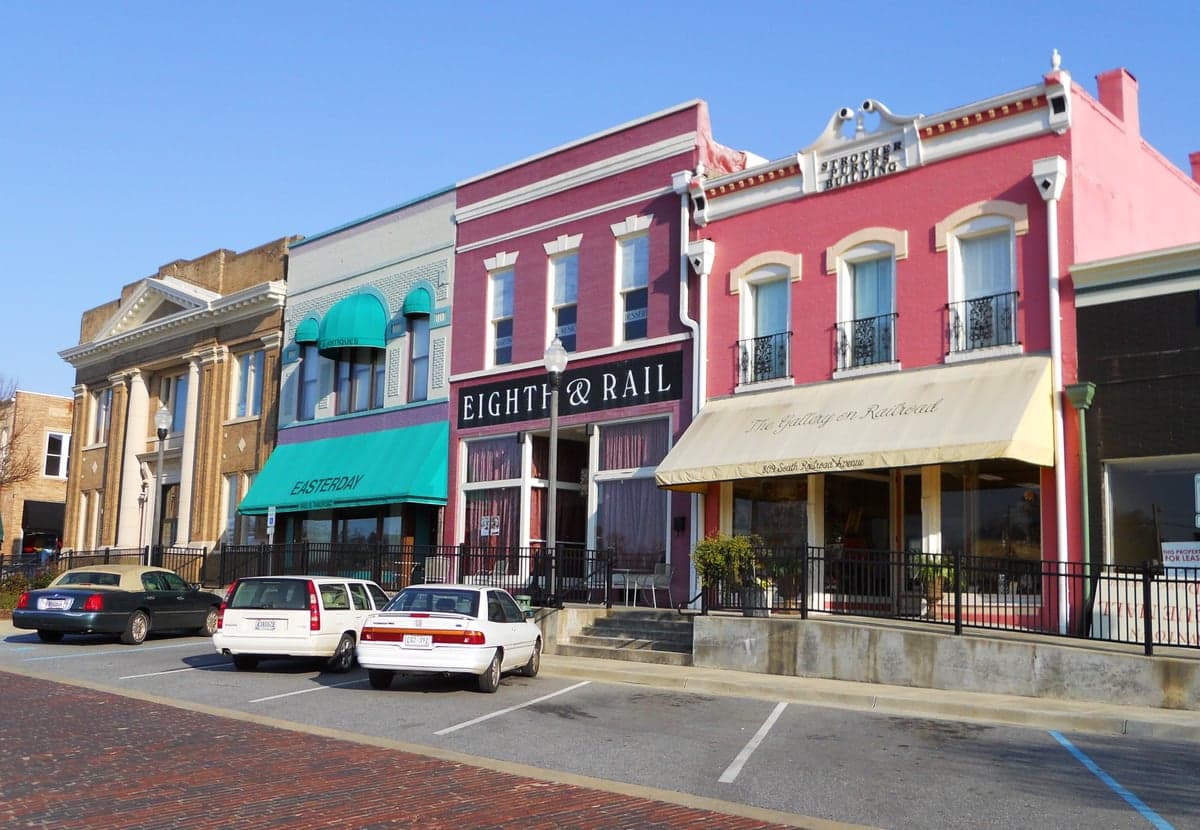
Opelika’s founding population was driven by the railroad boom of the 1840s and 1850s. The city was incorporated in 1854 as a depot town on the Montgomery & West Point Railroad, drawing Anglo-American settlers from Georgia and the Carolinas who established cotton plantations and mercantile businesses. The original residential core, now known as Historic Downtown Opelika, was built by these early merchants and railroad workers, with brick storefronts and modest frame houses. After the Civil War, the city’s economy shifted to textile manufacturing, and by the early 1900s, mills like the Opelika Cotton Mill attracted a wave of rural White families from surrounding Lee and Chambers counties. These workers settled in Mill Village neighborhoods such as Northside and Westside, where company-owned houses lined grid streets. The Black population, which had been present since slavery, grew during Reconstruction as freedmen moved to town for work; they concentrated in Jeter Hill and Southside, areas that remain predominantly Black today. By 1950, Opelika’s population was roughly 60% White and 40% Black, a ratio that held steady through the mid-century.
Modern era (post-1965)
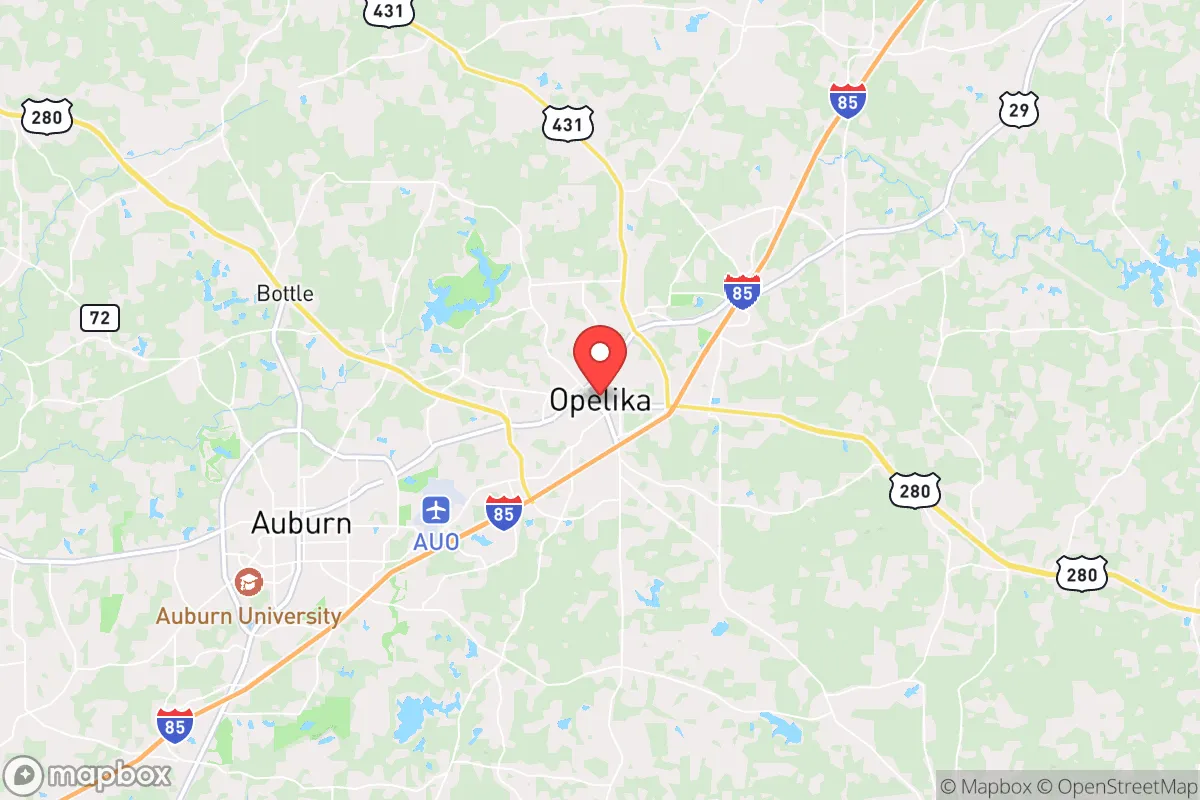
After the 1965 Hart-Cellar Act, Opelika saw minimal international immigration compared to larger Southern cities. The foreign-born population remains low at 3.4%, with the largest groups being Hispanic (9.7% of total population) and East/Southeast Asian (1.5%), primarily Vietnamese and Korean families who arrived in the 1980s and 1990s to work in manufacturing plants like the WestPoint Stevens mill. These newer residents settled in West Opelika, near the industrial corridor along US-280, and in the Fox Run subdivision, a middle-class development built in the 1990s. The Indian subcontinent population is negligible at 0.2%, reflecting the absence of a tech or medical anchor employer that would draw that group. Domestic in-migration accelerated after 2000, driven by the expansion of the Kia Motors plant in nearby West Point, Georgia, and the growth of Auburn University (just 10 miles east). This brought a wave of White and Black professionals from the Northeast and Midwest, who settled in newer subdivisions like Grand National and Saunders Estates. The Black population share has declined slightly from 40% in 1970 to 36.4% today, as White in-migration outpaced Black growth, while the Hispanic share rose from under 2% in 1990 to 9.7% in 2024, concentrated in service and construction jobs.
The future
Opelika’s population is trending toward greater diversity, but the pace is slow. The Hispanic share is projected to reach 12-14% by 2035, driven by natural increase and continued labor demand in logistics and manufacturing, with new arrivals likely settling in West Opelika and along the US-280 corridor. The East/Southeast Asian community is plateauing, as second-generation families often move to larger metros like Atlanta for professional opportunities. The White and Black populations are both aging, with younger families drawn to Auburn’s amenities rather than Opelika’s older neighborhoods. The city is not tribalizing into stark enclaves—most subdivisions are mixed—but Jeter Hill and Southside remain predominantly Black, while Grand National and Saunders Estates are over 80% White. The next decade will likely see Opelika become slightly more Hispanic and slightly less Black, with the White share holding near 50% as domestic in-migration from the Rust Belt continues.
For someone moving in now, Opelika is a moderately diverse, majority-minority city in transition—still predominantly native-born and Southern in character, but with a growing Hispanic workforce and a stable Black middle class. The lack of a large foreign-born population means less cultural friction than in coastal cities, but also fewer ethnic amenities. The city is becoming more suburban and less industrial, with new residents drawn by affordability and proximity to Auburn rather than by historic mill jobs. It is a place where demographic change is gradual, not disruptive, and where newcomers can expect a community that is politically conservative, family-oriented, and increasingly diverse in its younger cohorts.

* Values derived from national, state, county, city and local statistics and may differ in a specific area. Last updated: 2026-04-19T19:03:01.000Z
Narrative content on this page is AI-generated and may contain mistakes. Verify any details that matter before acting on them.
ReloMaps may earn a commission from affiliate links at no extra cost to you.

