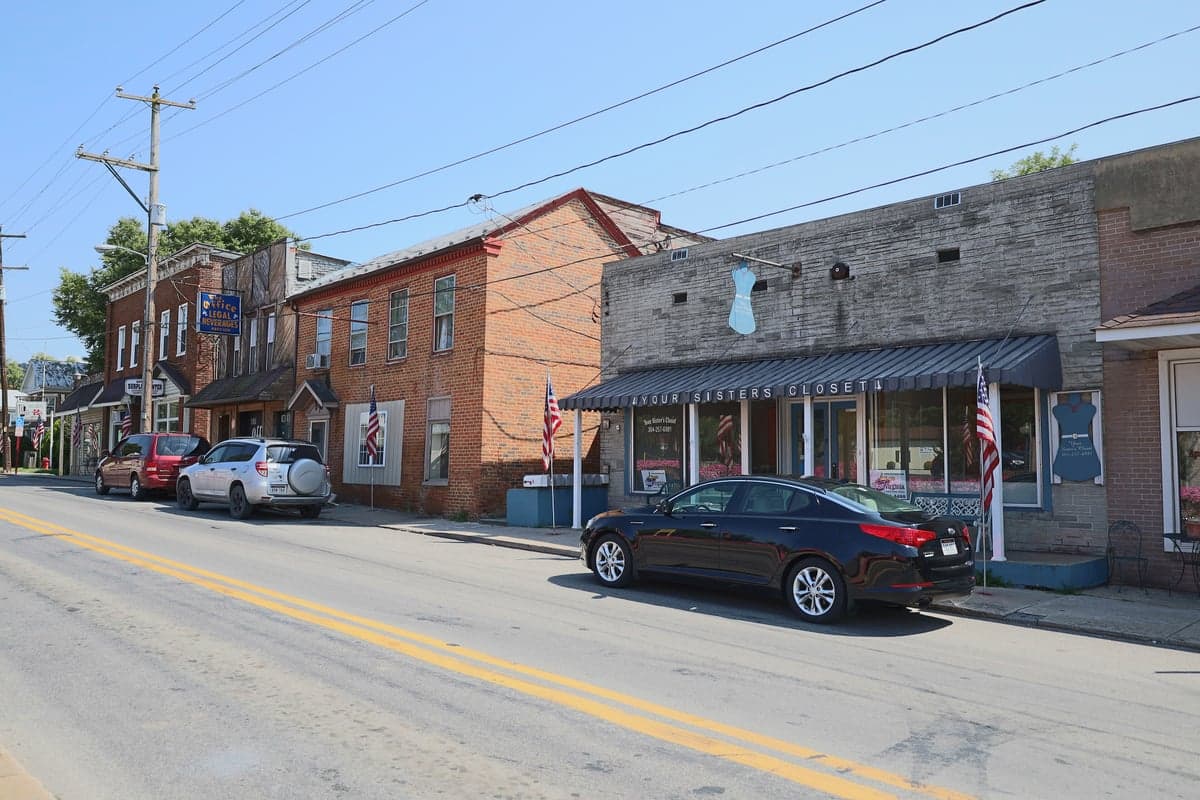
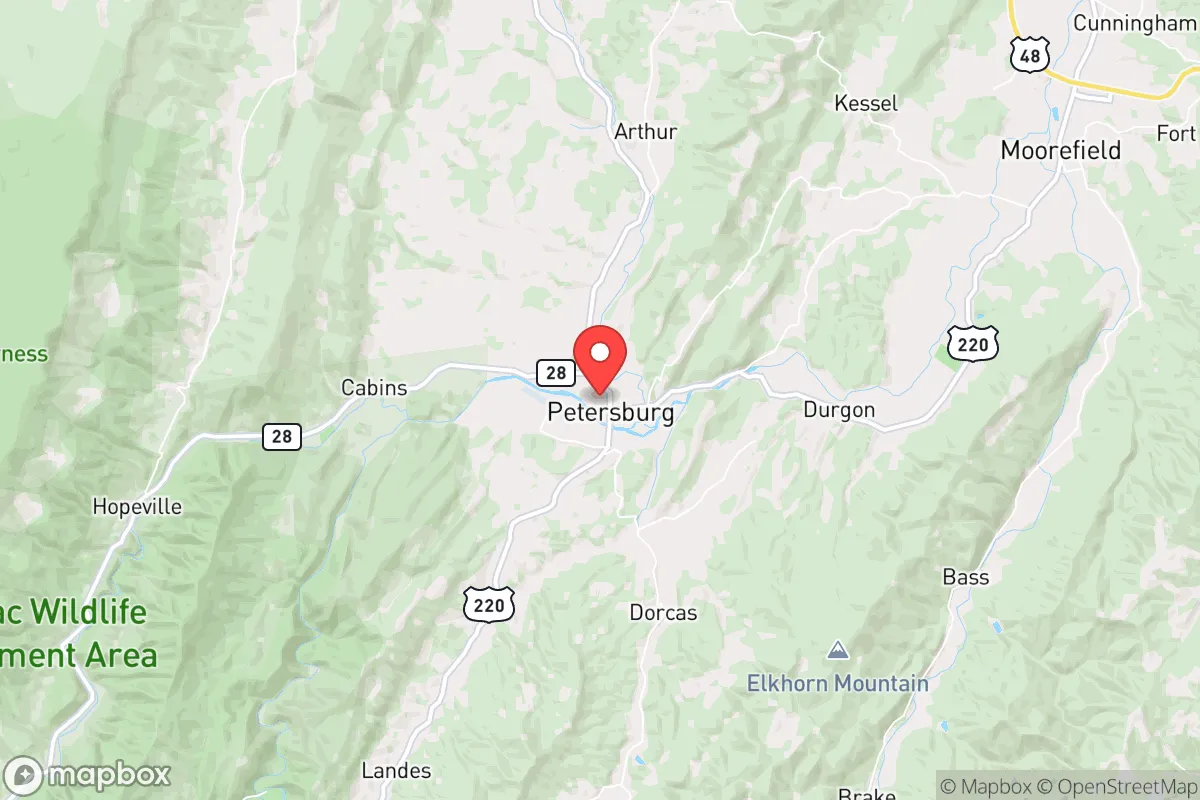
Photo: Wikipedia
Demographics of Petersburg, WV
Affluence Level in Petersburg, WV
A below-average socioeconomic profile. Incomes, home values, and educational attainment trail the U.S., with higher poverty and unemployment.
People of Petersburg, WV
The people of Petersburg, West Virginia, today form a small, tightly-knit community of roughly 3,172 residents, characterized by its overwhelming racial homogeneity and deep local roots. With a population that is 93.8% White and a foreign-born share of just 0.1%, the city stands as one of the least diverse in the state, a direct reflection of its isolated Appalachian geography and limited economic draw for newcomers. The city’s identity is distinctly rural and working-class, with a college attainment rate of 23.7% and a strong sense of place centered on family, church, and outdoor recreation along the South Branch Potomac River.
How the city was settled and grew
Petersburg’s human history begins with the Seneca and Shawnee peoples who used the South Branch Valley as hunting grounds, but permanent European settlement did not take hold until after the French and Indian War. The town was formally laid out in 1795 by Jacob Peterson, a German-descended settler who operated a mill on the river, and was named Petersburg in his honor. The original population was overwhelmingly of English, Scots-Irish, and German stock, drawn by land grants awarded to veterans of the Revolutionary War and the promise of fertile bottomland. These early families built the core of what is now Old Town Petersburg, the historic district centered on Main Street and Virginia Avenue, where many 19th-century homes and churches still stand. The arrival of the South Branch Valley Railroad in the 1880s spurred a second wave of growth, bringing Irish and Italian laborers who settled in the Railroad Addition neighborhood, just south of the tracks, where their descendants remain a visible part of the community today. By 1900, the population had reached roughly 800, and the town’s economy revolved around timber, tanning, and apple orchards.
Modern era (post-1965)
Following the 1965 Hart-Cellar Act, Petersburg experienced virtually no immigration-driven diversification, a pattern consistent with its remote location and lack of large-scale industry. The foreign-born population remains at 0.1%, and the Asian (East/Southeast Asian) and Indian-subcontinent populations are both at 0.0%. The Hispanic share, at 1.7%, is almost entirely accounted for by a small number of migrant farmworkers who pass through seasonally for apple harvests but do not settle permanently. The Black population, at 0.6%, has remained static since the 1970s. Domestic in-migration has been minimal, with most new residents being retirees or remote workers from the Washington, D.C., and Northern Virginia metro areas seeking lower housing costs. These newcomers have gravitated toward the Riverview Estates subdivision, a newer development on the western edge of town, and the Smoke Hole Road corridor, which offers larger lots and mountain views. Meanwhile, younger native-born residents have increasingly left for employment in the Eastern Panhandle or beyond, contributing to a gradual aging of the population.
The future
Petersburg’s demographic trajectory points toward continued homogenization and slow population decline. The city is not tribalizing into distinct ethnic enclaves—there are simply too few non-White residents for that pattern to emerge. Instead, the trend is one of generational thinning: the remaining young families are concentrated in the Petersburg Heights area near the high school, while the Downtown Historic District is increasingly home to older, long-term residents. The Hispanic share may grow slightly as apple and poultry operations expand, but it is unlikely to exceed 3-5% in the next decade. The foreign-born population will likely remain below 1%, and the White share will stay above 90%. The most significant demographic shift will be the continued out-migration of 18- to 35-year-olds, which will further skew the median age upward and reduce the school-age population.
For someone moving in now, Petersburg is becoming a quieter, older, and more insular place—a community where nearly everyone shares a similar background and where newcomers are expected to adapt to established local norms. The city offers stability and safety, but little demographic dynamism or cultural diversity. Those seeking a tight-knit, racially homogeneous rural environment will find it here; those looking for a growing or diversifying community will need to look elsewhere in the Potomac Highlands.

* Values derived from national, state, county, city and local statistics and may differ in a specific area. Last updated: 2026-05-01T08:02:59.000Z
Narrative content on this page is AI-generated and may contain mistakes. Verify any details that matter before acting on them.
ReloMaps may earn a commission from affiliate links at no extra cost to you.

