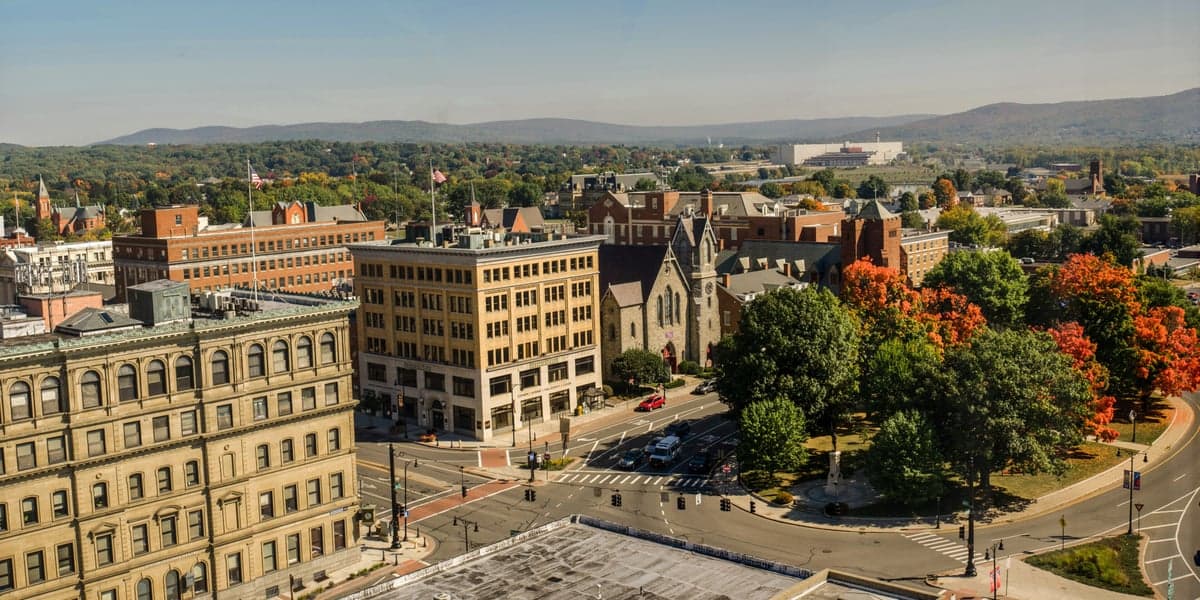
Photo: Wikipedia
Personal Sovereignty in Pittsfield, MA
Moderate friction. Expect trade-offs in some aspect of personal liberty and independence.
What does Personal Sovereignty tell us?
Personal Sovereignty measures your capacity for self-reliance and independence with minimal government friction. Higher scores mean fewer barriers between you and the way you want to live... but it assumes you have the space you need and good neighbors.
What does this tell us?
Personal Sovereignty measures your capacity for self-reliance and independence with minimal government friction. Higher scores mean fewer barriers between you and the way you want to live... but it assumes you have the space you need and good neighbors.
State Policy
Energy independence: Importer (5% of energy produced in-state)
Personal Liberty
Homesteading

Personal Liberty Analysis
For a conservative-leaning individual or family evaluating Pittsfield, Massachusetts, as a relocation destination, the concept of personal sovereignty requires a sober, data-driven assessment. The Berkshires offer a beautiful, rural landscape that appeals to self-reliance, but the state-level legal and regulatory environment imposes significant constraints on individual autonomy. Pittsfield sits at the intersection of a high-tax, heavily regulated state and a region with some potential for off-grid living, creating a complex trade-off for those prioritizing freedom from government overreach. The core reality is that while the local geography supports a degree of physical separation, the Commonwealth’s policies on taxation, self-defense, and personal liberties create a challenging environment for those seeking maximum personal sovereignty.
Tax burden and regulatory posture: The cost of living free in the Berkshires
Massachusetts is a high-tax state, and Pittsfield residents feel this acutely. The state imposes a flat 5.0% income tax on all earned income, with no standard deduction for most filers, meaning every dollar earned is taxed. Property taxes in Pittsfield are a major factor, with an effective rate around 1.5% of assessed home value, which on a median home price of roughly $250,000 translates to an annual bill of about $3,750. This is not extreme by Massachusetts standards, but it is a fixed cost that erodes disposable income. The state’s regulatory posture is equally burdensome. Massachusetts has a strict building code and environmental regulations that make even minor home improvements subject to permitting and inspection. For a prepper or homesteader, this means that adding a shed, installing a rainwater catchment system, or building a root cellar can trigger bureaucratic hurdles. The state’s energy policies, including the push for net-zero emissions, are driving up utility costs and limiting options for off-grid energy independence without extensive paperwork. The overall tax and regulatory climate in Pittsfield is one of high compliance costs and limited fiscal autonomy, a significant consideration for anyone seeking to minimize government intrusion into their financial life.
Self-defense and gun law specifics: Navigating a restrictive firearms environment
For those who view the Second Amendment as a cornerstone of personal sovereignty, Massachusetts presents a formidable challenge. The state has some of the strictest gun laws in the nation, including a requirement for a License to Carry (LTC) for any handgun possession, whether open or concealed. The LTC process in Berkshire County is administered by local police chiefs, who have significant discretion. In Pittsfield, the process is generally professional but can be slow, often taking 90 to 120 days for approval. The state also bans so-called "assault weapons" by feature, and the attorney general’s office has aggressively interpreted this ban to include many common semi-automatic rifles. Magazine capacity is limited to 10 rounds for rifles and 10 rounds for handguns. There is no "Shall Issue" standard; it is a "May Issue" system, meaning a chief can deny a license for "suitability" reasons, a vague standard that can be used to deny permits to those with no criminal record. For a survivalist, this means that building a meaningful defensive firearms capability is legally difficult, expensive, and subject to the whims of local officials. The state also has a red flag law (ERPO) that allows for the temporary seizure of firearms based on a complaint, a tool that many conservatives view as a threat to due process. In short, Pittsfield is not a location for those who prioritize unimpeded access to firearms for self-defense.
Self-reliance and homesteading viability: Lot sizes, zoning, and off-grid feasibility
The physical landscape around Pittsfield offers genuine potential for self-reliance, but it is constrained by local zoning and state environmental law. Many residential lots in the city limits are small, typically 0.25 to 0.5 acres, which limits large-scale gardening or livestock. However, the surrounding towns of Lanesborough, Dalton, and Richmond offer properties with 2 to 10+ acres at prices significantly lower than eastern Massachusetts. Zoning in these rural areas generally allows for backyard chickens, small livestock (goats, sheep), and substantial vegetable gardens, but you must check each town’s bylaws. The critical issue for off-grid living is water and waste. Massachusetts has strict Title 5 septic regulations, and any new construction or major renovation requires a percolation test and a state-approved septic system, which can cost $15,000 to $30,000. Rainwater collection for potable use is technically legal but heavily regulated by the Department of Environmental Protection, requiring permits and treatment systems. Solar panels are permitted, but net-metering rules are complex, and going fully off-grid (disconnecting from the grid) is practically impossible for a standard residence due to building codes that require a grid connection. The growing season is short (roughly 120-150 days), limiting year-round food production without a greenhouse. For a prepper, the area offers good land availability and a rural feel, but the regulatory framework makes true independence a bureaucratic and financial struggle.
Personal liberties: Parental rights, medical autonomy, speech, and property
On the spectrum of personal liberties, Massachusetts leans heavily toward state authority over individual choice. Parental rights are a flashpoint. The state has a mandatory vaccination schedule for school attendance, with limited religious exemptions and no philosophical exemptions. The Department of Children and Families (DCF) has broad authority to investigate families, and reports of educational neglect or medical neglect can trigger state intervention. Homeschooling is legal but requires annual approval from the local school superintendent, who can demand curriculum plans and progress reports, a level of oversight many conservatives find intrusive. Medical autonomy is similarly constrained. Massachusetts has a state-level individual mandate for health insurance, and the state actively promotes public health directives. During the COVID-19 pandemic, the state imposed some of the nation’s longest-lasting emergency orders. For those skeptical of government health mandates, this is a significant red flag. Free speech is generally protected, but the state has a strong anti-discrimination law (Chapter 151B) that can be used to penalize speech deemed harassing or discriminatory, creating a chilling effect for those with traditional views on social issues. Property rights are also limited. The state has a robust "Chapter 40B" law that allows developers to override local zoning for affordable housing projects, and the Wetlands Protection Act gives state agencies authority over land use on private property. Eminent domain is used for infrastructure projects, and property owners have limited recourse. In sum, Pittsfield offers a beautiful setting, but the legal framework consistently prioritizes state authority over individual sovereignty in education, health, speech, and property.
Overall, Pittsfield presents a paradox for the conservative relocation seeker. The physical environment—the mountains, the forests, the rural towns—offers a genuine escape from urban density and a foundation for a self-reliant lifestyle. However, the state-level legal and regulatory architecture is fundamentally at odds with a high-sovereignty worldview. The tax burden is heavy, gun laws are restrictive, off-grid living is bureaucratically difficult, and personal liberties in parenting, medicine, and property are subject to significant state oversight. Compared to states like New Hampshire, Texas, or Idaho, Pittsfield scores poorly on nearly every metric of personal sovereignty. For a survivalist or prepper, the best strategy here would be to treat Pittsfield as a base of operations in a beautiful, low-crime area, but to recognize that true independence will require constant vigilance against state overreach, and that the legal environment will never fully support the level of autonomy many conservatives seek. It is a location for those who value the land but are willing to fight for their freedoms within a system that does not grant them easily.

* Values derived from national, state, county, city and local statistics and may differ in a specific area. Last updated: 2026-04-24T08:07:05.000Z
Narrative content on this page is AI-generated and may contain mistakes. Verify any details that matter before acting on them.
ReloMaps may earn a commission from affiliate links at no extra cost to you.

