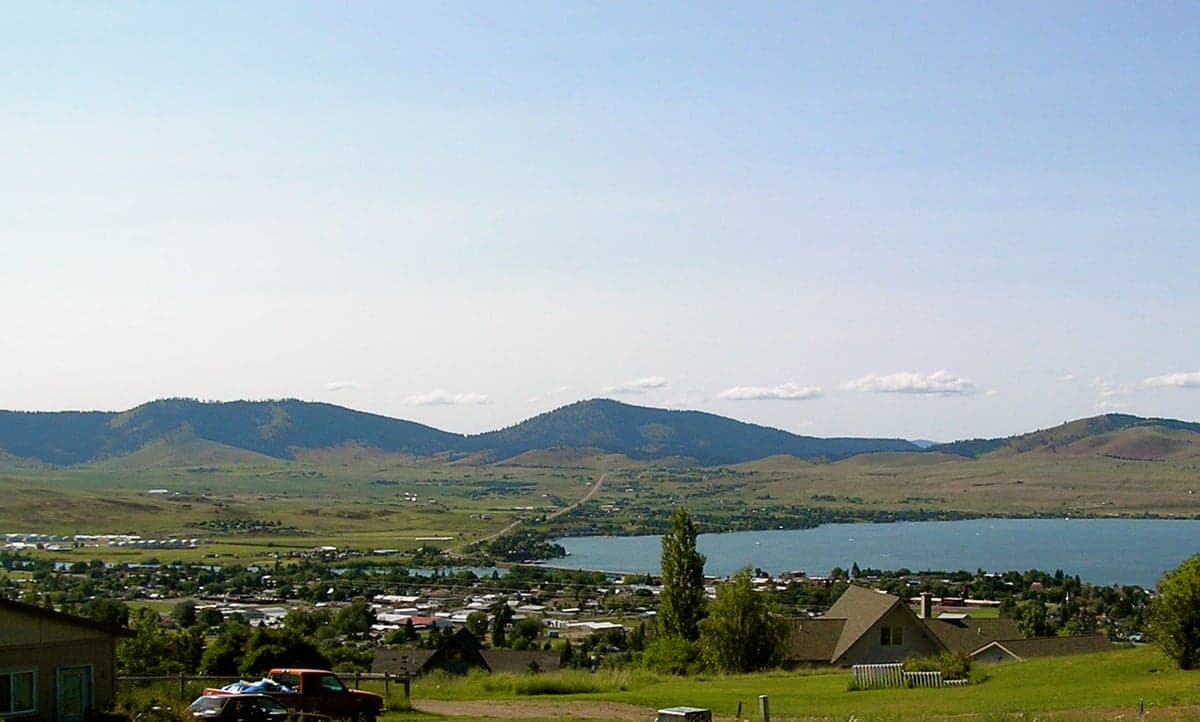
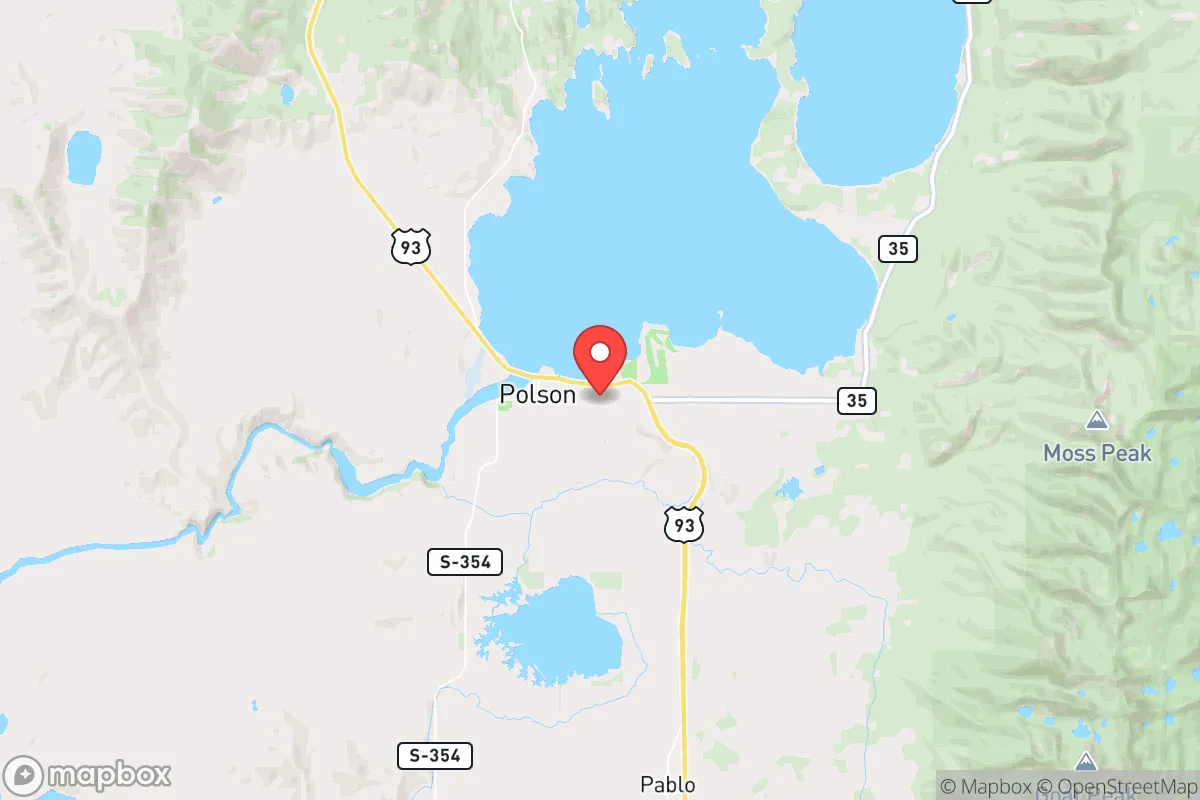
Photo: Wikipedia
Demographics of Polson, MT
Affluence Level in Polson, MT
A middle-class area roughly in line with national averages across income, home values, education, and employment.
People of Polson, MT
The people of Polson, Montana, today number 5,334, forming a community that is predominantly white (59.6%) with a notable Hispanic minority (7.3%) and a small but established Native American presence tied to the adjacent Flathead Indian Reservation. The city’s character is shaped by its lakeside setting on Flathead Lake, a working-class economy rooted in tourism and agriculture, and a politically conservative, family-oriented culture. Distinctive identity markers include a strong sense of local independence, a visible tribal government influence, and a population density of roughly 1,200 people per square mile—compact enough for neighborly familiarity but spread across several distinct residential pockets.
How the city was settled and grew
Polson’s human history begins with the Salish and Kootenai peoples, who inhabited the Flathead Lake region for centuries before European contact. The city itself was formally founded in 1910, after the construction of the Kerr Dam (now Séliš Ksanka Qlispe’ Dam) on the Flathead River, which drew workers and merchants. The original white settlers were primarily homesteaders of Northern European stock—German, Norwegian, and Irish—who arrived via the Great Northern Railway, which reached the area in the 1890s. These early families built the Historic Polson District around Main Street, a grid of modest wood-frame homes and brick storefronts that still anchors the downtown. A second wave came during the 1930s and 1940s, when the dam’s expansion and the growth of cherry orchards along the lake’s east shore attracted seasonal farm laborers, many of whom were Italian and Yugoslavian immigrants. These workers settled in the Cherry Valley neighborhood, a stretch of small homes and orchards east of town that remains a distinct, agricultural-flavored enclave. By 1950, Polson’s population had reached roughly 2,000, with a near-total white majority and a small but persistent Native American community living in the Mission Valley area south of the city, on reservation land.
Modern era (post-1965)
The 1965 Hart-Cellar Act had minimal direct impact on Polson, as the city’s foreign-born population today is just 2.1%—far below the national average. Instead, the post-1965 era was defined by domestic in-migration. Beginning in the 1970s, retirees and second-home buyers from California and the Pacific Northwest discovered Polson’s low cost of living and lake access, spurring suburban-style development. These newcomers, predominantly white and middle-class, built homes in the Skyline Drive area, a hillside neighborhood west of downtown offering panoramic lake views and larger lots. Simultaneously, the Hispanic population began to grow, driven by agricultural labor demand in the cherry orchards and nearby potato farms. Many of these families settled in the South Shore area, a lower-cost, unincorporated stretch along Highway 93 south of the city, where mobile homes and modest single-family houses predominate. The Native American population, while not captured in the city’s 2.1% foreign-born figure, is a significant presence: the Confederated Salish and Kootenai Tribes (CSKT) operate the KwaTaqNuk Resort and Casino on the lakefront, and tribal members live both within Polson’s city limits and in the adjacent Pablo and Ronan communities. The city’s racial composition today—59.6% white, 7.3% Hispanic, 0.4% Black, 0.4% Indian (subcontinent), and 0.0% East/Southeast Asian—reflects a community that has remained overwhelmingly white and native-born, with the Hispanic share growing steadily from near-zero in 1980 to its current level.
The future
Polson’s population is heading toward slow, steady growth, likely reaching 6,000–6,500 by 2040, driven by continued domestic migration from high-cost Western states and natural increase among the Hispanic community. The city is not tribalizing into distinct enclaves—neighborhoods remain relatively integrated by income and ethnicity—but the Hispanic population is concentrating in the South Shore and Cherry Valley areas, while white retirees and remote workers favor Skyline Drive and the newer Lake View Estates subdivision east of town. The Indian (subcontinent) community, at 0.4%, is a tiny but stable presence, likely tied to medical professionals at the nearby St. Joseph’s Hospital in Polson or the tribal health clinic. The East/Southeast Asian population is effectively zero, and no significant growth is expected given the lack of tech or manufacturing employers that typically attract such groups. The Native American population is expected to remain steady or grow slightly, as CSKT continues to invest in housing and economic development on the reservation. Over the next 10–20 years, Polson will likely homogenize further in terms of race—white and Hispanic will remain the dominant groups—but will see a modest increase in political and cultural diversity as more out-of-state transplants arrive.
For someone moving in now, Polson is becoming a place where the old-guard white working class, a growing Hispanic agricultural workforce, and a small but influential tribal community coexist under a broadly conservative, family-oriented culture. The city offers a stable, low-crime environment with a strong sense of place, but newcomers should expect limited racial diversity and a social fabric that values self-reliance over institutional change. It is a good fit for those seeking a quiet, lake-centered life in a politically red area, but less so for those seeking a multicultural or fast-growing urban environment.

* Values derived from national, state, county, city and local statistics and may differ in a specific area. Last updated: 2026-04-29T23:39:16.000Z
Narrative content on this page is AI-generated and may contain mistakes. Verify any details that matter before acting on them.
ReloMaps may earn a commission from affiliate links at no extra cost to you.

