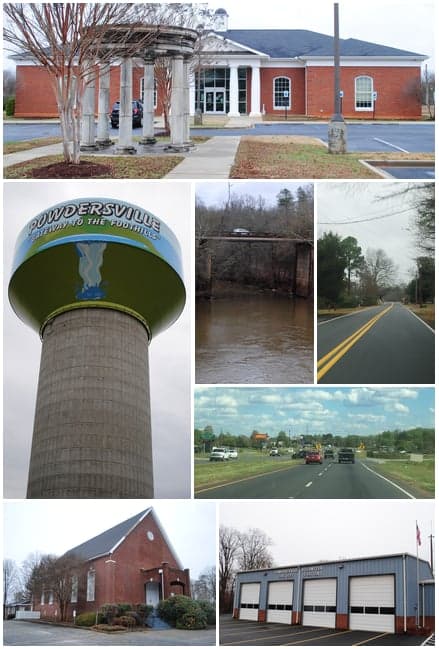
Photo: Wikipedia
Demographics of Powdersville, SC
Historical data isn't available for Powdersville, SC. Trends shown are for Anderson County, SC.
Affluence Level in Powdersville, SC
An upper-middle-class area. Household wealth, education levels, and homeownership run ahead of national benchmarks.
People of Powdersville, SC
Today, Powdersville, South Carolina is a rapidly growing unincorporated community of 11,321 residents that blends small-town Southern character with suburban expansion. The population is predominantly white (78.8%), with a notable Black community (10.6%) and a small but growing Hispanic presence (4.3%). A third of adults hold a college degree (33.6%), reflecting an upwardly mobile, family-oriented population that values proximity to Greenville without its urban pace.
How the city was settled and grew
Powdersville’s early history is rooted in the post-Civil War era, when the area was sparsely settled by yeoman farmers and sharecroppers working the rolling Piedmont hills. The community takes its name from the Powdersville post office, established in the 1880s, and its early economy revolved around cotton farming and small grist mills along the Saluda River. The original population was almost entirely white and Black families of Scots-Irish and African American descent, who built modest homesteads along what is now Highway 81. The historic core around Old Powdersville Road remains the community’s oldest settled area, where descendants of these early farming families still live in century-old farmhouses and newer subdivisions. A second early node was the area near the Saluda River bridge, where a general store and blacksmith shop served as a gathering point for the scattered rural population. By the mid-20th century, Powdersville remained a quiet crossroads community of fewer than 500 residents, with no significant industrial or railroad development to drive growth.
Modern era (post-1965)
The 1965 Hart-Cellar Act had little direct effect on Powdersville, as the community remained overwhelmingly native-born (foreign-born residents today are just 2.6%). Instead, the modern era began in the 1990s and accelerated after 2000, when Greenville’s suburban sprawl pushed south and west along the I-85 corridor. The construction of the Powdersville Road widening project and the extension of water and sewer lines triggered a wave of domestic in-migration, primarily white families from Greenville and Anderson counties seeking larger lots and newer homes. The Wrenwood subdivision, built in the late 1990s, became the first major planned community, attracting young families with its affordable starter homes and proximity to Wren schools. Riverwalk at the Saluda, developed in the 2000s, drew more affluent buyers with its riverfront lots and custom homes. The Black population, which had historically lived in scattered rural pockets along Highway 81 and the area around Wren Elementary, began to concentrate in established neighborhoods like Powdersville Heights, a mid-century subdivision that saw reinvestment as the community grew. The Hispanic population, though small at 4.3%, began to settle in the 2010s, primarily in rental duplexes and apartments along Highway 81 near the Anderson County line, drawn by construction and landscaping jobs in the booming Greenville metro. East/Southeast Asian residents (0.6%) and Indian-subcontinent residents (1.1%) are a very recent addition, mostly professionals working in Greenville’s manufacturing and tech sectors who chose Powdersville for its schools and lower home prices.
The future
Powdersville’s population is projected to continue growing at a steady clip, driven by Greenville’s ongoing expansion and the community’s reputation for strong schools (Wren High School consistently ranks among the state’s top 50). The population is becoming slightly more diverse, with Hispanic and Asian shares expected to rise as the Greenville metro attracts more immigrant professionals and service workers. New subdivisions like The Reserve at Powdersville and The Cottages at Saluda River are targeting young families and retirees, while the planned Powdersville Town Center along Highway 81 aims to create a walkable commercial core that the community has always lacked. The cultural identity is likely to remain predominantly white and Southern, but with a growing suburban character that emphasizes schools, churches, and youth sports over the old rural traditions. The next 10-20 years will likely see Powdersville become a more integrated bedroom community of Greenville, with its diversity increasing gradually but remaining below the national average.
For someone moving in now, Powdersville offers a stable, family-oriented environment with strong schools and a conservative-leaning social fabric. The community is becoming more suburban and slightly more diverse, but its core identity as a safe, affordable, and predominantly white Southern suburb is unlikely to shift dramatically in the near term. New residents should expect a place where newcomers are welcomed but where the old rural roots still shape the pace and character of daily life.

* Values derived from national, state, county, city and local statistics and may differ in a specific area. Last updated: 2026-08-11T13:03:14.000Z
Narrative content on this page is AI-generated and may contain mistakes. Verify any details that matter before acting on them.
ReloMaps may earn a commission from affiliate links at no extra cost to you.

