
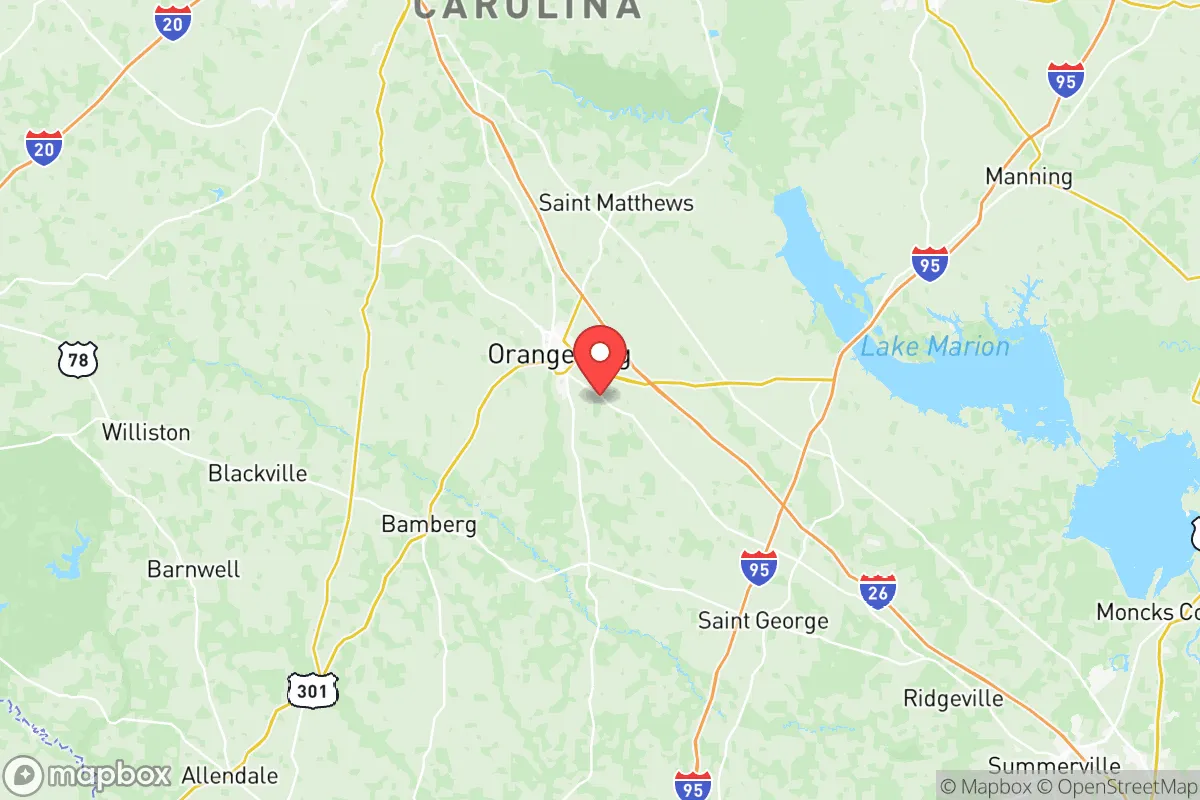
Photo: Wikipedia
Personal Sovereignty in Orangeburg County
Viable for self-reliance. Generally workable, though some barriers may limit total independence.
What does Personal Sovereignty tell us?
Personal Sovereignty measures your capacity for self-reliance and independence with minimal government friction. Higher scores mean fewer barriers between you and the way you want to live... but it assumes you have the space you need and good neighbors.
What does this tell us?
Personal Sovereignty measures your capacity for self-reliance and independence with minimal government friction. Higher scores mean fewer barriers between you and the way you want to live... but it assumes you have the space you need and good neighbors.
State Policy
Energy independence: Importer (25% of energy produced in-state)
Personal Liberty
Homesteading

Personal Liberty Analysis
Orangeburg County, South Carolina, offers a notably high degree of personal sovereignty relative to many other parts of the Southeast, particularly for those who value a light-touch regulatory environment and a culture of self-reliance. The county’s political and legal framework is shaped by South Carolina’s strong state-level preemption laws, which limit local government overreach in areas like firearms, land use, and taxation. For a single individual or family prioritizing autonomy, the area presents a practical balance of low taxes, permissive gun laws, and viable homesteading opportunities, though the degree of freedom varies between the more rural townships and the county seat of Orangeburg itself.
Tax burden and regulatory posture in Orangeburg County
South Carolina’s tax structure is generally favorable for those seeking to keep more of their earnings, and Orangeburg County aligns with this posture. The state’s income tax is a flat 3% as of 2026, with no local income tax, and the county’s property tax millage rate is competitive, especially in unincorporated areas and towns like Bowman and Elloree. The effective property tax rate on owner-occupied homes in the county is roughly 0.5% to 0.7% of assessed value, significantly lower than the national average. Sales tax in Orangeburg County is 8%, which includes state and local levies, but groceries and prescription drugs are exempt. Regulatory posture is light-touch: there is no county-wide building code for agricultural structures in unincorporated areas, and zoning is minimal outside the city limits of Orangeburg and Santee. This means a landowner in Rowesville or Vance can erect a barn, workshop, or tiny home with far fewer permits and inspections than in more urbanized counties. The county government does not impose a business license tax on most home-based enterprises, which supports entrepreneurial self-reliance.
Self-defense and gun law specifics in Orangeburg County
South Carolina is a shall-issue state for concealed weapons permits, and Orangeburg County’s sheriff’s office processes applications efficiently, typically within 30 days. The county is home to a strong gun culture, with multiple shooting ranges and gun shops in Orangeburg and St. Matthews. State law preempts local governments from enacting their own firearms ordinances, so the entire county enjoys uniform, permissive gun laws: no waiting periods, no magazine capacity restrictions, and no requirement to register firearms. Constitutional carry (permitless carry) has been legal since 2021, allowing any law-abiding adult to carry a concealed handgun without a permit. Stand-your-ground laws are in effect, and there is no duty to retreat in any place where the individual has a legal right to be. For a reader prioritizing self-defense autonomy, Orangeburg County offers one of the most straightforward legal environments in the Southeast. The sheriff’s office in Orangeburg is known for a pro-Second Amendment stance, and local law enforcement generally does not engage in proactive enforcement of federal firearms regulations that conflict with state law.
Self-reliance and homesteading viability across the county
Homesteading and off-grid living are highly viable in Orangeburg County, particularly in its rural townships. Minimum lot sizes in unincorporated areas are typically 1 acre, but many parcels in Bowman, Elloree, and Vance are available in 5- to 20-acre tracts, providing ample space for gardens, livestock, and alternative energy systems. Zoning in these areas is virtually nonexistent: there are no county-wide restrictions on keeping chickens, goats, or even larger livestock like cattle and horses on residential parcels. Off-grid water systems, including wells and rainwater catchment, are permitted without special permits, and solar panel installation is unregulated at the county level. Septic system installation requires a permit from the Department of Health and Environmental Control (DHEC), but the process is straightforward and fees are low. The county does not enforce any building code for owner-built dwellings in rural areas, though a standard electrical inspection is required for grid connection. For those seeking maximum self-reliance, Rowesville and Vance offer the most permissive environments, while the city of Orangeburg itself has more conventional zoning and building codes. The county’s agricultural extension office in Orangeburg provides free soil testing and workshops on sustainable farming, supporting the homesteading community.
Personal liberties: parental rights, medical autonomy, speech, and property
South Carolina’s legal framework strongly supports parental rights in education and healthcare. The state has a robust school choice program, including education savings accounts (ESAs) that can be used for private school tuition, homeschooling materials, or tutoring. Orangeburg County has a growing homeschooling community, with support groups in Orangeburg and St. Matthews. Medical autonomy is generally respected: there is no state-level vaccine mandate for adults, and the state has enacted laws prohibiting discrimination against unvaccinated individuals in employment and public accommodations. Property rights are well-protected under South Carolina’s eminent domain laws, which require a public purpose and just compensation, and the county has not engaged in aggressive condemnation practices. Free speech is protected under the state constitution, and there are no local ordinances restricting expressive activity on public property. The county’s political climate is conservative, with a strong emphasis on individual liberty, and local officials in Bowman and Elloree are particularly responsive to constituents’ concerns about government overreach.
Overall, Orangeburg County ranks among the more sovereignty-friendly areas in South Carolina, especially for those who choose to live outside the city limits of Orangeburg and Santee. The combination of low taxes, minimal zoning, permissive gun laws, and strong parental rights creates an environment where self-reliant individuals and families can operate with a high degree of autonomy. Compared to more regulated counties in the Upstate or the coastal Lowcountry, Orangeburg County offers a lighter regulatory touch and a culture that values personal independence. For a reader seeking a place where the government stays out of daily life, this county is a strong contender.

* Values derived from national, state, county, city and local statistics and may differ in a specific area. Last updated: 2026-08-08T12:01:26.000Z
Narrative content on this page is AI-generated and may contain mistakes. Verify any details that matter before acting on them.
ReloMaps may earn a commission from affiliate links at no extra cost to you.

