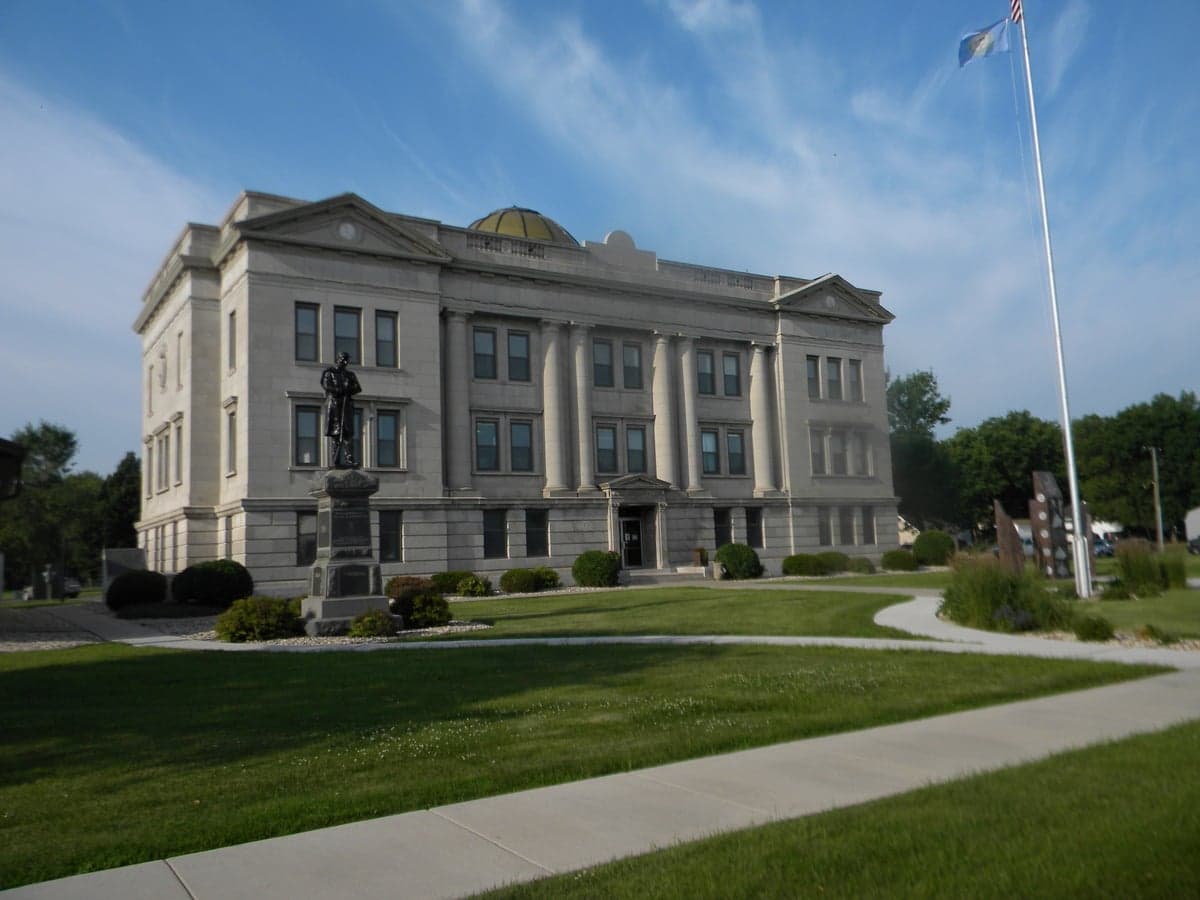
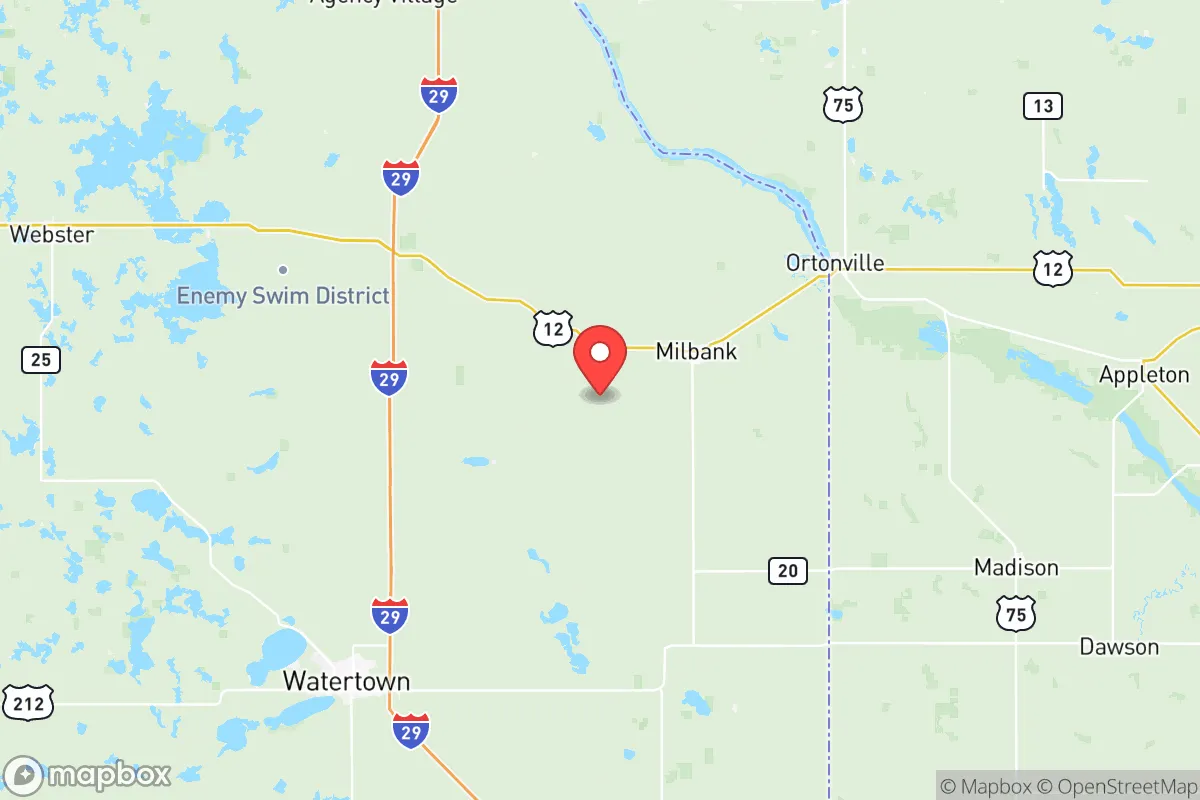
Photo: Wikipedia
Demographics of Grant County
Affluence Level in Grant County
A middle-class area roughly in line with national averages across income, home values, education, and employment.
People of Grant County
Grant County, South Dakota, is a predominantly rural, agricultural community of 7,544 residents where 90.0% of the population identifies as White and 6.7% as Hispanic, reflecting a deep Scandinavian and German heritage layered with a modest but growing Latino presence. The county remains one of the least ethnically diverse in the state, with a foreign-born share of just 4.6% and tiny Black (0.6%) and East/Southeast Asian (0.6%) populations. Its distinctive identity is rooted in small-town agrarian life, with Milbank as the commercial and governmental hub, and a cultural character shaped by generations of family farms, Lutheran church traditions, and a conservative, self-reliant ethos. The people here are overwhelmingly native-born, and the county's demographic story is one of early European settlement, long stability, and only recent, subtle diversification.
Settlement & growth (pre-1960)
Before European settlement, the area that is now Grant County was part of the traditional territory of the Dakota Sioux, specifically the Sisseton and Wahpeton bands, who hunted bison and gathered wild rice along the Minnesota River and Big Stone Lake. The United States acquired the region through the 1803 Louisiana Purchase, but significant American encroachment did not begin until after the 1851 Treaty of Traverse des Sioux and the 1862 Dakota War, which led to the forced removal of most Native people onto reservations. The first permanent non-Native settlers arrived in the 1870s, drawn by the Homestead Act of 1862, which offered 160 acres of land to anyone willing to farm it for five years.
The initial wave was overwhelmingly composed of Norwegian and Swedish immigrants, who began homesteading the prairie around 1872–1880. They were attracted by the availability of cheap, fertile land and the promise of religious and economic freedom, often migrating from earlier settlements in Wisconsin and Minnesota. Stockholm and Strandburg were founded as distinctly Swedish communities, with Lutheran churches and Swedish-language newspapers persisting well into the 20th century. Norwegian settlers concentrated around Milbank, which was platted in 1880 as a railroad town on the Chicago, Milwaukee, St. Paul and Pacific line and quickly became the county seat. A smaller but significant group of German immigrants arrived in the 1880s and 1890s, settling near Revillo and Twin Brooks, where they established Catholic and Lutheran congregations.
The county's population peaked at around 10,000 in the 1910s and 1920s, supported by a diversified agricultural economy of wheat, corn, dairy, and livestock. The arrival of the railroad in Milbank spurred the growth of creameries, grain elevators, and farm-implement dealerships. Big Stone City, on the shore of Big Stone Lake, developed as a small trading and resort center. The Great Depression and the Dust Bowl of the 1930s hit the region hard, causing a modest outmigration, but the county's population remained relatively stable through the 1950s, sustained by the post-war agricultural boom and the consolidation of family farms into larger operations.
Modern era (post-1965)
The 1965 Hart-Cellar Act, which dramatically reshaped U.S. immigration by eliminating national-origin quotas, had a minimal direct impact on Grant County. Unlike urban centers or Sun Belt suburbs, the county did not receive significant numbers of new immigrants from Asia, Africa, or Latin America in the decades following the act. Instead, the dominant demographic trend from 1965 through the early 2000s was rural outmigration: young adults left for college and jobs in Sioux Falls, Minneapolis, and the Dakotas' oil fields, causing the population to decline from about 9,000 in 1960 to roughly 7,500 by 2020.
The most notable post-1965 shift has been the gradual growth of the Hispanic population, which rose from near zero in 1990 to 6.7% today. This increase is tied to the agricultural economy: Latino workers, many of Mexican origin, began arriving in the 1990s and 2000s to work in dairy operations, meatpacking plants, and seasonal crop harvesting. They have concentrated primarily in and around Milbank, where a small but established Hispanic community now supports a Spanish-language church service and a few Latino-oriented businesses. The East/Southeast Asian population (0.6%) is tiny and likely consists of a few families employed in professional roles or small business ownership, with no distinct ethnic enclave. The Black population (0.6%) is similarly minimal, and the Indian subcontinent population is effectively zero. The county's college-educated share stands at 25.5%, below the national average, reflecting the agricultural and blue-collar character of the local economy.
Domestic migration patterns have been mixed. Some retirees and remote workers have moved into the county from larger Midwestern cities, attracted by low housing costs and a quiet lifestyle, but this inflow has not been large enough to reverse the overall population stagnation. Suburbanization is virtually absent; the county has no suburbs in the conventional sense, and most residents live in unincorporated farmsteads or small towns of fewer than 1,000 people.
The future
Grant County's population is likely to remain stable or decline slightly over the next 10–20 years, with a gradual aging of the White majority and a slow increase in the Hispanic share. The county's birth rate is below replacement level, and outmigration of young adults will continue unless new economic opportunities emerge. The Hispanic community, while still small, is the only segment showing organic growth through higher birth rates and continued labor migration; it may reach 10–12% of the population by 2040, but it is unlikely to form large ethnic enclaves. The East/Southeast Asian and Black populations will probably remain negligible, as there are no major employers or social networks to attract significant numbers.
Culturally, the county is not tribalizing into distinct enclaves but rather experiencing a slow, quiet assimilation of its Latino residents into the broader rural community. Intermarriage is increasing, and Spanish-language services are gradually being absorbed into existing institutions. The dominant cultural identity—rooted in Scandinavian and German heritage, Lutheranism, and agricultural values—remains strong and is likely to persist, though it may become slightly more diverse in outward expression. In-migration from outside the region is minimal and unlikely to alter the county's fundamental character.
For someone moving in now, Grant County offers a stable, safe, and deeply traditional rural environment where community ties are strong, change is slow, and the population is overwhelmingly native-born and White. The Hispanic presence is noticeable but integrated, and the county's future is one of gentle demographic evolution rather than dramatic transformation. It remains a place where the past—pioneer homesteads, small-town churches, and family farms—still shapes daily life, and where newcomers are expected to adapt to established rhythms rather than reshape them.

* Values derived from national, state, county, city and local statistics and may differ in a specific area. Last updated: 2026-05-15T02:08:48.000Z
Narrative content on this page is AI-generated and may contain mistakes. Verify any details that matter before acting on them.
ReloMaps may earn a commission from affiliate links at no extra cost to you.

