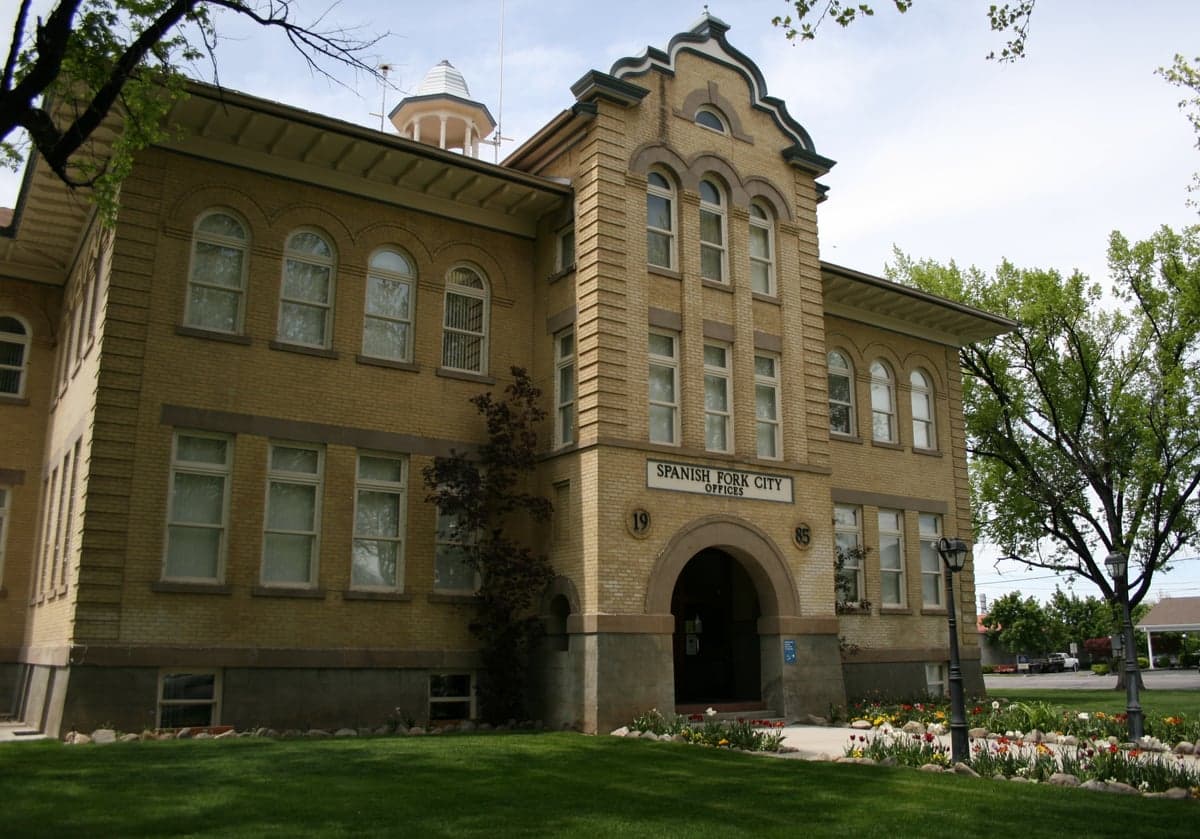
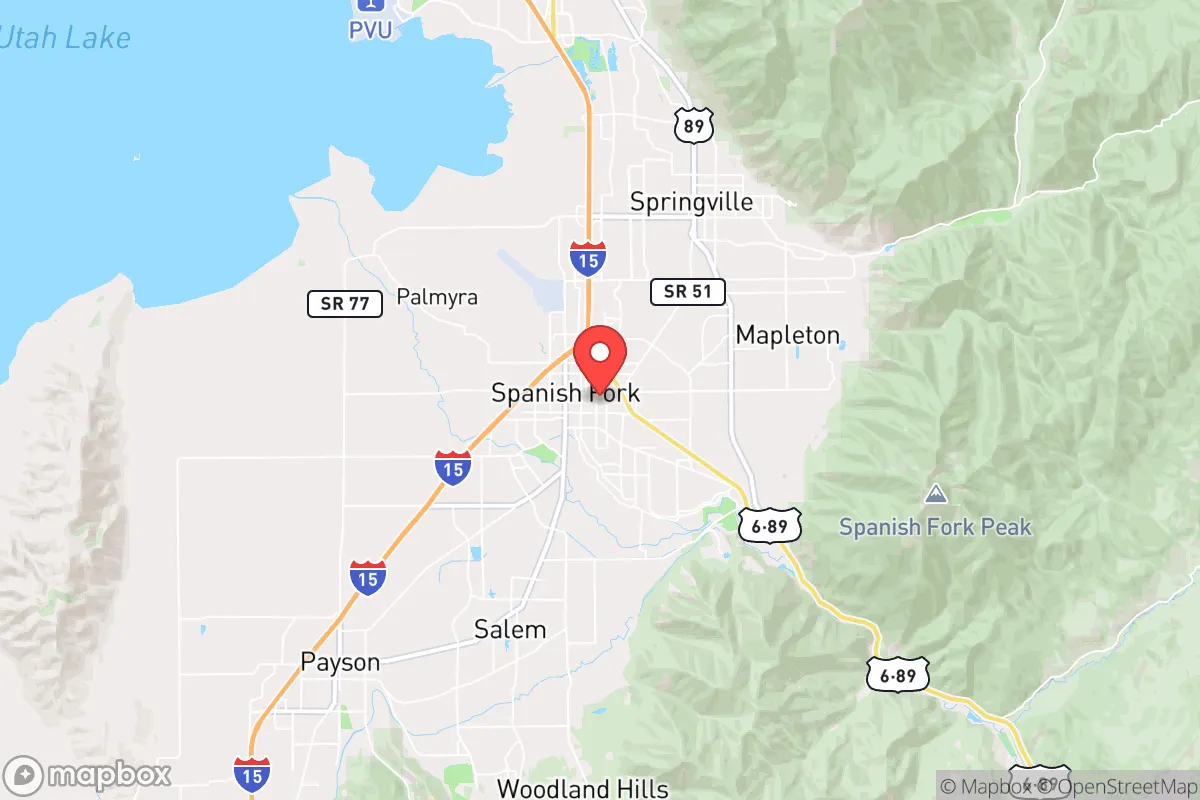
Photo: Wikipedia
Demographics of Spanish Fork, UT
Affluence Level in Spanish Fork, UT
An upper-middle-class area. Household wealth, education levels, and homeownership run ahead of national benchmarks.
People of Spanish Fork, UT
Today, Spanish Fork is home to 43,632 residents, a predominantly white (80.8%) and Latter-day Saint community with a growing Hispanic minority (13.7%) and a very small foreign-born population (2.1%). The city retains a strong family-oriented, conservative character, shaped by its agricultural roots and the dominant influence of Brigham Young University–Provo and local tech employers. Its identity is one of steady, managed growth—a place where newcomers are often drawn by affordable housing and a safe, religiously-infused community culture, rather than by rapid economic transformation.
How the city was settled and grew
Spanish Fork’s human history begins with Mormon pioneers dispatched by Brigham Young in the 1850s to settle the Utah Valley’s southern end. The first wave—mostly families from the British Isles and Scandinavia—arrived in 1851, establishing a farming community along the Spanish Fork River. They built the Historic Downtown core around Main Street, with its grid of adobe and brick homes, and the Pioneer Park neighborhood, where many original settler homes still stand. The city’s name derives from a Spanish exploration party that passed through in 1776, but the permanent population was entirely LDS pioneer stock until the late 19th century. A second wave came with the railroad in the 1870s, bringing a small number of Italian and Greek laborers who worked on the tracks and settled in the Railroad District near the depot. By 1900, the population was nearly 100% white, native-born, and LDS, with agriculture (sugar beets, alfalfa) as the economic backbone.
Modern era (post-1965)
The post-1965 period brought two major shifts. First, the expansion of Brigham Young University and the rise of Utah Valley’s tech sector (including nearby Novell and later Qualtrics) drew educated, white, LDS families from across the Intermountain West. These newcomers settled in newer subdivisions like Maple Hills (developed in the 1990s) and Lakeridge (2000s), which feature larger homes and cul-de-sacs. Second, a smaller but significant Hispanic population began arriving in the 1980s and 1990s, primarily from Mexico and Central America, drawn by agricultural work (dairy farms, orchards) and construction. This community concentrated in the Westside neighborhood, near the industrial corridor along I-15, and in older, more affordable housing stock around 400 North. The 2020 Census shows that while Spanish Fork remains overwhelmingly white, the Hispanic share (13.7%) is the highest in Utah County outside of Provo and Orem. The Asian population (0.3%) and Black population (0.6%) remain negligible, and the Indian-subcontinent population is effectively zero. The foreign-born share (2.1%) is low even by Utah standards, reflecting the city’s limited role as an immigrant gateway.
The future
Spanish Fork’s population is projected to grow to roughly 55,000 by 2035, driven by natural increase (high birth rates among LDS families) and continued domestic in-migration from California and other Western states. The Hispanic community is likely to grow slowly, reaching perhaps 18-20% by 2040, as second-generation families move into middle-class neighborhoods like East Bay and Riverbend, gradually dispersing from the Westside enclave. The white LDS majority will remain dominant, but the city is not homogenizing—rather, it is experiencing a mild form of ethnic diversification within a strongly assimilationist culture. The small Asian and Black populations are unlikely to grow significantly, as Spanish Fork lacks the job base or ethnic infrastructure to attract them. The city is becoming more suburban and less agricultural, with new master-planned communities like Spanish Fork Canyon Estates drawing higher-income families, while older neighborhoods near downtown see modest infill.
For a conservative-leaning individual or family moving in now, Spanish Fork offers a stable, safe, and religiously homogeneous environment with a growing but manageable Hispanic presence. The city is not becoming a diverse, cosmopolitan hub—it is becoming a larger, more prosperous version of its 1950s self, with a slightly browner complexion and a stronger tech economy. The key question for newcomers is whether they value that continuity or seek more diversity; for most of the target audience, the answer will be the former.

* Values derived from national, state, county, city and local statistics and may differ in a specific area. Last updated: 2026-04-21T07:25:44.000Z
Narrative content on this page is AI-generated and may contain mistakes. Verify any details that matter before acting on them.
ReloMaps may earn a commission from affiliate links at no extra cost to you.

