
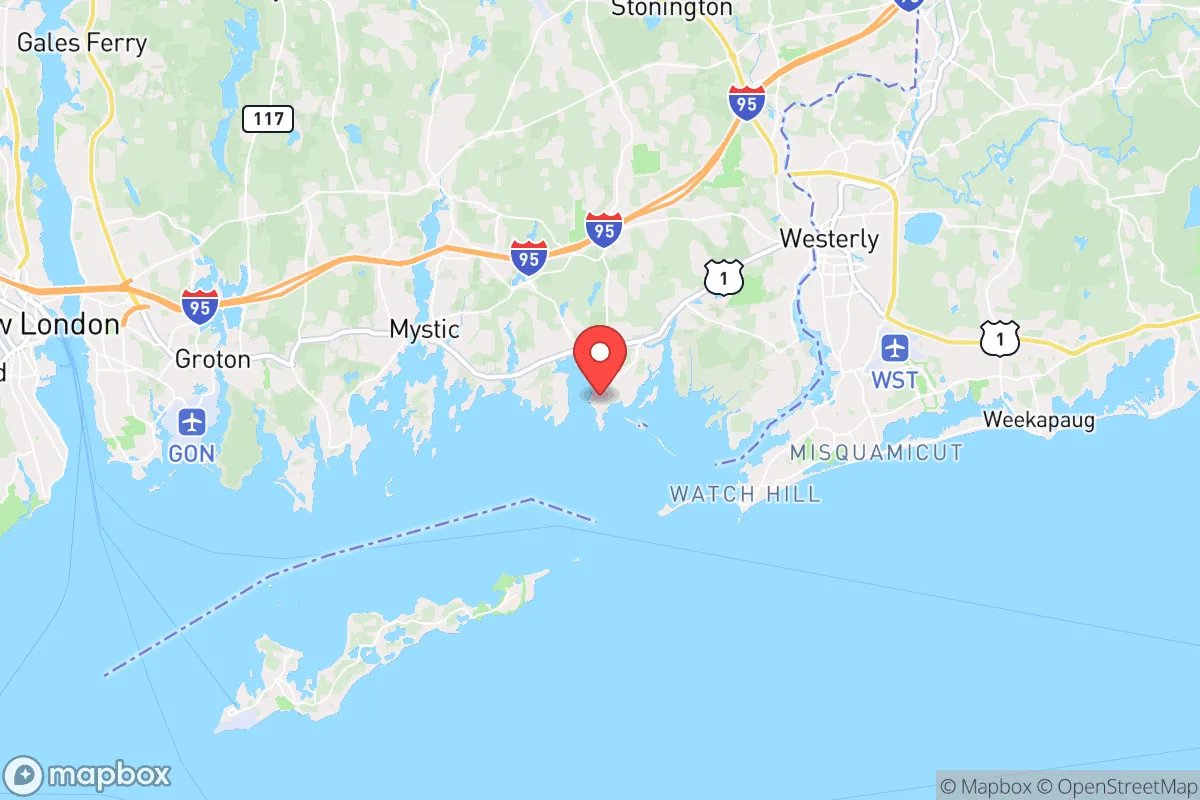
Photo: Wikipedia
Personal Sovereignty in Stonington, CT
Viable for self-reliance. Generally workable, though some barriers may limit total independence.
What does Personal Sovereignty tell us?
Personal Sovereignty measures your capacity for self-reliance and independence with minimal government friction. Higher scores mean fewer barriers between you and the way you want to live... but it assumes you have the space you need and good neighbors.
What does this tell us?
Personal Sovereignty measures your capacity for self-reliance and independence with minimal government friction. Higher scores mean fewer barriers between you and the way you want to live... but it assumes you have the space you need and good neighbors.
State Policy
Energy independence: Importer (5% of energy produced in-state)
Personal Liberty
Homesteading

Personal Liberty Analysis
Stonington, Connecticut, offers a mixed bag for those prioritizing personal sovereignty, with its coastal New England charm masking a state-level regulatory environment that leans heavily toward collective governance over individual autonomy. For the survivalist or prepper evaluating this southeastern corner of the state, the town’s local character—rooted in historic villages like Mystic and Old Mystic—provides some buffer against the more intrusive policies emanating from Hartford, but the overarching legal framework remains a significant constraint. The key question for a conservative-leaning individual or family is whether Stonington’s relative isolation and rural pockets can offset Connecticut’s aggressive tax posture, restrictive gun laws, and expanding reach into medical and parental decisions. The answer is nuanced: you gain some breathing room in daily life, but the state’s long arm is never far away.
Tax burden and regulatory posture in Stonington compared to surrounding areas
Connecticut’s tax burden is among the highest in the nation, and Stonington residents feel it directly. The state imposes a progressive income tax with rates up to 6.99%, a sales tax of 6.35%, and some of the highest property taxes in the country. Stonington’s mill rate hovers around 22-24 mills, meaning a home assessed at $300,000 carries an annual property tax bill of roughly $6,600 to $7,200. For a prepper focused on land and self-sufficiency, this is a recurring cost that eats into resources better spent on supplies or infrastructure. The regulatory posture is equally burdensome: Connecticut has a robust state building code, strict environmental regulations (especially in coastal zones like Stonington’s shoreline), and a permitting process that can delay or derail projects like adding a workshop, installing solar panels, or building a root cellar. Compared to nearby Rhode Island or Massachusetts, Connecticut is not the worst, but it is far from the libertarian-friendly environments of New Hampshire or states further south. The town’s zoning is largely suburban and rural, but any significant alteration to property—especially near wetlands or historic districts—requires town approval, which can be unpredictable and time-consuming.
Self-defense and gun law specifics in Connecticut
For those who view the Second Amendment as a cornerstone of personal sovereignty, Connecticut is a challenging state. The state requires a permit to purchase any firearm, a pistol permit to carry (open or concealed), and mandates a waiting period and background check for all transfers, including private sales. Stonington residents must navigate a system where local police chiefs have discretion in issuing permits, though the town is generally considered reasonable compared to more restrictive jurisdictions like Hartford or New Haven. Magazine capacity is capped at 10 rounds, and the state maintains an assault weapons ban that covers many popular rifles and shotguns. For a prepper, this means stockpiling standard-capacity magazines or certain semi-automatic platforms is illegal unless they were legally owned before the ban’s effective date. Self-defense laws are also restrictive: Connecticut does not have a Stand Your Ground statute, imposing a duty to retreat in public spaces before using deadly force, and the Castle Doctrine applies only inside one’s home, with no presumption of reasonableness. This legal landscape forces a defensive-minded individual to think carefully about legal exposure, even in a justified use of force. The local gun culture in Stonington is more muted than in rural areas of the Midwest or South, but there are active shooting ranges and clubs in the region for those willing to comply with state requirements.
Self-reliance and homesteading viability in Stonington
Stonington’s rural character offers some genuine opportunities for self-reliance, but they come with caveats. Minimum lot sizes in the town’s agricultural zones are typically 1 to 2 acres, which is enough for a substantial garden, a few chickens, and perhaps a goat or two, but not for larger livestock like cattle or pigs without special permits. Zoning allows for accessory apartments and home-based businesses, but the permitting process can be cumbersome, especially for anything involving structural changes or water use. Off-grid feasibility is limited: Connecticut requires connection to the electrical grid for new construction, and while solar panels are permitted, net metering policies are state-controlled and have been revised to reduce payouts to homeowners. Rainwater collection is legal but must comply with state health codes if used for potable water, and septic systems are strictly regulated. For a prepper aiming for true independence, the state’s environmental and building codes make it difficult to operate entirely off-grid. However, Stonington’s access to the coast provides a unique advantage: fishing, crabbing, and foraging from Long Island Sound can supplement food supplies, and the town’s agricultural history means there are local farms and farmers’ markets for barter and trade. The key is to view Stonington as a place where partial self-sufficiency is achievable, but full autonomy is not—you will always be tied to the state’s infrastructure and regulatory system.
Personal liberties in Stonington: parental rights, medical autonomy, speech, and property
Connecticut has been at the forefront of expanding state authority into areas traditionally reserved for personal and family decision-making. Parental rights are under pressure: the state mandates comprehensive sex education in public schools, and recent laws have removed parental notification requirements for certain medical procedures, including mental health treatment and reproductive care. For a conservative parent, this means your child can access services without your knowledge or consent, a direct challenge to family sovereignty. Medical autonomy is similarly constrained: Connecticut has strict vaccine mandates for school attendance, and during the COVID-19 pandemic, the state imposed broad emergency powers that limited individual choice. While those emergency orders have expired, the legal framework remains in place for future use. Free speech is generally protected, but the state has enacted laws targeting “hate speech” and online harassment that some critics argue could be used to chill political dissent. Property rights are perhaps the strongest area: Connecticut’s eminent domain laws are not as aggressive as in some states, and Stonington’s local government is relatively hands-off with private land use, provided you stay within zoning and environmental rules. However, the state’s estate tax—which kicks in at $9.1 million—can be a concern for those planning to pass land or assets to the next generation. Overall, personal liberties in Stonington are best described as conditional: you have freedom as long as you operate within a state-defined framework that prioritizes collective welfare over individual autonomy.
In the broader context of personal sovereignty, Stonington sits in the middle of the pack nationally but near the bottom for New England. It is not as restrictive as Massachusetts or New York, but it lacks the constitutional protections and low-tax environment of New Hampshire or the libertarian-leaning counties of the Mountain West. For a survivalist or prepper, the town offers a decent base for partial self-reliance—good land, coastal resources, and a local culture that values independence—but the state’s tax burden, gun laws, and erosion of parental and medical autonomy are significant liabilities. If your priority is maximum sovereignty with minimal government interference, you would be better served looking at states like Texas, Idaho, or Wyoming. But if you are tied to the Northeast for family or work reasons, Stonington represents one of the more tolerable options within Connecticut, provided you are willing to navigate the regulatory landscape and accept that true autonomy will always be limited by Hartford’s reach.

* Values derived from national, state, county, city and local statistics and may differ in a specific area. Last updated: 2026-04-19T08:24:39.000Z
Narrative content on this page is AI-generated and may contain mistakes. Verify any details that matter before acting on them.
ReloMaps may earn a commission from affiliate links at no extra cost to you.

