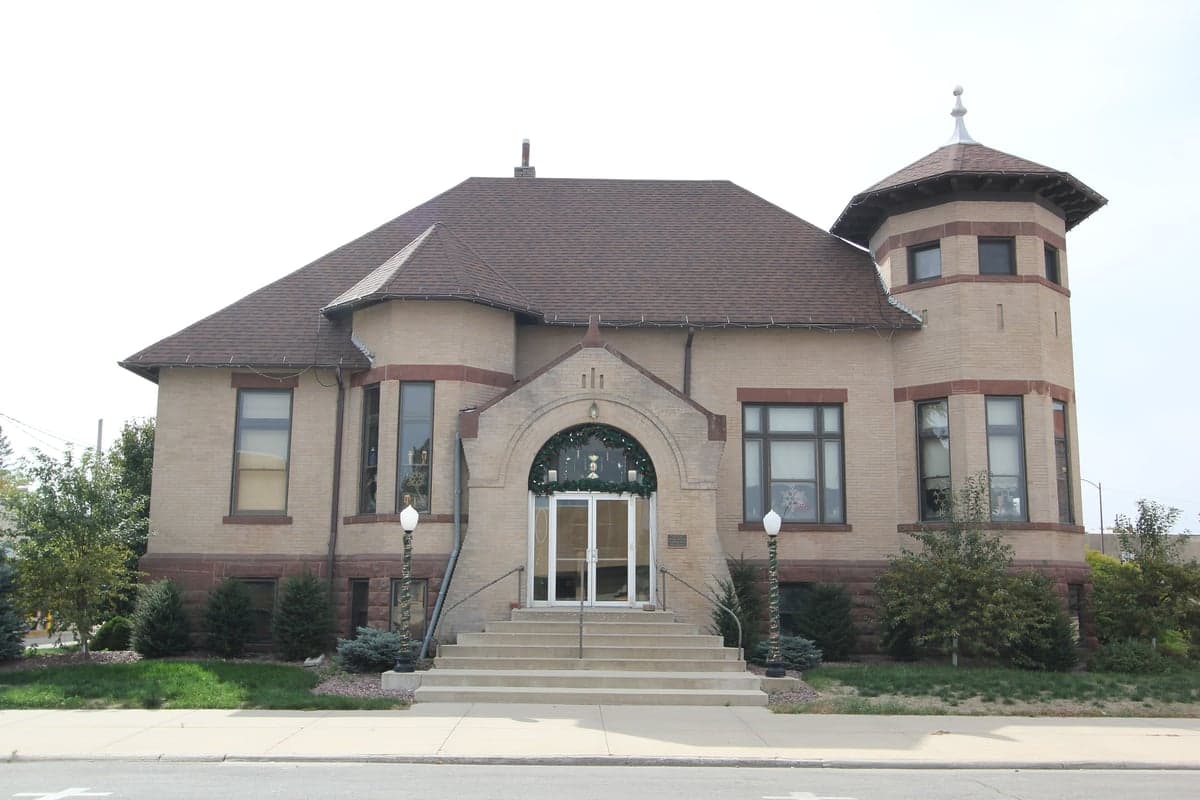
Photo: Wikipedia
Demographics of Storm Lake, IA
Affluence Level in Storm Lake, IA
A middle-class area roughly in line with national averages across income, home values, education, and employment.
People of Storm Lake, IA
Storm Lake, Iowa, is one of the most ethnically diverse small cities in the Midwest, with a population of 11,275 where no single racial or ethnic group holds a majority. The city is characterized by a dense, compact urban core surrounded by agricultural land, and its identity is defined by a rapid demographic transformation over the past 30 years. Today, the population is 34.0% white, 41.0% Hispanic, 14.7% East/Southeast Asian, and 3.8% Black, with a foreign-born share of 19.0%—nearly triple the national average. This is a working-class, immigrant-driven community where meatpacking and manufacturing anchor the economy, and where English is often a second language in schools and neighborhoods.
How the city was settled and grew
Storm Lake was founded in the 1870s as a railroad town and agricultural service center, drawing its first wave of settlers from German, Scandinavian, and Irish immigrant stock. These groups built the original residential core around the lake and along Lake Avenue, establishing neighborhoods like Lakeside (the historic district of early merchants and professionals) and East Storm Lake, where railroad workers and farmers settled in modest frame houses. By 1900, the town had grown to about 2,500, sustained by grain shipping and a small meatpacking plant. A second wave arrived during the 1940s and 1950s, when the Hygrade meatpacking plant expanded, drawing rural white migrants from surrounding Buena Vista County and a small number of Mexican laborers through the Bracero program. These workers settled in the South Lake Avenue corridor, near the plant, forming the nucleus of what would become a much larger Hispanic community. Through the mid-20th century, Storm Lake remained overwhelmingly white—over 98% as late as 1970—with a stable, church-centered social fabric.
Modern era (post-1965)
The 1965 Immigration and Nationality Act opened the door to non-European immigration, but Storm Lake’s transformation accelerated after 1990, when the local pork processing plant (then owned by IBP, now Tyson Foods) began actively recruiting immigrant labor. The first major group was East/Southeast Asian refugees—ethnic Chinese from Vietnam, plus Lao and Hmong families—who arrived in the 1980s and 1990s through refugee resettlement programs. They concentrated in the North Lake Drive area and along Flindt Drive, where affordable rental housing and proximity to the plant created a dense Asian enclave. By 2000, the Asian share had reached 8.0%. Simultaneously, Hispanic migration surged, driven by direct recruitment from Texas, California, and Mexico. Hispanic workers and their families settled in the West Side neighborhoods near the plant and in the Sunset Addition subdivision, a post-1990 development of starter homes and duplexes. Today, Hispanics are the largest single group at 41.0%, and the white share has fallen from 85% in 1990 to 34.0% today. The Black population (3.8%) is smaller and more dispersed, with a visible cluster near the East Lakeside public housing complex. The city’s college-educated share is just 18.9%, reflecting the predominance of blue-collar, plant-based employment.
The future
Storm Lake’s population is likely to continue diversifying, with the Hispanic share projected to approach or exceed 50% within the next decade, driven by higher birth rates and continued labor demand at the plant. The East/Southeast Asian community, now at 14.7%, appears stable but aging, with younger adults often leaving for larger cities. The white population, which skews older, is slowly declining through out-migration and natural decrease. The city is not tribalizing into hostile enclaves—neighborhoods are mixed, and intermarriage is rising—but distinct cultural zones persist: the West Side remains heavily Hispanic, North Lake Drive retains an Asian character, and the Lakeside historic district is predominantly white and older. For a newcomer, Storm Lake offers a tight-knit, family-oriented environment with low housing costs and a strong sense of community, but the dominant culture is increasingly Hispanic and working-class. The schools are majority-minority, and English-language support is a routine part of daily life.
Storm Lake is becoming a majority-Hispanic, immigrant-driven small city where the old white ethnic identity has largely faded. For a conservative-leaning mover, this means a place where traditional values of hard work, family, and faith are visible across all groups, but where the language, food, and social rhythms are shifting. It is not a homogenizing suburb—it is a dynamic, blue-collar hub where demographic change is the central fact of life.

* Values derived from national, state, county, city and local statistics and may differ in a specific area. Last updated: 2026-04-29T21:51:34.000Z
Narrative content on this page is AI-generated and may contain mistakes. Verify any details that matter before acting on them.
ReloMaps may earn a commission from affiliate links at no extra cost to you.

