Photo: Wikipedia
Demographics of Sturgis, SD
Affluence Level in Sturgis, SD
A middle-class area roughly in line with national averages across income, home values, education, and employment.
People of Sturgis, SD
Today, Sturgis, South Dakota is a city of 7,111 residents defined by its deep-rooted Western heritage, a predominantly white population (92.3%), and a famously low foreign-born share of just 0.3%. The city’s identity is overwhelmingly shaped by its annual motorcycle rally, but its year-round character is that of a tight-knit, conservative-leaning community where family ties and local institutions—churches, the school system, and the Sturgis Volunteer Fire Department—form the social backbone. With a college-educated rate of 19.8%, the population is less formally educated than state averages, reflecting a workforce historically tied to trades, ranching, and small business rather than white-collar industries.
How the city was settled and grew
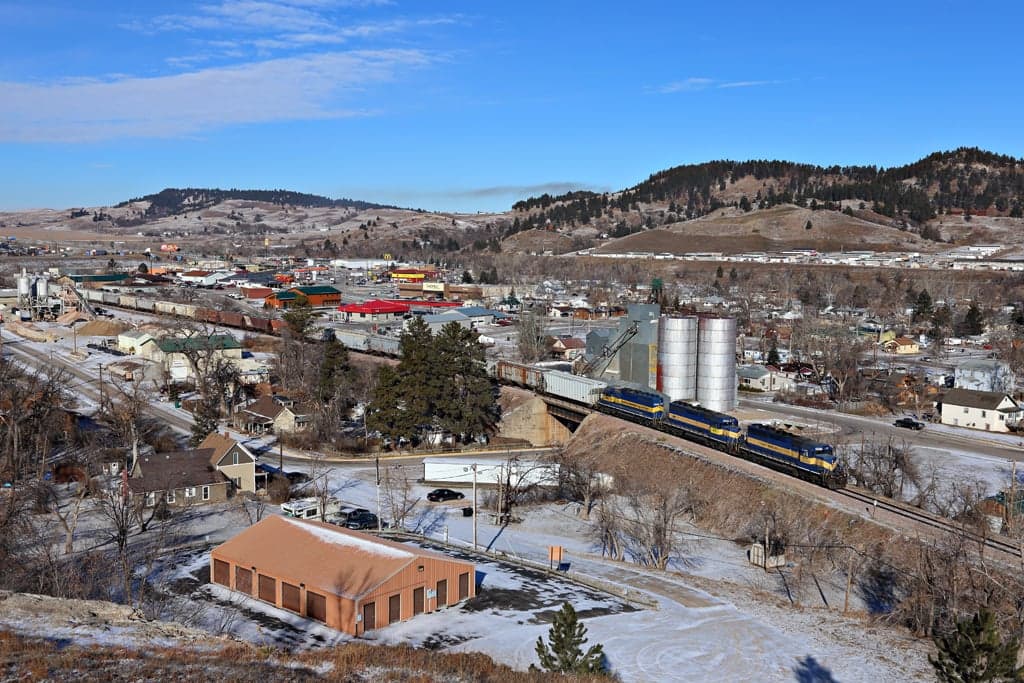
Sturgis was founded in 1878 as a railroad and military supply town, named after Samuel D. Sturgis, a Union general. The original wave of settlers were predominantly white homesteaders of Northern European descent—Germans, Scandinavians, and Irish—drawn by the 1862 Homestead Act and the promise of 160-acre plots in the Black Hills. The U.S. Army’s Fort Meade, established in 1878 just east of town, brought a second wave of soldiers, veterans, and their families, many of whom stayed after service. These early groups built their homes in what is now Old Town Sturgis, the original grid of streets around Main and Junction, where many 19th-century commercial buildings still stand. A smaller but notable wave of Eastern European immigrants—primarily Czech and Polish—arrived in the 1880s and 1890s to work in the region’s gold mines and railroad yards, settling in the North Sturgis area near the railroad tracks. By 1900, the population was nearly entirely white and native-born, a pattern that held through the Great Depression and World War II. The post-war era saw modest growth from returning GIs and their families, who built ranch-style homes in the West Hills subdivision, a neighborhood that remains predominantly white and middle-class today.
Modern era (post-1965)
After the 1965 Hart-Cellar Act, Sturgis saw virtually no new immigration—its foreign-born population today is 0.3%, among the lowest in any U.S. city. Instead, the modern era has been defined by domestic in-migration from other parts of South Dakota and neighboring states like Wyoming, Montana, and Nebraska. These new residents are overwhelmingly white, drawn by the area’s low cost of living, outdoor recreation, and the expanding healthcare and tourism sectors tied to the Sturgis Rally. The Whitewood Addition, a subdivision developed in the 1970s and 1980s just north of the city limits, absorbed many of these newcomers, offering larger lots and a semi-rural feel. The city’s Hispanic population, at 1.9%, is small but slightly higher than in surrounding rural counties, concentrated in the South Sturgis area near the industrial park, where seasonal agricultural and construction work provides entry-level jobs. The Black population (1.5%) and East/Southeast Asian population (0.1%) are tiny and dispersed, with no distinct ethnic enclave. The Indian subcontinent population is effectively zero. The overall demographic picture is one of remarkable stability: Sturgis has not experienced the suburbanization or ethnic diversification seen in larger Plains cities like Rapid City or Sioux Falls.
The future
Sturgis’s population is heading toward slow, steady homogenization rather than diversification. The city’s population has hovered around 7,000 for two decades, with growth limited by a lack of large employers and housing stock. The Hispanic share may inch upward as agricultural and service-sector jobs attract workers from the broader region, but the foreign-born rate is unlikely to rise above 1% given the city’s remote location and limited economic pull. The white population, currently 92.3%, will likely remain dominant, with any growth coming from domestic retirees and remote workers seeking a low-cost, conservative environment. The Bear Butte Creek area, a newer development on the city’s eastern edge, is attracting some of these newcomers, but it remains overwhelmingly white and middle-aged. The city is not tribalizing into distinct ethnic enclaves—it is too small and too homogeneous for that. Instead, the social divide is more about length of residence: long-time families in Old Town and North Sturgis versus newer arrivals in West Hills and Whitewood Addition.
For someone moving in now, Sturgis is a place where the population is stable, culturally conservative, and deeply rooted in its Western and military history. The lack of ethnic diversity means a newcomer will find a community where shared values—self-reliance, family, and tradition—are more defining than any demographic shift. The city is not becoming more diverse; it is becoming more settled, with a population that knows its neighbors and expects newcomers to fit into an established way of life.

* Values derived from national, state, county, city and local statistics and may differ in a specific area. Last updated: 2026-05-05T15:16:01.000Z
Narrative content on this page is AI-generated and may contain mistakes. Verify any details that matter before acting on them.
ReloMaps may earn a commission from affiliate links at no extra cost to you.

