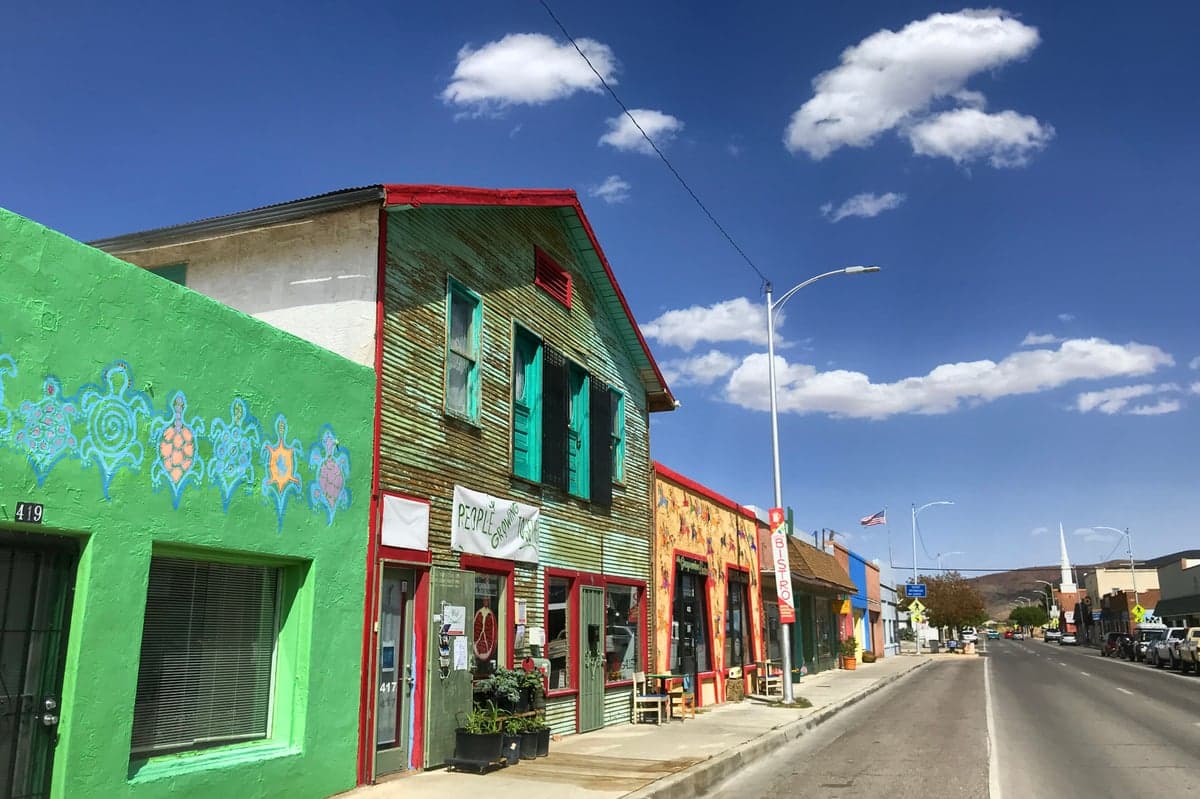
Photo: Wikipedia
Personal Sovereignty in Truth Or Consequences, NM
Viable for self-reliance. Generally workable, though some barriers may limit total independence.
What does Personal Sovereignty tell us?
Personal Sovereignty measures your capacity for self-reliance and independence with minimal government friction. Higher scores mean fewer barriers between you and the way you want to live... but it assumes you have the space you need and good neighbors.
What does this tell us?
Personal Sovereignty measures your capacity for self-reliance and independence with minimal government friction. Higher scores mean fewer barriers between you and the way you want to live... but it assumes you have the space you need and good neighbors.
State Policy
Energy independence: Net exporter (250% of energy produced in-state)
Personal Liberty
Homesteading

Personal Liberty Analysis
Truth or Consequences, New Mexico, offers a mixed but notably favorable environment for personal sovereignty when measured against national trends of expanding government oversight. While New Mexico as a state carries a reputation for progressive governance, Sierra County and the T or C area specifically operate with a lighter regulatory touch, lower population density, and a culture of self-reliance that appeals to those seeking to minimize entanglement with state authority. For the strategic relocator—whether a single prepper or a family building a resilient homestead—this town presents a viable base of operations, provided you understand where state-level friction points exist and how to navigate them.
Tax burden and regulatory posture: How New Mexico compares to surrounding states
New Mexico’s overall tax burden ranks in the middle of the pack nationally, but the structure matters more than the headline number for sovereignty-minded individuals. The state levies a progressive income tax with rates from 1.7% to 5.9% on taxable income over $210,000 for single filers—meaning most residents pay at the lower end. Property taxes are a standout advantage: New Mexico’s effective property tax rate is among the lowest in the country, averaging roughly 0.55% of assessed value, which in Sierra County translates to annual bills often under $1,000 even on modest acreage. There is no state-level sales tax on groceries or prescription drugs, though the gross receipts tax (GRT) in T or C runs about 8.0% on most other goods and services. Regulatory posture is generally permissive for small-scale operations. Sierra County does not impose county-level building codes outside the city limits, and the state’s environmental regulations are less aggressive than those in Colorado or California. However, the New Mexico Environment Department does enforce groundwater protections that can affect well drilling and septic system placement, so due diligence on permits is advised. For a prepper household, the combination of low property taxes, minimal county interference, and a state income tax that only bites at higher incomes makes T or C a fiscally attractive base.
Self-defense and gun law specifics: What the Second Sanctuary status means
New Mexico is a shall-issue state for concealed carry permits, meaning no subjective approval process—if you meet the statutory requirements, the permit is granted. The state also recognizes permitless carry for residents 21 and older, allowing concealed or open carry without a license. This is a significant plus for those prioritizing self-defense without government permission. In 2021, Sierra County was designated a Second Amendment Sanctuary County by a unanimous county commission vote, signaling local law enforcement’s unwillingness to enforce state-level gun control measures they deem unconstitutional. That said, the state legislature in Santa Fe has passed red-flag laws (Extreme Risk Protection Orders) allowing temporary firearm seizure based on a court petition, and a 2023 law raised the minimum purchase age for semiautomatic rifles to 21. These state-level infringements are real, but enforcement in Sierra County is minimal. The practical reality: you can own, carry, and use firearms for self-defense with fewer bureaucratic hurdles than in most Western states. Magazine capacity restrictions do not exist at the state level, and suppressors are legal for hunting. For the survivalist, the sanctuary status provides a buffer, not a shield—but it’s a meaningful one in a region where the sheriff’s office publicly prioritizes individual rights over state mandates.
Self-reliance and homesteading viability: Lot sizes, zoning, and off-grid feasibility
Truth or Consequences sits in a high desert valley at 4,200 feet elevation, with the surrounding Sierra County offering abundant land at prices that undercut most of the West. Unimproved lots of 1 to 5 acres within 15 minutes of town can be found for $5,000 to $15,000, while larger parcels of 20 to 40 acres with mountain views run $30,000 to $80,000. Zoning outside city limits is minimal: Sierra County does not require building permits for owner-built structures on rural land, and there are no county-level restrictions on tiny homes, shipping container dwellings, or earthbag construction. Off-grid living is legally feasible. The state allows rainwater catchment without a permit, and solar panel installation requires no special approval beyond standard electrical work. Well drilling requires a permit from the Office of the State Engineer, with a typical cost of $8,000 to $15,000 for a domestic well that reaches the aquifer at 200 to 400 feet. Septic systems must meet state health department standards, but the process is straightforward for a single-family home. The biggest practical challenge is water availability—Sierra County averages 10 inches of annual rainfall, making dryland farming impractical without irrigation. For the prepper, this means securing a reliable well or hauling water from the Rio Grande (which runs through T or C) is essential. The county’s low population density (roughly 12 people per square mile) and lack of aggressive code enforcement create a genuine frontier environment where self-reliance is not just tolerated but expected.
Personal liberties: Parental rights, medical autonomy, speech, and property
New Mexico’s state-level policies on parental rights and medical autonomy are a mixed bag that requires strategic awareness. The state does not have a parental rights in education statute, and public schools in T or C follow state curriculum standards that include comprehensive sex education and social-emotional learning—content some conservative parents find objectionable. However, homeschooling is lightly regulated: parents need only file a simple notice of intent and provide annual evidence of progress, with no standardized testing requirement or curriculum approval. The state also allows private and religious schools to operate without significant oversight. On medical autonomy, New Mexico has no vaccine mandate for adults and allows religious exemptions for school-required immunizations. The state legalized recreational cannabis in 2021, which some see as a freedom issue and others as a cultural concern—either way, it reflects a permissive regulatory environment. Free speech protections are robust under the state constitution, and there are no hate speech laws that criminalize political expression. Property rights are generally strong, with no statewide rent control and limited eminent domain activity in Sierra County. The county assessor’s office is small and accessible, meaning property disputes are often resolved locally rather than through state bureaucracy. For the sovereignty-minded individual, the key takeaway is that T or C offers a high degree of personal autonomy in daily life, with the main friction points being state-level education mandates and the potential for future medical mandates—both of which can be mitigated through homeschooling and self-directed healthcare choices.
Overall, Truth or Consequences ranks as a strong contender for personal sovereignty relative to other affordable Western towns. It lacks the extreme regulatory freedom of, say, rural Idaho or Montana, but it compensates with lower land costs, minimal county interference, and a Second Amendment sanctuary culture that pushes back against state overreach. The biggest trade-offs are the arid climate requiring careful water planning and the risk that Santa Fe may tighten gun or medical mandates in the future. For the strategic relocator who values low taxes, permissive building codes, and a community that largely minds its own business, T or C offers a rare combination of affordability and autonomy that is increasingly hard to find in the contiguous United States.

* Values derived from national, state, county, city and local statistics and may differ in a specific area. Last updated: 2026-05-01T09:20:23.000Z
Narrative content on this page is AI-generated and may contain mistakes. Verify any details that matter before acting on them.
ReloMaps may earn a commission from affiliate links at no extra cost to you.

