
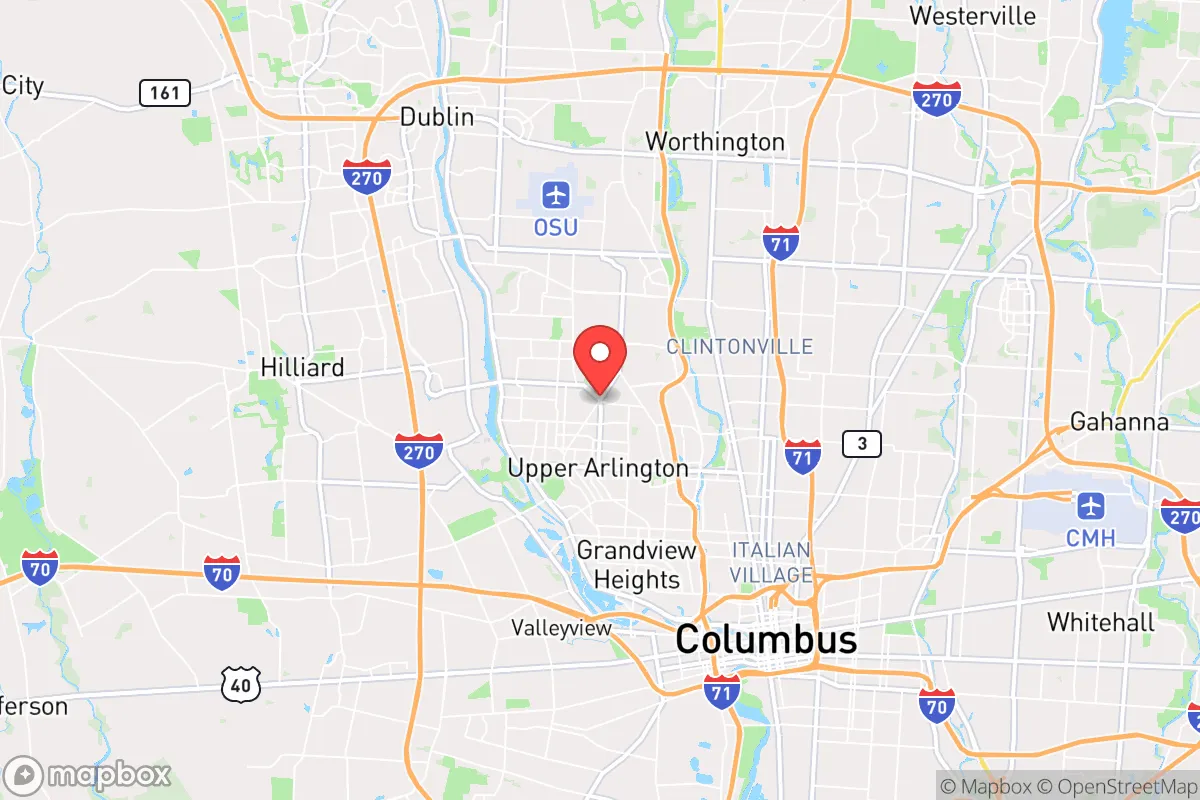
Photo: Wikipedia
Strategic Assessment of Upper Arlington, OH
Multiple tactical vulnerabilities. Population density, target proximity, or disaster risk are likely compounding. A retreat property and exit planning is required.
What does the Strategic Assessment tell us?
Our Strategic Assessment grades tactical survivability of an area. Major population centers, military targets, fallout zones, natural disasters, and border exposure all drive risk — lower exposure means a more defensible position in a crisis.
This is heavily inspired by Joel Skousen's Strategic Relocation book. Highly recommended you checkout the book ($)What does this tell us?
Our Strategic Assessment grades tactical survivability of an area. Major population centers, military targets, fallout zones, natural disasters, and border exposure all drive risk — lower exposure means a more defensible position in a crisis.
This is heavily inspired by Joel Skousen's Strategic Relocation book. Highly recommended you checkout the book ($)Strategic Pillars

Key Distances
Regional Safe Places
Below is our recommended "safe zones" in Ohio and the surrounding area based on our strategic heuristics. For most people, it's unrealistic to live in a “safe zone” full-time due to work, family or other personal reasons. They tend to be more rural. However, many of these areas are perfect for second homes and retreat properties that double as a vacation home or even a short-term rental.

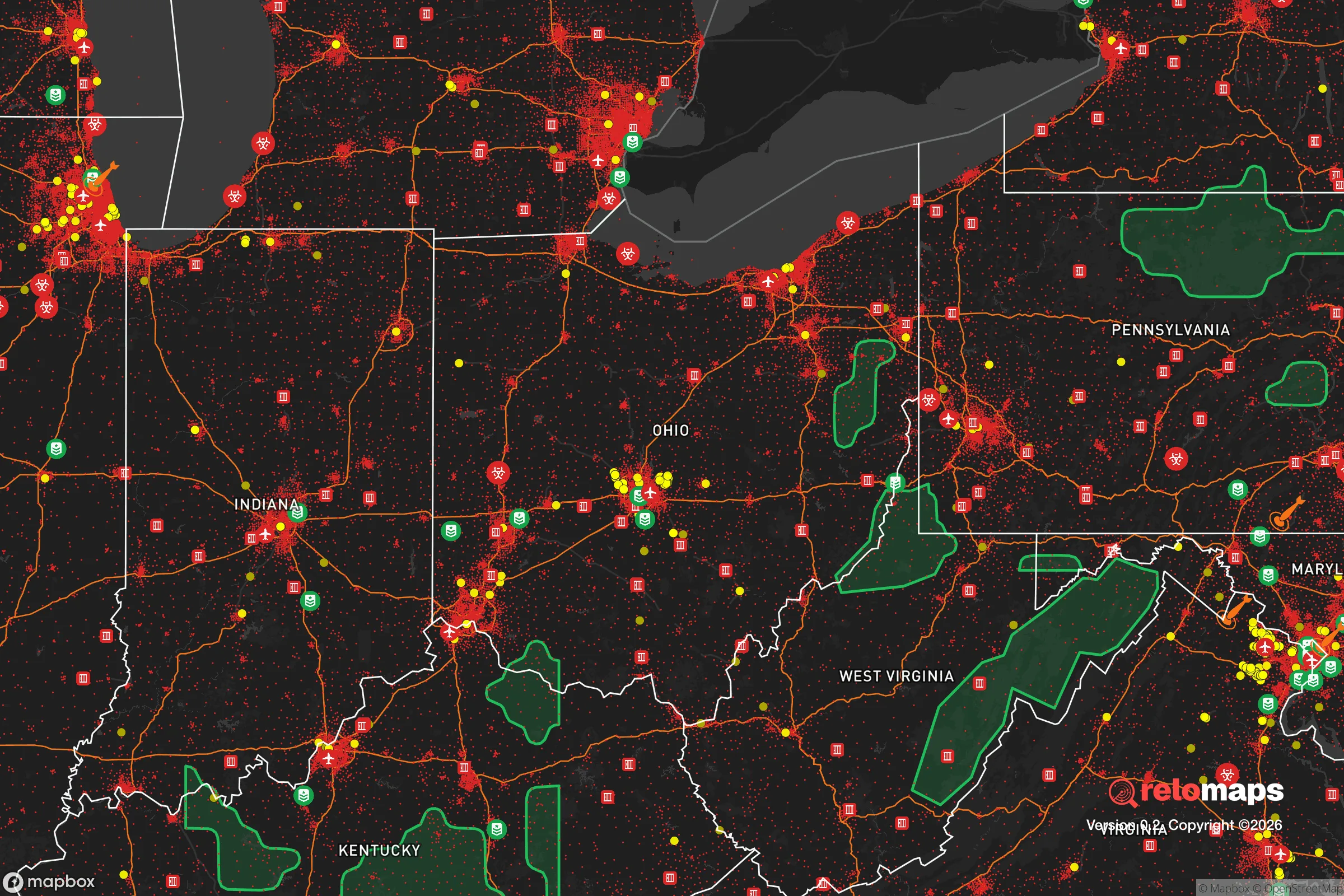


Important Note: For informational purposes only. This does not mean nothing bad ever happens in the green zones. Please use common sense. This is based on public data and modeled with AI. We tried to take a conservative approach but mistakes happen. We update this regularly as new information becomes available.
Solar Generator Recommendations
Backup power matters more here than in safer locations. We've picked three solar generators across budgets and capacity tiers — start with the budget unit if you only need a few essentials, or step up if you want to run a fridge and HVAC for days at a time.

Jackery Portable Power Station Explorer 300
Budget OptionPower on the Go: Weighing only 11 lbs, it's convenient to set up and store with book-sized foldable solar panels

BLUETTI Portable Power Station AC180
Designed for both indoor and outdoor scenarios, AC180 is highly capable as it has a robost capacity and continuous output power.

EF ECOFLOW DELTA Pro Ultra Power Station
Upgraded PickEcoFlow DELTA Pro Ultra is a whole-home energy system designed to grow with your family. Integrated with the Smart Home Panel 2, it scales to meet your evolving energy needs — keeping your home powered, intelligent, and secure through every stage of life.
We earn a commission, at no additional cost to you.
Strategic Assessment Analysis
Upper Arlington, Ohio, presents a complex strategic picture for the conservative prepper or survivalist. Its primary resilience lies in its high socioeconomic status, robust local infrastructure, and a community that, on paper, has the resources to self-organize. However, its position as a wealthy, dense suburb of Columbus—a major state capital and logistics hub—creates a double-edged sword. The very advantages that make it a pleasant place to live in peacetime become significant liabilities during a major disruption, making it a location that demands careful, sober assessment rather than blind optimism.
Geographic position and natural advantages: The heart of the Ohio flyover zone
Upper Arlington sits in a classic Midwestern "flyover" zone, which offers a baseline level of strategic obscurity. It is not a coastal target, a major port, or a border city. The terrain is gently rolling, typical of the Ohio till plains, with no significant natural barriers like mountains or large rivers that would channel or restrict movement. The area is far enough inland to be insulated from direct hurricane storm surge and most tsunami risks. The climate is temperate, with four distinct seasons, which is manageable for long-term food storage and off-grid living, though winter heating is a non-negotiable requirement. The primary natural advantage is the region's deep, fertile soil. In a prolonged crisis, the ability to grow food is paramount, and the surrounding farmland of central Ohio is some of the most productive in the world. However, Upper Arlington itself is a fully built-out suburb of 35,000 people on roughly 10 square miles. There is virtually no undeveloped land for personal farming, hunting, or water catchment within the city limits. The natural advantage is regional, not local, meaning a relocator would be dependent on access to the surrounding countryside, which could be contested or inaccessible during a collapse.
Risks, exposures, and proximity to fallout-relevant landmarks
This is where the assessment turns sharply negative for the survivalist. Upper Arlington's proximity to Columbus is its greatest strategic vulnerability. Columbus is home to the Ohio Statehouse, the Ohio National Guard headquarters, major data centers, and a massive logistics hub at Rickenbacker International Airport. It is a prime target for cyber attacks, civil unrest, or even a kinetic strike in a major conflict. The city's population of nearly 1 million in the metro area would become a desperate, mobile threat in any prolonged grid-down scenario. Upper Arlington is a wealthy, highly visible target for looting and home invasion. Its tree-lined streets and large homes scream "resources" to a hungry or desperate population. Furthermore, the area is crisscrossed by major highways (I-270, SR-315, US-33) that would become chokepoints and escape routes for panicked crowds. There is no natural defensibility—no hills, rivers, or forests to create a perimeter. The Scioto River runs nearby, but it is a modest waterway, not a defensive moat. The presence of the Ohio State University campus, a massive population of young, transient individuals, adds another layer of instability risk. In short, Upper Arlington is a high-value, low-defensibility target in the immediate shadow of a major population center.
Practical resilience for a relocator: Food, water, energy, and defensibility
For a single individual or family looking to hunker down, the practical challenges are severe. Water is the first critical failure point. The city relies entirely on the Columbus water system, drawing from the Scioto River and treated at the Hap Cremean Water Plant. A single point of failure at that plant, or a contamination event, would leave every resident without potable water. Well water is not an option in this dense suburb. Rainwater catchment is possible but limited by roof space and storage capacity, and it would be highly conspicuous. Energy dependence is equally concerning. The grid is reliable in normal times, but AEP Ohio's infrastructure is above-ground and vulnerable to weather, sabotage, or cascading failure. Solar panels on a suburban roof are a visible target and require battery storage for night use. Natural gas is the primary heating source, which would also fail in a grid-down scenario. Food storage is feasible in the large basements common to older Upper Arlington homes, but resupply would be impossible without travel. The local grocery stores (Kroger, Giant Eagle) would be stripped within hours of a crisis. Defensibility is the hardest problem. The standard suburban lot offers no tactical advantage. A single-family home on a quarter-acre lot is a glass box. Neighbors are close, and noise travels. A determined group of looters could easily overwhelm a single household. The best-case scenario for a prepper here is to have a well-stocked basement and a plan to bug out to a rural property within 50-100 miles, rather than attempting to defend this location. The community itself, while affluent, is not a cohesive survival group. It is a bedroom community of professionals, not a network of like-minded, self-sufficient individuals.
The overall strategic picture for Upper Arlington is one of calculated risk with a low probability of long-term success in a major crisis. It offers a high quality of life in stable times, with excellent schools, low crime, and a strong local economy. For the conservative relocator who believes in being prepared but also values normalcy, it could serve as a "pre-position" location—a place to build wealth, store supplies, and establish a network, with the understanding that it is not a final redoubt. The prudent strategy would be to treat Upper Arlington as a peacetime base and a launching point for a rural retreat, not as a fortress. The area's lack of natural defensibility, complete dependence on centralized infrastructure, and proximity to a major urban center make it a poor choice for a long-term survival homestead. If the goal is to ride out a localized, short-term disruption (a week-long power outage, a winter storm), it is fine. If the goal is to survive a societal collapse, civil war, or major economic depression, a relocator should look further out, into the rural counties of central Ohio, where land, water, and distance provide the strategic depth that Upper Arlington fundamentally lacks.

* Values derived from national, state, county, city and local statistics and may differ in a specific area. Last updated: 2026-04-19T05:00:37.000Z
Narrative content on this page is AI-generated and may contain mistakes. Verify any details that matter before acting on them.
ReloMaps may earn a commission from affiliate links at no extra cost to you.

