 Popular
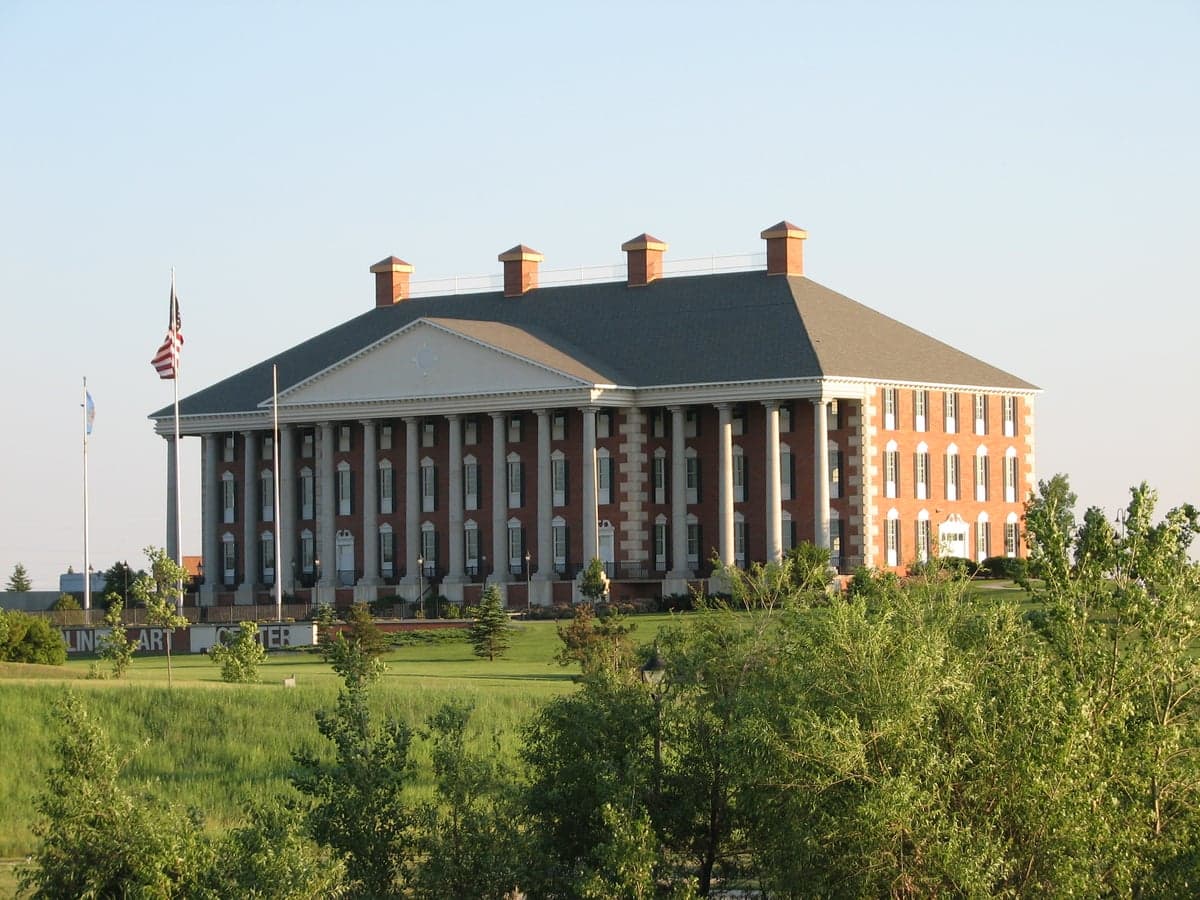
Photo: Wikipedia
Demographics of Watertown, SD
Affluence Level in Watertown, SD
A middle-class area roughly in line with national averages across income, home values, education, and employment.
People of Watertown, SD
Watertown, South Dakota, is a predominantly white, family-oriented community of 22,859 residents, where 89.9% of the population identifies as white alone. The city’s character is rooted in its agricultural and manufacturing heritage, with a notably low foreign-born population of just 0.9% and a small but growing Hispanic community at 3.4%. This is a place where generational roots run deep, and the population is stable, with a modest college attainment rate of 21.2% reflecting a workforce oriented toward trades, farming, and local industry rather than a large professional class.
How the city was settled and grew
Watertown’s human history begins with the Dakota people, who inhabited the region along the Big Sioux River before European settlement. The city was formally founded in 1879 as a railroad town, with the arrival of the Chicago and North Western Railway drawing the first major wave of settlers. These were primarily Yankee and German immigrants from the Midwest, who established farms and businesses in the original Plat A district, the city’s earliest grid of streets near the river. A second wave of Scandinavian immigrants—Norwegians, Swedes, and Danes—arrived in the 1880s and 1890s, drawn by cheap land and railroad work. They concentrated in the North End neighborhood, where Lutheran churches and Scandinavian social halls still anchor the area. By 1900, Watertown’s population had reached roughly 3,000, and the city’s identity as a regional agricultural hub was set. The Southwest Addition, platted in the 1910s, became home to second-generation German and Scandinavian families who moved out of the original downtown core as the city expanded.
Modern era (post-1965)
After the 1965 Hart-Cellar Act, Watertown saw virtually no immigration-driven diversification. The foreign-born share has remained below 1% for decades, a stark contrast to national trends. Instead, the city’s modern growth has come from domestic in-migration—primarily white families from rural Codington County and neighboring farming communities seeking schools and jobs. The Lake Kampeska area, a chain of lakes just north of the city, became a desirable suburban-style enclave for middle-class families in the 1970s and 1980s, with newer subdivisions like Prairie Winds attracting younger couples. The small Hispanic population (3.4%) began appearing in the 1990s, largely tied to work at the Lake Area Technical College and local meatpacking plants, with families settling in the East Side near the industrial corridor. The Black (0.9%) and East/Southeast Asian (0.6%) populations remain tiny and dispersed, with no distinct ethnic enclave forming. The Indian subcontinent population is effectively zero (0.0%), and the Arab population is negligible.
The future
Watertown’s demographic trajectory points toward slow homogenization rather than rapid diversification. The white share has held steady above 89% for the past decade, and the foreign-born rate is unlikely to rise significantly given the lack of refugee resettlement programs or major immigrant-employing industries. The Hispanic population is the only group showing measurable growth, increasing from 2.1% in 2010 to 3.4% today, but this is a gradual trend, not a wave. The West Side neighborhoods, including the newer Fox Run subdivision, are absorbing most new construction, attracting white families from within the region. The city’s population has grown by roughly 4% since 2010, a pace that suggests continued modest expansion driven by natural increase and regional migration, not international arrivals. The college-educated share (21.2%) is below the national average, indicating that Watertown is not drawing a large knowledge-worker cohort, which reinforces its existing demographic profile.
For someone moving in now, Watertown offers a stable, culturally homogeneous community where the population is slowly aging but still family-oriented. The city is not becoming more diverse in any meaningful sense, and the small Hispanic and Asian populations are assimilating into the broader white-majority fabric. New arrivals should expect a place where social networks are built through church, school, and local sports, and where the demographic character will look much the same in 2040 as it does today.

* Values derived from national, state, county, city and local statistics and may differ in a specific area. Last updated: 2026-04-30T21:12:55.000Z
Narrative content on this page is AI-generated and may contain mistakes. Verify any details that matter before acting on them.
ReloMaps may earn a commission from affiliate links at no extra cost to you.

