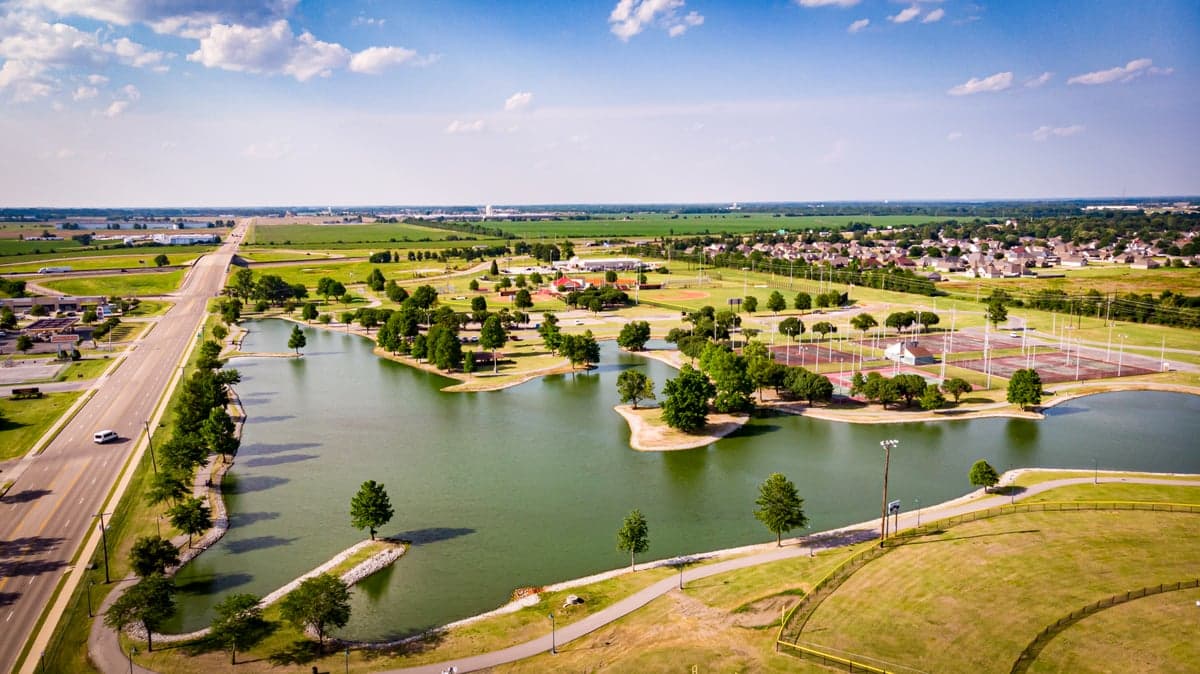
Photo: Wikipedia
Demographics of West Memphis, AR
Affluence Level in West Memphis, AR
A low-income area with significant economic hardship. Household wealth and educational attainment are well below national averages.
People of West Memphis, AR
The people of West Memphis, Arkansas today form a predominantly Black working-class city of 24,147, with 63.9% of residents identifying as Black or African American and 29.0% as White. The city is notably less diverse than the national average, with a foreign-born population of just 0.4% and minimal Hispanic (1.9%), East/Southeast Asian (0.4%), or Indian subcontinent (0.0%) communities. Only 14.8% of adults hold a college degree, reflecting a population shaped by industrial and logistics employment rather than professional or tech sectors. West Memphis is a city where deep-rooted family ties to the Delta region remain strong, and where the population has been slowly declining since its 1990 peak.
How the city was settled and grew
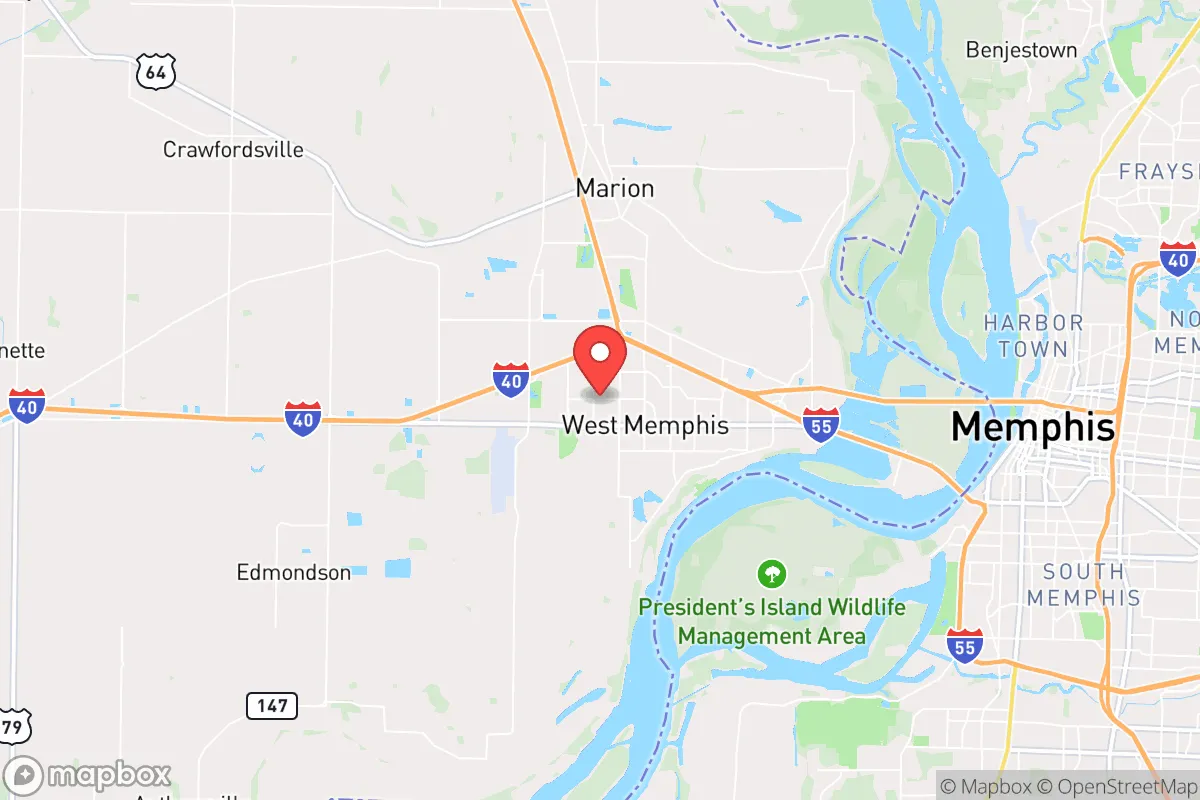
West Memphis was not a pre-Civil War settlement but a 20th-century creation, born from the expansion of the Memphis metropolitan area across the Mississippi River. The city was formally incorporated in 1927, and its early growth was driven by the construction of the Memphis & Arkansas Bridge (opened 1929) and the rise of the lumber and cotton industries. The original white settlers—mostly farmers, merchants, and railroad workers—established themselves in the Downtown West Memphis area near the riverfront and along Broadway Avenue. During the Great Migration (1910–1970), tens of thousands of Black families fleeing Jim Crow oppression in the Mississippi Delta moved into the region, with many settling in West Memphis because of its proximity to Memphis jobs and its relatively lower housing costs. The Franklin Street corridor and the Southland Park neighborhood became the primary landing points for Black families, who built churches, small businesses, and a tight-knit community fabric. By 1960, the city's population had swelled to over 15,000, with Black residents making up roughly 40% of the total.
Modern era (post-1965)
The post-1965 period saw West Memphis undergo a dramatic racial and economic transformation. The Immigration and Nationality Act of 1965 had little direct effect here—the city never attracted significant foreign-born populations—but domestic migration patterns reshaped the city. White flight to suburban Crittenden County and across the river to Tennessee accelerated after the 1968 assassination of Martin Luther King Jr. in Memphis and the subsequent racial unrest. By 1980, the Black share of the population had risen to over 55%, and it continued climbing through the 1990s and 2000s. The East End neighborhood, east of Interstate 55, became a predominantly Black middle-class area, while the West End near the river retained a mix of older white residents and newer Black arrivals. The Village Creek area, originally a white working-class enclave, transitioned to majority-Black by the 1990s. The city's population peaked at 28,259 in 1990, then began a slow decline as manufacturing jobs—especially at the nearby steel mills and chemical plants—consolidated or moved overseas. Today, the city's economy is anchored by logistics and warehousing tied to the Port of West Memphis and the Union Pacific rail yard, but these jobs have not reversed the population loss.
The future
West Memphis's population is projected to continue its slow decline, with the 2020 census showing 24,147 residents—a drop of roughly 15% from 1990. The city is homogenizing rather than diversifying: the Black share is stable or slightly increasing, while the white share is shrinking. The Hispanic population, at 1.9%, is growing slowly but remains far below national averages, and the East/Southeast Asian and Indian subcontinent communities are negligible and unlikely to expand significantly given the lack of professional-sector employment. The Southland Park and Franklin Street neighborhoods remain overwhelmingly Black, while the East End has seen some white return as housing prices in Memphis push families across the river. The city's future likely holds a continued contraction to around 22,000–23,000 by 2040, with an aging population and limited in-migration from outside the Delta region. New development is concentrated around the I-40/I-55 interchange corridor, where truck stops and distribution centers are replacing older residential blocks.
For someone moving in now, West Memphis offers a low-cost, deeply rooted community where family and church networks are strong, but where economic opportunity is limited and the population is shrinking. It is a place for those who value stability and familiarity over growth and diversity, and who are comfortable in a predominantly Black, working-class environment with minimal immigrant presence. The city is not becoming more cosmopolitan or diverse; it is becoming more settled and more insular, with a population that knows its history and intends to stay.

* Values derived from national, state, county, city and local statistics and may differ in a specific area. Last updated: 2026-04-21T07:16:41.000Z
Narrative content on this page is AI-generated and may contain mistakes. Verify any details that matter before acting on them.
ReloMaps may earn a commission from affiliate links at no extra cost to you.

