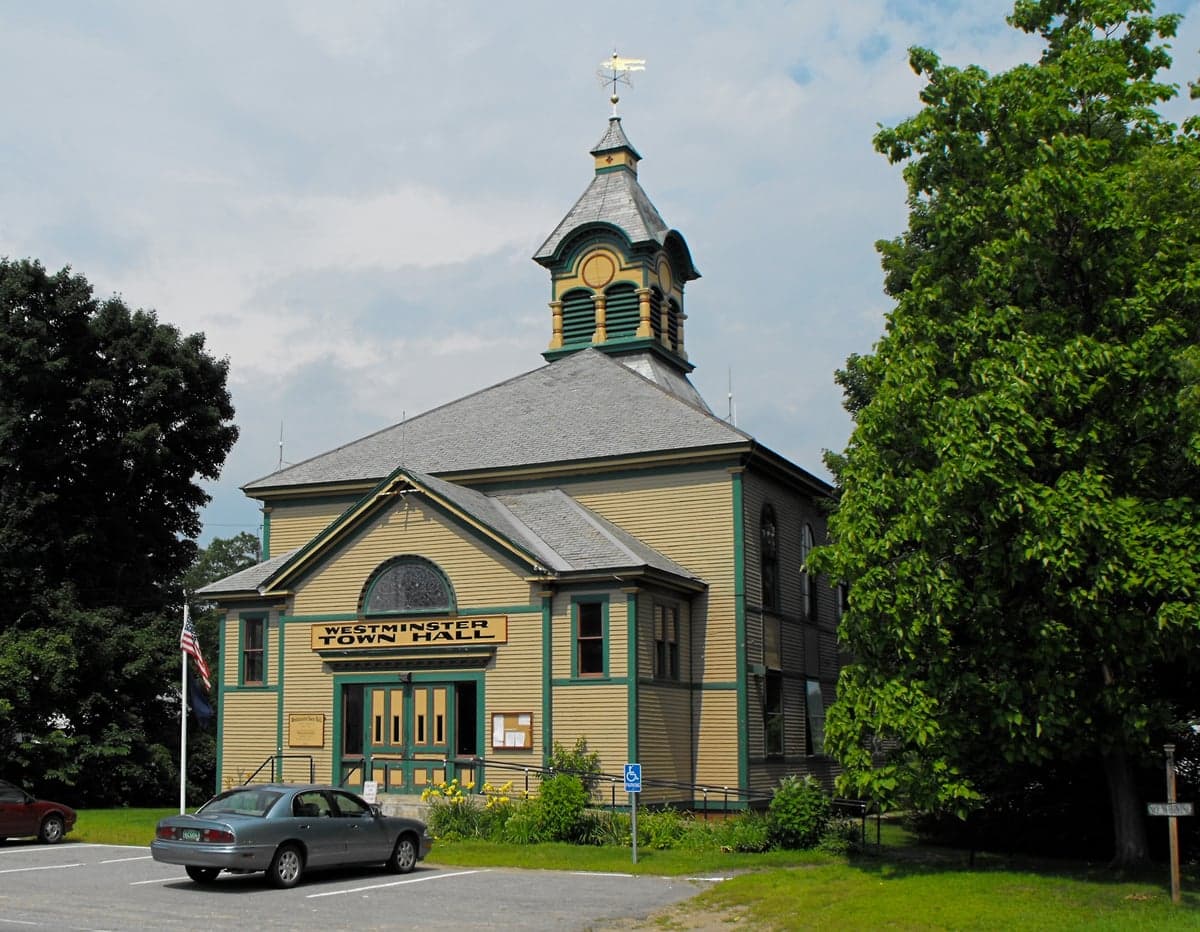
Photo: Wikipedia
Demographics of Westminster, VT
Affluence Level in Westminster, VT
A middle-class area roughly in line with national averages across income, home values, education, and employment.
People of Westminster, VT
The people of Westminster, Vermont, today form a small, predominantly white, and highly educated community of 622 residents, with a character shaped more by rural New England tradition than by diversity. The population is 91.0% white, with a Hispanic share of 5.6% and virtually no foreign-born presence (0.5%), making it one of the least ethnically diverse towns in Windham County. Nearly half of adults (47.8%) hold a college degree, a figure that reflects the town’s draw for remote workers, retirees, and second-home owners seeking quiet, land, and proximity to the Connecticut River. Westminster is not a place of rapid change; its identity is rooted in a long, slow history of Yankee settlement, agricultural persistence, and a recent trickle of newcomers from other parts of New England and the Mid-Atlantic.
How the city was settled and grew
Westminster was chartered in 1735 as part of the New Hampshire Grants, but permanent settlement did not begin until after the French and Indian War, around 1760. The earliest wave consisted almost entirely of English Protestants—Congregationalists and Baptists—from Massachusetts and Connecticut, drawn by cheap land along the Connecticut River. They built the town around a central common, now known as Westminster Village, where the first meetinghouse and tavern stood. A second wave arrived in the early 1800s: Scottish and Scots-Irish families who took up marginal hill farms in what became Westminster West, a distinct upland neighborhood that remains more rural and sparsely populated than the river valley. The town’s economy was agricultural—sheep, then dairy—supplemented by small mills along the Saxtons River. The 1840s brought a brief Irish influx to build the Connecticut River Railroad, but most moved on after construction. By 1900, Westminster’s population had already peaked near 1,200 and began a long decline as young people left for factory jobs in Springfield and Bellows Falls. The original Yankee stock remained dominant, with little immigration from Southern or Eastern Europe.
Modern era (post-1965)
After the 1965 Hart-Cellar Act, Westminster saw no significant immigrant influx; the foreign-born share has never risen above 1%. Instead, the modern era has been defined by domestic in-migration. Starting in the 1970s, back-to-the-land homesteaders—many from the Boston and New York metro areas—bought cheap farmhouses in Westminster West and along Grafton Road, drawn by low property taxes and a countercultural vision of self-sufficiency. A smaller wave of second-home buyers and retirees followed in the 1990s and 2000s, concentrating in Westminster Village and along the riverfront near Putney Road. These newcomers were disproportionately college-educated and politically liberal, creating a quiet cultural divide with longer-resident families who still farm or work in trades. The Hispanic share (5.6%) is a very recent development, likely tied to a small number of agricultural workers on dairy farms and tree farms in the surrounding area, but no distinct Hispanic neighborhood has formed. The Black and Asian populations remain at zero, reflecting the town’s persistent lack of racial diversity.
The future
Westminster’s population is likely to remain small, white, and aging, with slow growth or slight decline over the next 10–20 years. The town is not homogenizing into a single enclave; rather, it is tribalizing into two distinct groups: long-term Yankee families concentrated in Westminster West and the hill farms, and newer, more educated arrivals clustered in Westminster Village and along the river corridor. The Hispanic share may grow modestly if dairy operations expand, but it will likely remain a single-digit percentage. The foreign-born population is unlikely to rise significantly, as the town offers few jobs and little rental housing. The college-educated share will probably increase as more remote workers and retirees buy in, but the lack of young families and the high median age (estimated in the mid-50s) suggest a continued demographic drift toward an older, quieter, and more affluent population.
For someone moving in now, Westminster is becoming a place of settled rural retreat—safe, scenic, and socially homogeneous—where the main choice is between the historic village and the deeper countryside. It offers little ethnic or economic diversity, but a high level of education and civic engagement among its residents. The town is not growing or diversifying; it is refining its existing character as a white, college-educated, and land-oriented community along the Connecticut River.

* Values derived from national, state, county, city and local statistics and may differ in a specific area. Last updated: 2026-04-30T07:01:38.000Z
Narrative content on this page is AI-generated and may contain mistakes. Verify any details that matter before acting on them.
ReloMaps may earn a commission from affiliate links at no extra cost to you.

