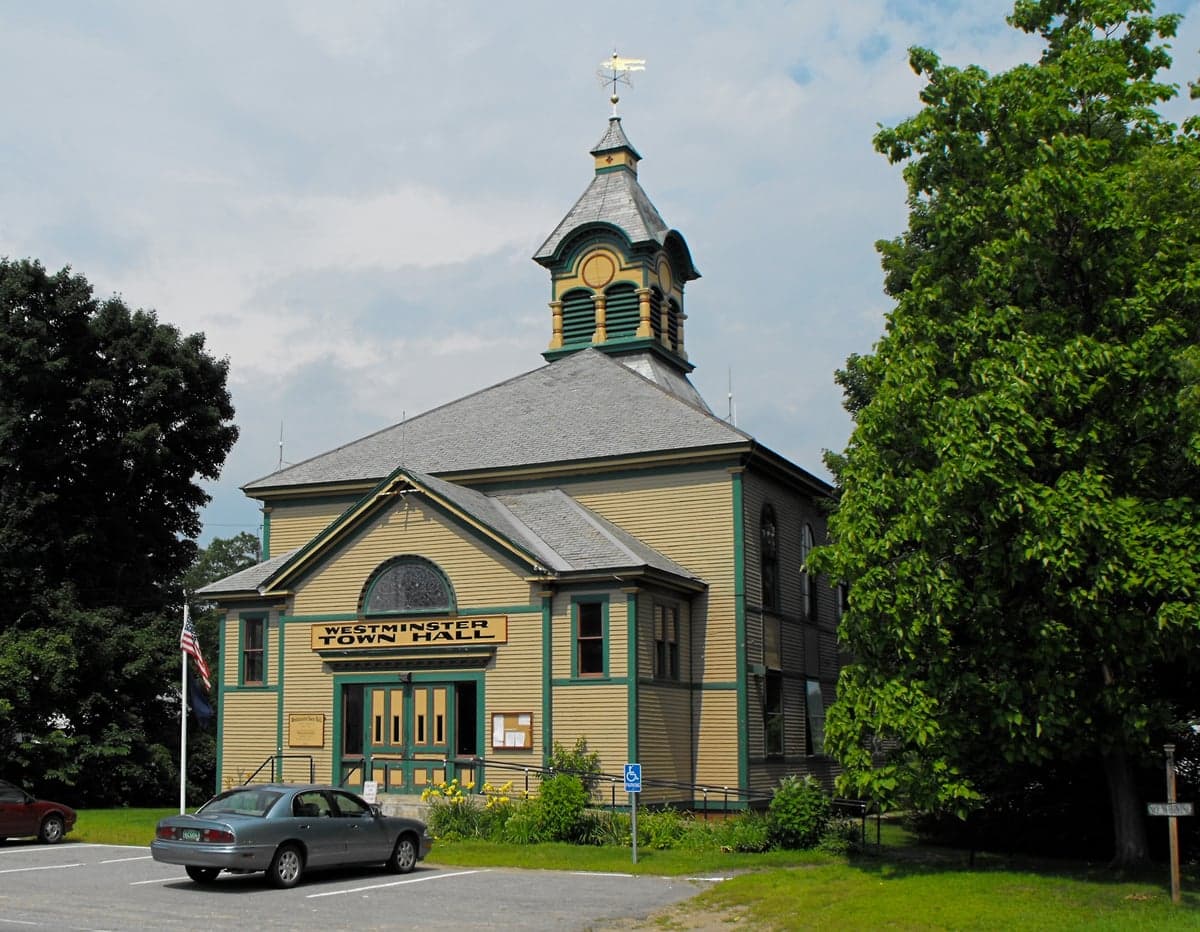
Photo: Wikipedia
Personal Sovereignty in Westminster, VT
Moderate friction. Expect trade-offs in some aspect of personal liberty and independence.
What does Personal Sovereignty tell us?
Personal Sovereignty measures your capacity for self-reliance and independence with minimal government friction. Higher scores mean fewer barriers between you and the way you want to live... but it assumes you have the space you need and good neighbors.
What does this tell us?
Personal Sovereignty measures your capacity for self-reliance and independence with minimal government friction. Higher scores mean fewer barriers between you and the way you want to live... but it assumes you have the space you need and good neighbors.
State Policy
Energy independence: Importer (15% of energy produced in-state)
Personal Liberty
Homesteading

Personal Liberty Analysis
Westminster, Vermont, offers a nuanced environment for personal sovereignty that demands careful scrutiny from those prioritizing autonomy. While the state’s progressive reputation often raises red flags for conservative-leaning individuals, Westminster’s rural character and small-town governance provide pockets of genuine self-determination, particularly for those willing to navigate Vermont’s regulatory landscape. The key is understanding where the state’s overreach ends and where local resilience begins—a calculation that can make or break a relocation decision for survivalists, preppers, and families seeking to minimize government intrusion.
Tax burden and regulatory posture: How Vermont’s policies affect your wallet and freedom
Vermont’s tax burden is among the highest in the nation, and Westminster residents feel this acutely. The state imposes a progressive income tax with rates up to 8.75%, a statewide property tax averaging around 1.8% of assessed value, and a 6% sales tax. For a prepper or homesteader, this means every dollar earned or invested in land is subject to significant government extraction. The property tax is particularly onerous because it funds education and municipal services, but it also disincentivizes land ownership—a core tenet of self-reliance. However, Westminster’s rural zoning is relatively permissive compared to more urbanized parts of Vermont. The town allows agricultural and residential uses on most parcels without excessive permitting, though any new construction must comply with state Act 250, a land-use law that can delay or block development projects. This regulatory posture creates a trade-off: you can own land and build a homestead, but the state’s bureaucracy will demand its pound of flesh at every step. For those willing to work within the system, the tax burden is a predictable cost of doing business in a state that prioritizes collective services over individual liberty.
Self-defense and gun law specifics: What Westminster allows for armed preparedness
Vermont’s gun laws are a mixed bag for the sovereignty-minded. On the positive side, the state has no permit requirement for open or concealed carry of handguns, and no registration or licensing for long guns. This aligns with a prepper’s need for immediate, unencumbered access to defensive tools. However, Vermont passed a red flag law in 2018, allowing courts to issue extreme risk protection orders (ERPOs) that temporarily confiscate firearms from individuals deemed a threat. This is a clear overreach—a subjective standard that can be weaponized by neighbors or family members against gun owners. Additionally, the state bans magazines over 15 rounds for handguns and 10 rounds for long guns, though these restrictions are rarely enforced in rural areas like Westminster. The town itself has no local gun ordinances, and the Windham County sheriff’s office is generally supportive of Second Amendment rights. For a survivalist, the lack of a permit system is a major plus, but the red flag law and magazine limits are persistent threats to autonomy. Stockpiling standard-capacity magazines before moving is advisable, as Vermont’s laws may tighten further under progressive pressure.
Self-reliance and homesteading viability: Lot sizes, zoning, and off-grid feasibility in Westminster
Westminster’s rural character makes it a strong candidate for homesteading and off-grid living. Minimum lot sizes in agricultural zones are typically 2 to 5 acres, though many parcels exceed 10 acres, providing ample space for gardens, livestock, and water catchment. Zoning is lenient for agricultural structures like barns and greenhouses, but residential dwellings must meet state building codes, which can be a hurdle for DIY construction. Off-grid systems—solar panels, composting toilets, and rainwater collection—are legal but require permits from the Vermont Department of Environmental Conservation. The state’s net metering policy allows solar owners to sell excess power back to the grid, but the regulatory paperwork can be daunting. Westminster’s soil quality is generally good for gardening, with a growing season of about 140 days, and the Connecticut River Valley provides reliable water access. For preppers, the biggest challenge is winter: heating a home off-grid requires substantial wood or propane reserves, and road maintenance is the town’s responsibility, not the state’s. Overall, Westminster offers viable self-reliance, but it demands a high level of preparation and compliance with state oversight that many sovereignty advocates will find intrusive.
Personal liberties: Parental rights, medical autonomy, speech, and property protections
Vermont’s record on personal liberties is troubling for conservative families. Parental rights are weak: the state mandates comprehensive sex education in public schools, and parents cannot opt their children out of LGBTQ-inclusive curriculum without a legal fight. Medical autonomy is similarly constrained—Vermont has a vaccine mandate for school attendance, and COVID-era restrictions were among the most aggressive in New England. This history suggests that future public health emergencies could again curtail individual choice. Free speech is protected under the First Amendment, but Vermont’s social climate in Windham County leans heavily left, meaning conservative viewpoints on topics like immigration or gun rights may face social ostracism rather than legal suppression. Property rights are stronger: Vermont has no statewide rent control, and Westminster’s zoning board generally respects landowner decisions, though Act 250 can be used by environmental groups to challenge developments. For a prepper, the most concerning liberty issue is the potential for state overreach during emergencies—Vermont’s governor has broad executive powers that could restrict movement or mandate medical interventions. This makes Westminster a location where personal sovereignty is exercised quietly, not loudly.
In the broader landscape of personal sovereignty, Westminster, Vermont, sits in a precarious middle ground. It offers genuine advantages—no gun permits, permissive homesteading zoning, and a rural culture of self-reliance—but these are offset by high taxes, red flag laws, and a state government that consistently prioritizes collective mandates over individual rights. Compared to states like New Hampshire or Texas, Vermont’s regulatory burden is heavier, but within New England, Westminster is a relative haven for those willing to accept trade-offs. For a survivalist or prepper, the key is to treat Westminster as a base for low-profile autonomy: keep your head down, build your homestead, and prepare for the possibility that state overreach may escalate. It’s not a fortress of liberty, but it’s a place where a determined individual can carve out a sovereign life—if they’re ready to fight for it.

* Values derived from national, state, county, city and local statistics and may differ in a specific area. Last updated: 2026-04-30T07:01:38.000Z
Narrative content on this page is AI-generated and may contain mistakes. Verify any details that matter before acting on them.
ReloMaps may earn a commission from affiliate links at no extra cost to you.

