Photo: Wikipedia
Demographics of Wright, WY
Affluence Level in Wright, WY
A middle-class area roughly in line with national averages across income, home values, education, and employment.
People of Wright, WY
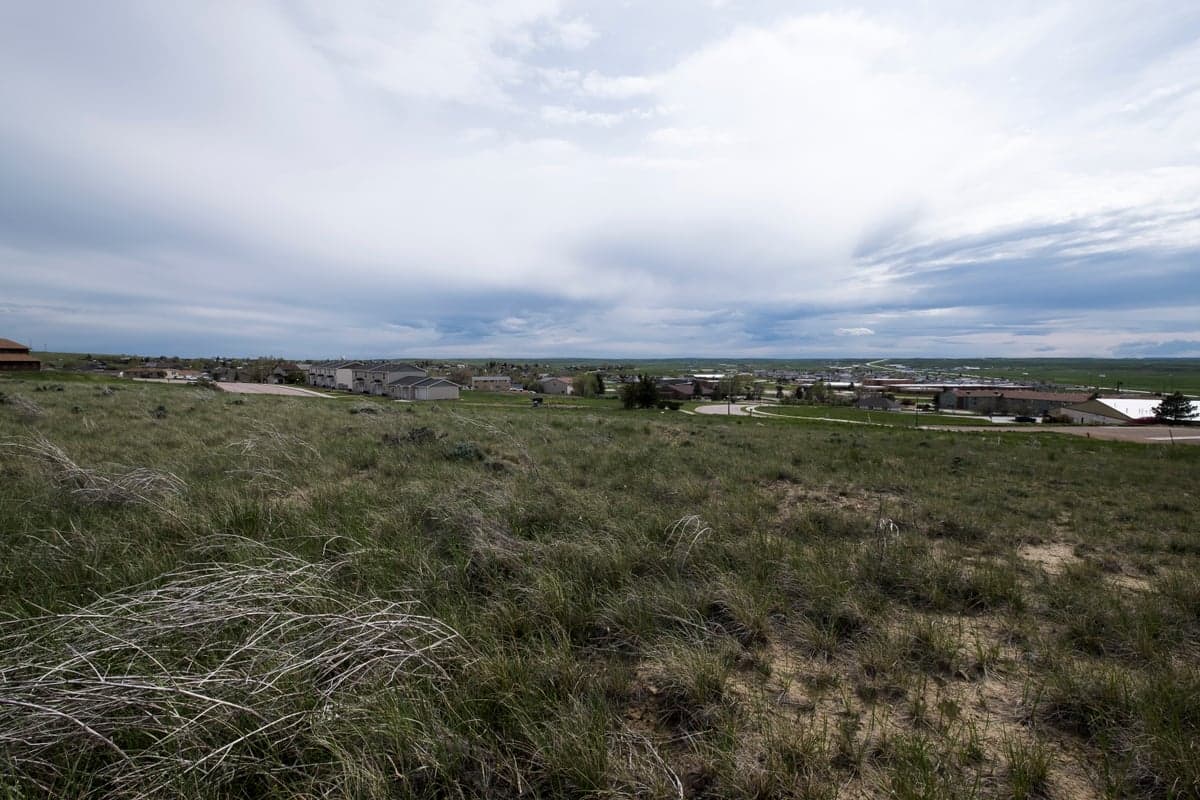
Wright, Wyoming, is a small, tightly-knit community of roughly 1,400 residents, defined by its roots in the energy industry and a predominantly white, working-class character. The city’s population is notably less diverse than the national average, with a white share of 72.8% and a Hispanic population of 16.3%, while Black and Asian residents each make up less than 1% of the populace. A distinctive marker is the high foreign-born share of 15.6%, largely tied to energy-sector labor, though the college-educated rate stands at just 8.5%, reflecting a workforce oriented toward trades and extraction rather than professional services. Wright’s identity is that of a planned company town turned independent community, where family ties to mining and oil remain the central social fabric.
How the city was settled and grew
Wright is a genuinely post-1970s planned community, with no colonial or pioneer-era history. The city was founded in 1975 by the Atlantic Richfield Company (ARCO) to house workers for the nearby Black Thunder Coal Mine, one of the largest coal operations in the United States. The original population was almost entirely white, drawn from other parts of Wyoming and the broader Rocky Mountain region by high-paying mining jobs. The first wave of settlers built homes in the Original Townsite, the core grid of streets around Wright Boulevard, where many of the earliest company-built houses still stand. A second wave in the 1980s, fueled by the oil boom, expanded into the West Wright Addition, a neighborhood of larger single-family homes on wider lots, reflecting the influx of workers from Texas and Oklahoma. The city’s growth was deliberately planned, with no historic ethnic enclaves; the early population was homogeneous, with a small number of Hispanic laborers arriving in the 1990s to work in mine maintenance and trucking, settling primarily in the Southside Trailer Park area near the mine access road.
Modern era (post-1965)
Wright’s modern demographic story is one of modest diversification driven by energy-sector labor demand, not by post-1965 immigration reform. The foreign-born share of 15.6% is high for a Wyoming town of this size, but it is almost entirely composed of Hispanic workers from Mexico and Central America who arrived from the late 1990s onward. These workers and their families have concentrated in the Meadow View neighborhood, a cluster of manufactured homes and duplexes south of the town center, and in the East End area near the highway, where rental properties serve transient mine and oilfield crews. The white population, while still the majority, has aged and shrunk slightly as younger locals leave for college or jobs in Casper and Gillette. The Black and Asian populations remain negligible—0.9% and 0.0%, respectively—with no significant Indian-subcontinent community. The Hispanic population has grown from near zero in 1990 to 16.3% today, but this growth has not led to ethnic enclaves in the traditional sense; rather, Hispanic families are integrated into the same neighborhoods, with Meadow View being the only area with a noticeable concentration. The college-educated share of 8.5% is low, reflecting the town’s reliance on high-school-educated labor for mining and energy jobs, and this has limited the in-migration of professional or tech workers.
The future
The population of Wright is likely to remain stable or shrink slightly over the next decade, as the coal industry faces long-term decline and automation reduces the need for manual labor. The Hispanic community is expected to grow as a share of the total, potentially reaching 20-25% by 2035, driven by family reunification and continued recruitment for remaining mine and oilfield positions. However, this growth is unlikely to create distinct ethnic enclaves; instead, Hispanic families are assimilating into the existing neighborhoods, with second-generation children attending Campbell County schools and speaking English as a first language. The white population will continue to age, with younger adults moving to larger cities for education and white-collar jobs, leading to a gradual homogenization of the town’s character around a working-class, energy-industry identity. No new immigrant communities from Asia or the Indian subcontinent are expected to arrive, given the lack of professional job opportunities. The Original Townsite will likely see more retirees and empty-nesters, while West Wright Addition may attract younger families seeking affordable housing compared to Gillette.
For someone moving in now, Wright is becoming a more Hispanic-influenced but still overwhelmingly white, blue-collar community where the energy industry remains the sole economic anchor. The town offers stability and low crime, but limited upward mobility for those without a trade skill. The population is not tribalizing into distinct enclaves but rather slowly integrating, with the main division being between long-term mining families and newer energy workers, regardless of ethnicity. This is a place for those who value a quiet, family-oriented life tied to the land and the mine, not for those seeking diversity or professional opportunity.

* Values derived from national, state, county, city and local statistics and may differ in a specific area. Last updated: 2026-04-21T11:30:04.000Z
Narrative content on this page is AI-generated and may contain mistakes. Verify any details that matter before acting on them.
ReloMaps may earn a commission from affiliate links at no extra cost to you.

