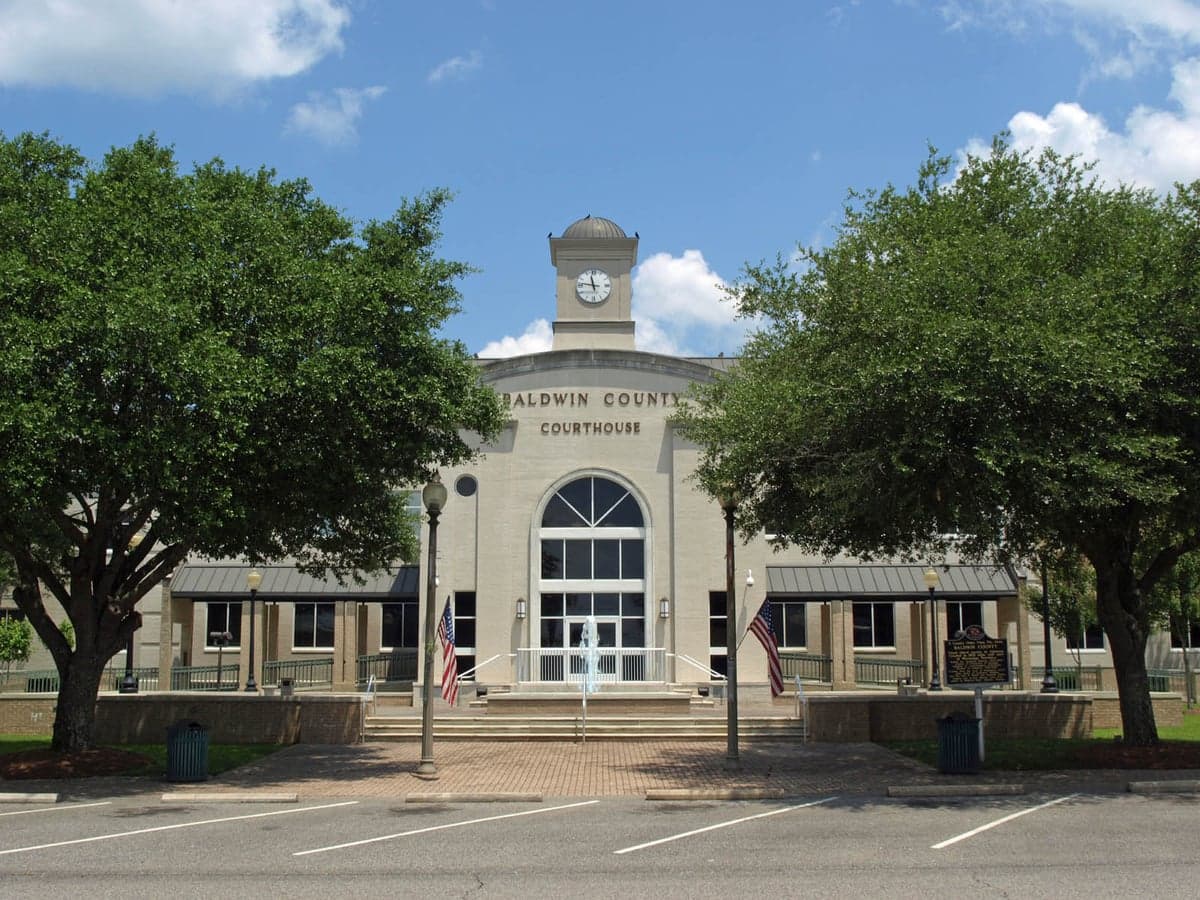
Photo: Wikipedia
Demographics of Baldwin County
Affluence Level in Baldwin County
A middle-class area roughly in line with national averages across income, home values, education, and employment.
People of Baldwin County
Baldwin County, Alabama, is home to 239,945 residents who are predominantly white (81.4%) and native-born (only 2.1% foreign-born), creating a cultural landscape that is more Southern and rural in character than the national average. The county’s identity is shaped by its deep-rooted Protestant heritage, a strong military and coastal economy, and a population that is notably less diverse than the broader United States. With 32.8% of adults holding a college degree, the area attracts families and retirees seeking a slower pace near the Gulf Coast, but its demographic story is one of gradual, rather than radical, change.
Settlement & growth (pre-1960)
Long before European arrival, the area now known as Baldwin County was inhabited by the Muskogean-speaking peoples, including the Creek Confederacy and the Choctaw. These groups lived in dispersed villages along the Mobile Bay and the Tensaw River, relying on fishing, hunting, and agriculture. Spanish explorers, including Hernando de Soto, passed through in the 1540s, but permanent European settlement did not begin until the early 1700s, when the French established a presence at Mobile (just across the bay) and built Fort Louis. The French influence was thin, however, and the region remained a sparsely populated frontier under French, then British, then Spanish control until the United States acquired it in the 1813 Mississippi Territory annexation.
American settlement exploded after the Treaty of Fort Jackson (1814), which forced the Creek Nation to cede vast tracts of land. The first major wave of Anglo-American settlers were Scots-Irish and English farmers from the Upper South—Virginia, the Carolinas, and Tennessee—who arrived in the 1810s and 1820s. They established small cotton plantations and subsistence farms, founding towns like Daphne (established 1763 as a French settlement, but re-settled by Americans after 1814) and Stockton (an early river port). The county’s economy was built on enslaved African-American labor; by 1860, enslaved people made up roughly 40% of the county’s population, concentrated on plantations near the Mobile-Tensaw Delta.
After the Civil War and Reconstruction, the county’s population grew slowly. The timber and turpentine industries drew a modest number of white laborers from the Deep South in the 1880s and 1890s, but Baldwin County remained overwhelmingly rural and agricultural. The arrival of the Louisville and Nashville Railroad in the 1890s spurred the growth of Bay Minette (the county seat, incorporated 1901) and Fairhope (founded 1894 as a utopian single-tax colony by Midwestern reformers). Fairhope attracted a distinct group of Northern-born, educated settlers—a small but influential wave of progressive-minded families from Ohio, Illinois, and Iowa—who shaped the town’s character as a liberal enclave within a conservative county.
The 20th century brought little demographic change until after World War II. The Boll Weevil infestation and the Great Depression pushed many black and white farmers off the land, but the county’s population actually grew during the 1940s due to the establishment of Brookley Air Force Base in nearby Mobile and the expansion of the shipbuilding industry along the coast. The 1950s saw the first wave of Sun Belt migration, as retirees and military personnel began settling in Gulf Shores and Orange Beach, drawn by the white-sand beaches and the opening of the Gulf State Park in 1939. By 1960, the county’s population had reached roughly 50,000, still overwhelmingly white and native-born, with a small but established African-American community concentrated in Baldwin County’s rural northern half and in the town of Loxley.
Modern era (post-1965)
The 1965 Hart-Cellar Act, which ended national-origin quotas, had a minimal direct impact on Baldwin County. The foreign-born population remains just 2.1% today, far below the national average of roughly 14%. The county did not experience the large-scale immigration from Latin America or Asia that transformed many other Southern counties. Instead, the post-1965 story is one of domestic migration—primarily from the Rust Belt and the interior South—and the gradual suburbanization of the Mobile Bay coastline.
The most significant demographic shift began in the 1970s and accelerated through the 1990s: the retirement and tourism boom along the Gulf Coast. Gulf Shores and Orange Beach transformed from sleepy fishing villages into major vacation destinations, attracting seasonal residents and permanent retirees from the Midwest, the Northeast, and Canada. This wave was overwhelmingly white and middle-class, drawn by the warm climate, low taxes, and relatively low cost of living. The county’s population more than doubled between 1970 and 2000, from roughly 60,000 to over 140,000.
In the same period, Fairhope and Daphne evolved into affluent suburbs of Mobile, attracting professionals and executives who worked across the bay. This suburbanization brought a modest influx of white-collar migrants from other parts of Alabama and the South, but the county’s racial composition remained remarkably stable: the white share of the population hovered around 80-85% throughout the late 20th century. The African-American population, which had been roughly 25% in 1960, declined to about 8% by 2020, as many black families left for urban areas with better economic opportunities.
The Hispanic population, now 5.6%, began to grow in the 1990s and 2000s, driven by construction and service-industry jobs tied to the tourism economy. This community is largely of Mexican and Central American origin, with a smaller number of Puerto Ricans. They are dispersed across the county, with small concentrations in Foley and Robertsdale, where agricultural work (especially in poultry processing and vegetable farming) provided initial footholds. The East/Southeast Asian population (0.8%) and Indian-subcontinent population (0.2%) remain tiny, mostly professionals in healthcare and engineering who settled in the Daphne-Fairhope corridor.
The future
Baldwin County is projected to continue growing, with estimates suggesting a population of over 300,000 by 2040. The primary driver will remain domestic migration from other states, particularly from the Midwest and the Northeast, as retirees and remote workers seek the Gulf Coast’s lower cost of living and warmer winters. The county’s foreign-born population is likely to remain low, though the Hispanic share may rise modestly to 8-10% as the service economy expands.
The county is not tribalizing into distinct ethnic enclaves in the way that larger metropolitan areas are. Instead, the dominant trend is cultural homogenization around a conservative, Southern, Protestant identity. The influx of out-of-state retirees is being absorbed into this existing culture rather than transforming it, as most newcomers are themselves white and politically conservative. The African-American population is likely to remain stable or decline slightly, while the Hispanic community will grow but remain a small minority.
The most significant cultural tension is not ethnic but urban-rural: the coastal towns of Gulf Shores, Orange Beach, Fairhope, and Daphne are becoming more affluent, more educated, and more politically moderate, while the northern part of the county—Bay Minette, Stockton, Loxley—remains poorer, more rural, and more deeply conservative. This divide may widen as coastal property values rise and inland areas struggle to attract investment.
For someone moving in now, Baldwin County offers a stable, predominantly white, and culturally traditional environment with a growing economy tied to tourism and retirement. The population is becoming slightly more diverse at the margins, but the core identity—native-born, Protestant, conservative—is likely to persist for at least another generation. The county is a place where change happens slowly, and where newcomers are expected to adapt to the existing social order rather than reshape it.

* Values derived from national, state, county, city and local statistics and may differ in a specific area. Last updated: 2026-05-09T19:29:23.000Z
Narrative content on this page is AI-generated and may contain mistakes. Verify any details that matter before acting on them.
ReloMaps may earn a commission from affiliate links at no extra cost to you.

