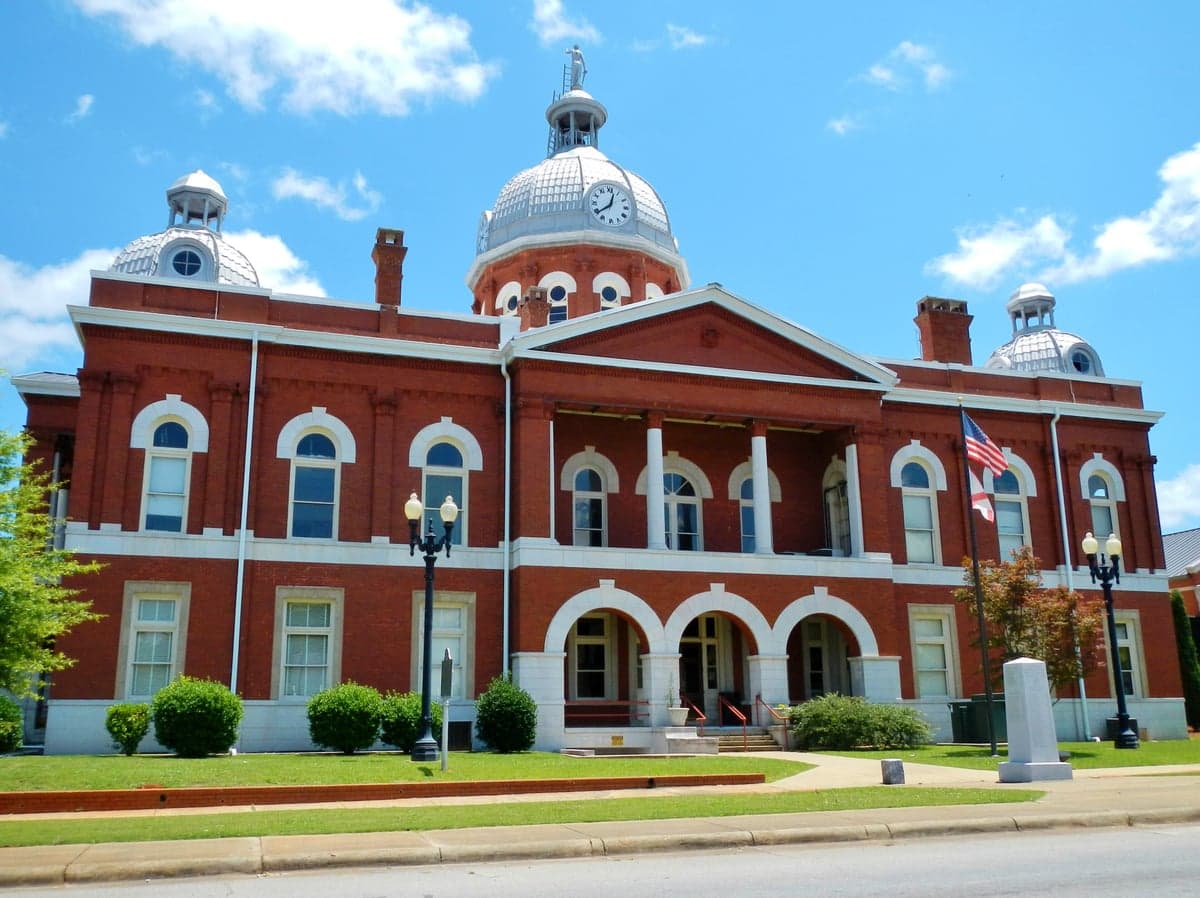
Photo: Wikipedia
Demographics of Chambers County
Affluence Level in Chambers County
A below-average socioeconomic profile. Incomes, home values, and educational attainment trail the U.S., with higher poverty and unemployment.
People of Chambers County
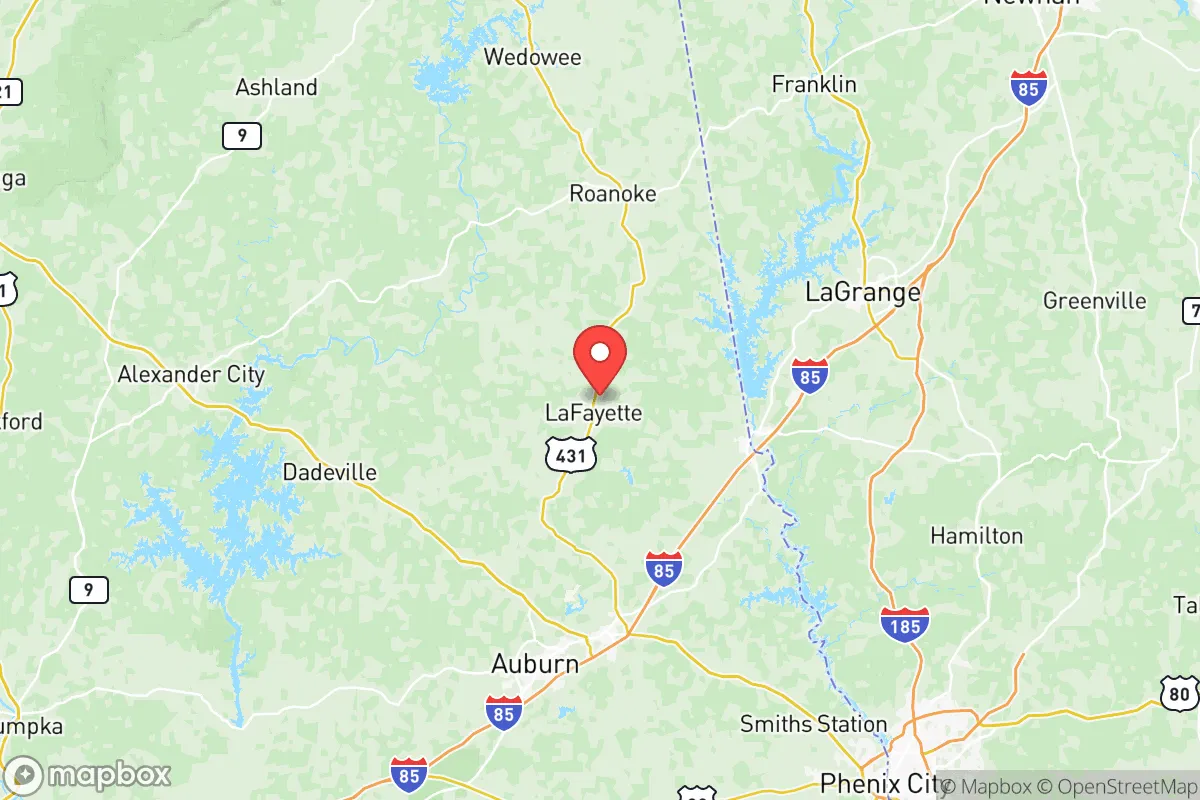
Chambers County, Alabama, is home to 34,450 residents, a population shaped by a deep-rooted Black and White Southern heritage, with a small but growing Hispanic presence. The county’s character is defined by its rural and small-town fabric, anchored by the cities of LaFayette (the county seat) and Valley, along with the historic mill towns of Lanett and Huguley. With a population that is 53.9% White and 39.7% Black, Chambers County reflects a biracial Southern dynamic, while its low foreign-born share of 2.4% and a college attainment rate of just 14.6% mark it as a community with deep local roots and limited recent international immigration.
Settlement & growth (pre-1960)
Long before European settlement, the area that is now Chambers County was the domain of the Creek (Muscogee) Nation, whose towns and farmlands lined the Tallapoosa River and its tributaries. The Creeks were forcibly removed in the 1830s following the Indian Removal Act, opening the land to White settlers from Georgia and the Carolinas. These early settlers, primarily of Scots-Irish and English descent, arrived in the 1830s and 1840s, drawn by the promise of fertile cotton land. They established the county’s earliest communities, including LaFayette, founded in 1835, and Five Points, which grew as a trading post. The county was officially created in 1858, carved from parts of Montgomery and Tallapoosa counties, and named for U.S. Senator Henry Chambers.
The post-Civil War era brought profound change. Emancipation freed thousands of enslaved Black people, who remained in the county as sharecroppers and tenant farmers. By the late 19th century, the cotton textile industry began to reshape the economy and population. The construction of the West Point Manufacturing Company mills along the Chattahoochee River in the 1880s and 1890s created the mill villages of Lanett (incorporated 1895), Langdale, River View, and Fairfax. These company towns drew White and Black workers from the surrounding countryside, creating dense, insular communities centered on the mill whistle. Valley, incorporated in 1980, later consolidated several of these mill villages into a single city. The textile boom also attracted a small number of European immigrants, though their numbers remained negligible compared to the dominant native-born population.
The Great Migration (1910–1970) saw a significant outflow of Black residents from Chambers County to industrial cities in the North and Midwest, a trend that continued for decades. Meanwhile, the county’s White population remained relatively stable, anchored by the textile mills and small-scale agriculture. By 1960, Chambers County was a biracial, rural-industrial society, with a population of roughly 36,000, nearly evenly split between Black and White residents. The county’s economy was overwhelmingly dependent on the textile mills, which employed thousands and defined the social order of towns like Lanett and Valley.
Modern era (post-1965)
The post-1965 era brought gradual but significant demographic shifts to Chambers County. The 1965 Hart-Cellar Act, which reshaped U.S. immigration, had a muted effect here compared to urban and coastal areas. The foreign-born population remains low at 2.4%, and the county has not seen the large-scale immigration from Latin America, Asia, or Africa that transformed many other Southern counties. The Hispanic share of the population is 3.7%, a modest presence concentrated in Valley and LaFayette, where a small number of Mexican and Central American immigrants have arrived to work in poultry processing, construction, and agriculture. East and Southeast Asian residents make up 0.6% of the population, with a handful of families in Valley and Lanett, often connected to small businesses or professional roles. The Indian-subcontinent population is effectively zero.
The most dramatic domestic shift has been the decline of the textile industry. Beginning in the 1970s and accelerating through the 1990s and 2000s, mill closures devastated the economies of Lanett, Valley, and Huguley. The West Point Manufacturing Company, once the county’s largest employer, shrank and eventually closed most of its operations. This led to population loss and out-migration, particularly among younger residents seeking jobs elsewhere. The county’s population peaked at around 39,000 in 1980 and has since declined to 34,450. The White population share has fallen from a slight majority to 53.9%, while the Black share has remained relatively stable at 39.7%, reflecting a slow but steady out-migration of both groups.
Suburbanization has been limited. Chambers County remains rural and small-town, with no major metropolitan growth spilling over from nearby Auburn or Columbus, Georgia. However, some commuters have moved into the county, particularly to Valley and LaFayette, seeking lower housing costs. The county’s low college attainment rate of 14.6% reflects the loss of educated young adults to larger cities and the limited local demand for high-skill labor. The economy has diversified modestly into healthcare, education, and retail, but manufacturing and agriculture remain significant employers.
The future
Chambers County’s population is projected to continue a slow decline or stabilize at current levels, with little prospect of rapid growth. The county is becoming slightly more diverse, driven by the gradual increase in the Hispanic population, which is expected to rise from 3.7% to perhaps 5-7% over the next decade, as families settle in Valley and LaFayette for work in poultry processing and construction. The Black and White populations are likely to remain stable in absolute numbers, though their shares may shift slightly as the Hispanic share grows. The East/Southeast Asian population is expected to remain very small, below 1%.
The county’s cultural identity is evolving slowly. The old mill-town culture, once dominant in Lanett and Valley, is fading as the textile industry recedes into memory. Newer residents, including retirees and commuters, are drawn by low property taxes and a slower pace of life, but the county lacks the amenities and job base to attract large numbers of newcomers. The next 10-20 years will likely see Chambers County remain a predominantly biracial, rural community with a small but growing Hispanic minority, a low college attainment rate, and an economy that continues to struggle to replace the manufacturing jobs that once defined it.
For someone moving in now, Chambers County offers a deeply rooted, affordable, and quiet Southern lifestyle, but with limited economic opportunity and demographic diversity. The county is becoming a place where long-time residents age in place and a trickle of newcomers arrive for low costs, not for a booming job market or cultural dynamism. It is a community that values stability and tradition, but faces the challenge of retaining its young people and attracting the investment needed to reverse decades of population decline.

* Values derived from national, state, county, city and local statistics and may differ in a specific area. Last updated: 2026-10-20T14:15:37.000Z
Narrative content on this page is AI-generated and may contain mistakes. Verify any details that matter before acting on them.
ReloMaps may earn a commission from affiliate links at no extra cost to you.

