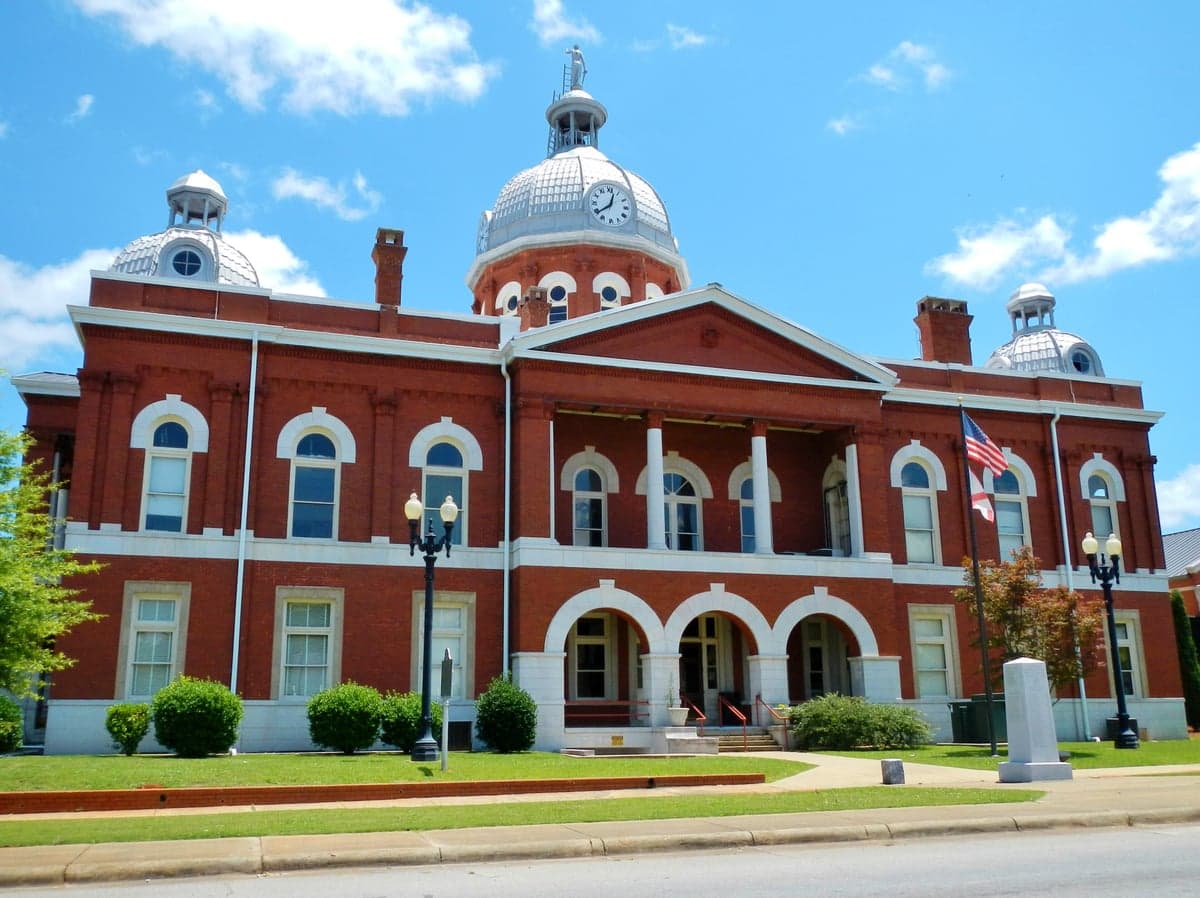
Photo: Wikipedia
Political ClimatePolitical Climate in Chambers County
Showing district-level results — no local-only data available.
Local Political AnalysisPolitical Analysis of Chambers County
Chambers County is a solidly Republican stronghold, carrying a Cook Partisan Voting Index of R+23, making it one of the most reliably red counties in eastern Alabama. The county has been trending further right over the last decade, driven largely by the rural and small-town electorate's alignment with national GOP priorities. While the county seat, LaFayette, and the smaller town of Cusseta have shown slightly more competitive margins in local races—occasionally leaning blue in down-ballot contests—the overall trajectory is unmistakably conservative, with Valley and Lanett anchoring the Republican base in the northern part of the county.
How it compares
Compared to the rest of Alabama, Chambers County is significantly more Republican than the state average. Alabama as a whole has a Cook PVI of R+15, meaning Chambers County is about eight points more conservative than the state baseline. This gap is most visible in presidential and U.S. Senate races, where Chambers County routinely delivers margins 10 to 15 points higher for GOP candidates than the statewide average. The county's political geography mirrors the broader "Black Belt" pattern—rural, predominantly white precincts in the north and west vote heavily Republican, while the southern and eastern parts of the county, including parts of LaFayette and the area around Five Points, have a higher concentration of African American voters who reliably support Democratic candidates. This creates a clear urban-rural and racial divide within the county, but the sheer population weight of the conservative precincts ensures the overall result stays deep red.
What this means for residents
For conservative residents, the political climate means their values are broadly reflected in local governance—county commission meetings, school board decisions, and law enforcement priorities tend to align with traditional Republican platforms. Tax policy is generally low, and gun rights are strongly protected. For liberal residents, the reality is more isolating. While there are pockets of Democratic support in LaFayette and Cusseta, progressive voices are often outnumbered in public forums and local elections. That said, the county's small size means that personal relationships still matter more than party labels in many local disputes—a pragmatic streak runs through Chambers County politics that can sometimes surprise outsiders. The county's economy, heavily tied to manufacturing and agriculture, means that policy debates often center on jobs, infrastructure, and industrial recruitment rather than the culture war issues that dominate national headlines.
Culturally, Chambers County is distinct from the more urbanized parts of Alabama like Jefferson County or Madison County. There is a strong sense of local identity tied to the Chattahoochee River and the textile mill history of Valley and Lanett. Policy-wise, the county has been slower to adopt broadband expansion and economic diversification initiatives compared to the state's growth corridors, partly due to a cautious fiscal conservatism. However, recent investments in the Kia plant and related suppliers in West Point, just across the Georgia line, have begun to shift the conversation toward infrastructure and workforce development. For anyone moving here, the political climate is straightforward: expect a deeply conservative community where local issues like road funding and school quality matter more than national partisan battles, but where the overall direction is firmly red and likely to stay that way for the foreseeable future.

State Political ClimatePolitical Climate in Alabama
State Political AnalysisPolitical Environment in the State
Alabama is one of the most reliably Republican states in the country, with a deep-red lean that has only solidified over the past 20 years. The state has not voted for a Democratic presidential candidate since 1976, and in 2024, Donald Trump carried it by roughly 30 points. The dominant coalition is a blend of rural white evangelicals, suburban conservatives, and a growing number of transplants from blue states drawn by low taxes and a slower pace of life. Over the last decade, the shift has been subtle but real: the rural-urban gap has widened, while the state’s few blue pockets—chiefly in the Black Belt and parts of Birmingham—have become more isolated politically.
Urban vs. rural divide
The political map of Alabama is starkly divided. The state’s largest metro, Birmingham (Jefferson County), is a Democratic stronghold, delivering about 60% of its vote to Joe Biden in 2020. But drive 20 minutes south to Shelby County, and you’re in one of the most Republican suburbs in the nation—Shelby gave Trump over 70% of the vote. Montgomery, the capital, leans Democratic thanks to its large Black population, while Huntsville, a fast-growing tech hub in Madison County, is a fascinating mix: historically conservative, but now trending purple as out-of-state engineers and defense contractors move in. Mobile and Baldwin counties on the Gulf Coast are reliably red, with Baldwin being one of the fastest-growing and most conservative areas in the state. The rural Black Belt—stretching from Greene County to Macon County—remains overwhelmingly Democratic and majority-Black, but its population is shrinking. Meanwhile, the rural white counties in north and south Alabama are as Republican as any in the country.
Policy environment
Alabama’s policy environment is shaped by a deep commitment to low taxes and limited government. There is no state income tax on Social Security benefits, and the state’s income tax rate tops out at 5%, one of the lowest in the Southeast. Property taxes are among the lowest in the nation—averaging around 0.4% of home value—which is a major draw for relocators. The state has a right-to-work law, meaning no one can be forced to join a union as a condition of employment. Education policy is a mixed bag: the state has a robust school choice program, including the Alabama Accountability Act, which provides tax credits for private school tuition, but public school funding remains near the bottom nationally. Healthcare is a persistent challenge—Alabama did not expand Medicaid under the Affordable Care Act, leaving a coverage gap that affects roughly 200,000 low-income adults. Election laws are among the most restrictive in the country: voter ID is required, absentee voting requires a notarized application or two witnesses, and early voting is not available. The state also passed a 2019 law banning curbside voting and limiting the distribution of absentee ballot applications.
Recent policy direction
Over the past five years, Alabama has moved decisively in a conservative direction on nearly every front. In 2022, the state passed a near-total abortion ban with no exceptions for rape or incest, which took effect after the Dobbs decision. Gun laws are among the most permissive in the nation: permitless carry became law in 2022, meaning any adult who can legally own a firearm can carry it concealed without a license. The state also passed a “stand your ground” law in 2006 and has no red flag law. On education, the 2022 “Parental Rights” law (HB 322) requires schools to notify parents of any medical or mental health services offered to their child, and the 2023 “Don’t Say Gay” law (HB 385) restricts classroom discussion of sexual orientation and gender identity in K-5. Property rights are strongly protected—Alabama is a “right to farm” state, limiting nuisance lawsuits against agricultural operations. On privacy and surveillance, the state has no comprehensive data privacy law, though a 2023 law restricts the use of facial recognition by law enforcement without a warrant. Voting access has tightened: in 2024, the state passed a law making it a crime to return another person’s absentee ballot, with limited exceptions. The overall direction is toward more individual liberty in some areas (guns, taxes, property) and more government restriction in others (abortion, education, voting).
Civil unrest & political movements
Alabama has a quieter political landscape than many states, but it has seen its share of flashpoints. In 2020, protests over the murder of George Floyd in Birmingham and Montgomery were large but largely peaceful, though there were isolated incidents of property damage. The state’s immigration politics are relatively low-key compared to border states, but a 2011 law (HB 56) was one of the toughest in the nation, requiring police to check immigration status during stops and making it a crime to harbor undocumented immigrants—much of it was later struck down or weakened in court. There is no sanctuary city movement in Alabama; in fact, the state passed a law in 2024 banning sanctuary policies outright. Election integrity has been a recurring theme: after the 2020 election, some Republican legislators pushed for a forensic audit of the results, though no widespread fraud was found. The most visible political movement in recent years has been the “school choice” and parental rights push, which has energized conservative voters in suburban areas like Hoover and Auburn. On the left, the Alabama Poor People’s Campaign and the Alabama Arise coalition have been active on Medicaid expansion and criminal justice reform, but they have limited legislative success.
Projection
Over the next 5-10 years, Alabama is likely to remain deeply Republican, but the nature of that conservatism may shift. In-migration from states like California, Illinois, and New York is accelerating, particularly to Huntsville and Baldwin County. These newcomers tend to be fiscally conservative but socially moderate, which could soften the state’s hardline positions on some issues over time. Huntsville’s growth—driven by the defense and aerospace sectors—is already making Madison County more competitive; it voted for Trump by 17 points in 2020, down from 28 points in 2016. The Black Belt will continue to lose population, reducing the Democratic base outside of Birmingham and Montgomery. The state’s Republican primary will remain the real battleground, with fights between establishment conservatives and more populist, Trump-aligned factions. On policy, expect continued pressure to expand school choice, further restrict abortion access (possibly through a state constitutional amendment), and resist any federal push for gun control. Medicaid expansion remains a long shot, but the coverage gap is a persistent issue that could become a political liability if healthcare costs continue to rise. A relocator moving in now should expect a state that is solidly red, but with a growing suburban moderate wing that could make the politics less predictable in a decade.
For a new resident, the bottom line is this: if you’re conservative, you’ll find a state that largely aligns with your values on taxes, guns, and education, with a political culture that rewards engagement in Republican primaries. If you’re liberal, you’ll find a state where your vote carries less weight in statewide elections, but where cities like Birmingham, Huntsville, and Montgomery offer like-minded communities and local representation. The practical takeaway is that Alabama’s politics are stable, predictable, and unlikely to surprise you—but the demographic shifts underway in places like Huntsville and Baldwin County are worth watching if you’re planning to put down roots for the long haul.
* Values derived from national, state, county, city and local statistics and may differ in a specific area. Last updated: 2026-10-20T14:15:37.000Z
Narrative content on this page is AI-generated and may contain mistakes. Verify any details that matter before acting on them.
ReloMaps may earn a commission from affiliate links at no extra cost to you.

