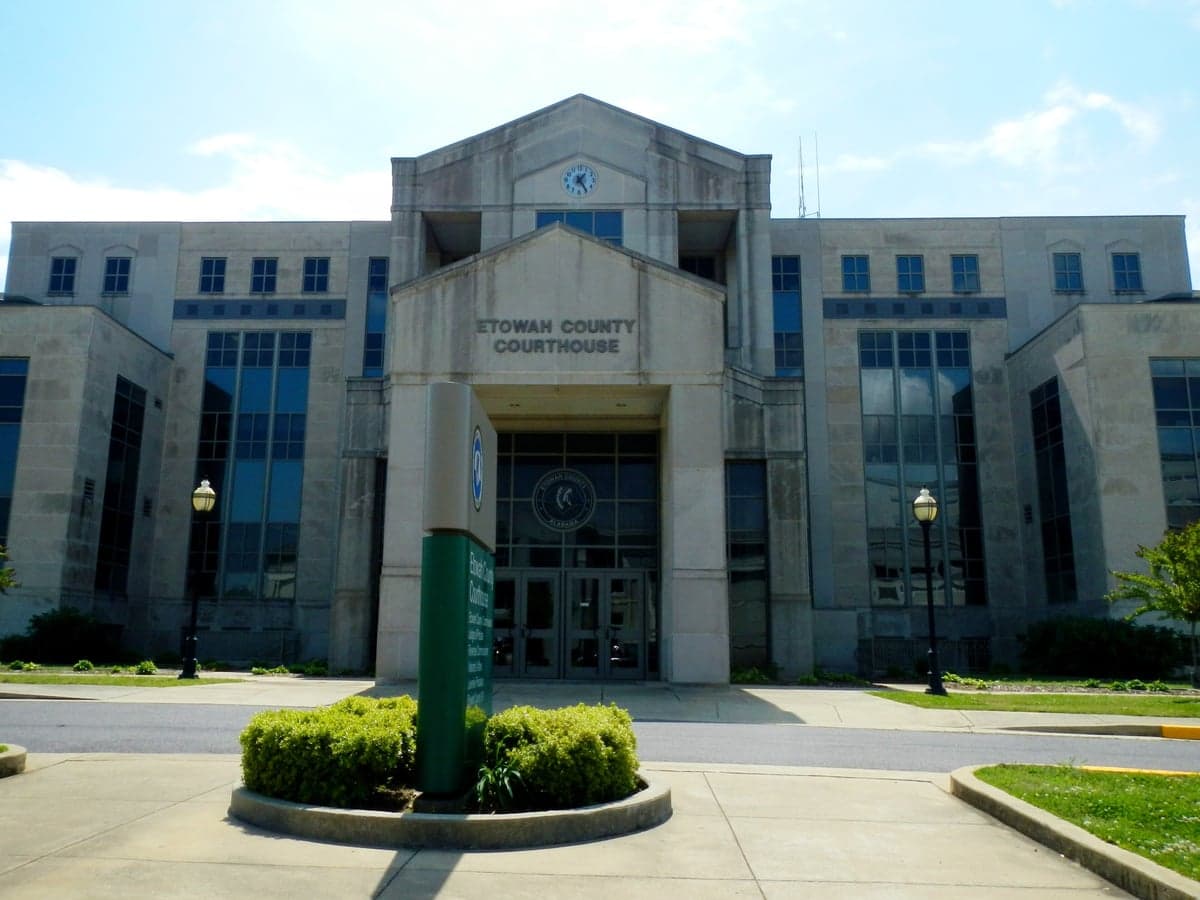
Photo: Wikipedia
Demographics of Etowah County
Affluence Level in Etowah County
A below-average socioeconomic profile. Incomes, home values, and educational attainment trail the U.S., with higher poverty and unemployment.
People of Etowah County
Etowah County, Alabama, is home to 103,208 residents, a population shaped by deep Southern roots, industrial-era migration, and a notably low foreign-born share of just 1.5%. The county’s identity is overwhelmingly native-born and white (76.5%), with a significant Black minority (15.0%) and a small but growing Hispanic community (5.0%). This is a place where the legacy of 19th-century Scots-Irish settlement and 20th-century industrial recruitment still defines the character of its towns, from the county seat of Gadsden to the smaller communities of Attalla, Rainbow City, and Southside.
Settlement & growth (pre-1960)
Before European settlement, the area now known as Etowah County was part of the ancestral homeland of the Cherokee Nation. The Coosa River valley provided fertile bottomlands for Cherokee agriculture, and the region’s strategic location at the falls of the Coosa—where Gadsden now sits—made it a natural gathering point. The Cherokee were forcibly removed along the Trail of Tears in the 1830s, opening the land to white settlement under the 1830 Indian Removal Act.
The first major wave of European settlers arrived in the 1830s and 1840s, primarily Scots-Irish and English yeoman farmers from the Upper South—Virginia, Tennessee, and the Carolinas. These families were drawn by cheap, fertile land in the Coosa River basin and the promise of self-sufficient farming. They established small communities like Gadsden (founded 1846, named after a U.S. Army engineer), Attalla (settled 1840s), and Altoona (a farming hamlet). The county itself was created in 1866 from parts of Blount, Calhoun, and DeKalb counties, named after a Cherokee leader, reflecting the region’s Native American past even as its population was now entirely white and Black.
The second transformative wave came with the post-Civil War industrial boom. In the 1880s and 1890s, the discovery of iron ore and coal in the surrounding hills, combined with the arrival of the Alabama Great Southern Railroad, turned Gadsden into a manufacturing hub. The city became home to the Gadsden Iron Works and later the Goodyear Tire & Rubber Company (opened 1929), which would dominate the local economy for decades. This industrial growth pulled in a new population: white Appalachian migrants from the surrounding hills, as well as a significant number of Black families moving from rural areas into Gadsden’s mill villages and neighborhoods like East Gadsden and South Gadsden. By 1950, Gadsden’s population had swelled to over 40,000, making it one of Alabama’s largest cities, with a workforce heavily concentrated in tire manufacturing, steel fabrication, and textile mills.
Smaller towns grew as satellites of Gadsden’s industry. Rainbow City, incorporated in 1950, was originally a bedroom community for Gadsden’s factory workers. Southside, on the Coosa River’s south bank, grew as a residential area for white middle-class families. Hokes Bluff and Sardis City remained smaller, more rural enclaves, populated by descendants of the original Scots-Irish settlers who worked the land or commuted to Gadsden’s plants. By 1960, Etowah County was a classic Southern industrial county: heavily white, with a substantial Black minority concentrated in Gadsden’s older neighborhoods, and a workforce tied to a single dominant employer—Goodyear.
Modern era (post-1965)
The 1965 Hart-Cellar Act had minimal direct impact on Etowah County. The foreign-born population today is just 1.5%, far below the national average, and the county did not experience the post-1965 waves of Asian, Latin American, or Middle Eastern immigration that reshaped larger Southern cities like Atlanta or Birmingham. Instead, the county’s demographic story since the 1970s has been one of industrial decline, suburbanization, and a slow diversification driven by domestic migration.
The collapse of the Rust Belt hit Etowah County hard. Goodyear, once employing over 10,000 workers, began downsizing in the 1980s and 1990s, with the last tire plant closing in 2008. The loss of manufacturing jobs triggered a population exodus: the county’s population peaked at around 104,000 in 1970, dipped to 99,000 by 1990, and has only recently recovered to 103,208. This decline was disproportionately white and working-class, as younger families left for job opportunities in Huntsville, Birmingham, or the Atlanta suburbs. The Black population, historically concentrated in Gadsden’s older neighborhoods, remained more stable, though many middle-class Black families also moved to larger cities.
Suburbanization reshaped the county’s geography. Rainbow City and Southside grew as retail and residential hubs, attracting white families from Gadsden’s older core. Glencoe, a small town on the county’s southern edge, saw new subdivisions built for commuters to Anniston and Oxford. The Hispanic population, while still small at 5.0%, began to grow in the 2000s, primarily in Gadsden and Attalla, where immigrants from Mexico and Central America found work in construction, poultry processing, and landscaping. This community remains modest in size and largely concentrated in a few neighborhoods, with no large ethnic enclave comparable to those in Birmingham or Atlanta.
The East/Southeast Asian population (0.5%) and Indian-subcontinent population (0.2%) are tiny, mostly professionals—engineers, doctors, and academics—who moved to the area for jobs at Gadsden’s remaining industries or at nearby Gadsden State Community College. They are scattered across Gadsden and Rainbow City, with no visible ethnic neighborhood. The college-educated share of the population is just 17.5%, reflecting the county’s historical reliance on blue-collar manufacturing and a slower transition to a knowledge economy.
The future
Etowah County’s population is projected to remain stable or grow slowly, driven by domestic in-migration from higher-cost areas of the South and Midwest. The county is not homogenizing into a single cultural identity; rather, it is seeing a subtle tribalization along geographic and economic lines. Gadsden itself is becoming more diverse, with a growing Hispanic minority and a stable Black population, while the suburban towns of Rainbow City, Southside, and Glencoe remain overwhelmingly white and more conservative. The rural areas around Hokes Bluff and Sardis City are aging and losing population, as younger generations leave for urban job markets.
The Hispanic community is likely to grow slowly, as families settle and birth rates remain higher than the white population, but it will not reach the scale seen in Alabama’s larger counties. The foreign-born share may rise to 2-3% over the next decade, still far below national levels. The Black population is expected to remain stable, with some movement from Gadsden’s older neighborhoods to newer subdivisions in Rainbow City and Southside. The East/Southeast Asian and Indian populations will remain tiny, limited by the county’s lack of high-tech employment and its distance from major research universities.
Culturally, Etowah County is absorbing new arrivals into its existing Southern identity rather than being transformed by them. New residents—whether from California, the Midwest, or Latin America—tend to adopt the county’s conservative, churchgoing, family-oriented norms. The county voted heavily Republican in 2024, reflecting a population that values low taxes, gun rights, and traditional social values. The next 10-20 years will likely see a slow, stable population with a slightly more diverse Gadsden core and whiter, more affluent suburbs, but no dramatic demographic shift.
For someone moving in now, Etowah County offers a deeply rooted, native-born community with a strong sense of place, low crime in its suburbs, and a cost of living well below the national average. It is not a place of rapid change or ethnic enclaves; it is a place where the past—Cherokee trails, Scots-Irish farms, Goodyear factories—still shapes the present. The county’s future is one of gradual, modest diversification within a fundamentally Southern, conservative framework, making it a stable choice for families and individuals seeking affordability and continuity.

* Values derived from national, state, county, city and local statistics and may differ in a specific area. Last updated: 2026-05-09T19:29:35.000Z
Narrative content on this page is AI-generated and may contain mistakes. Verify any details that matter before acting on them.
ReloMaps may earn a commission from affiliate links at no extra cost to you.

