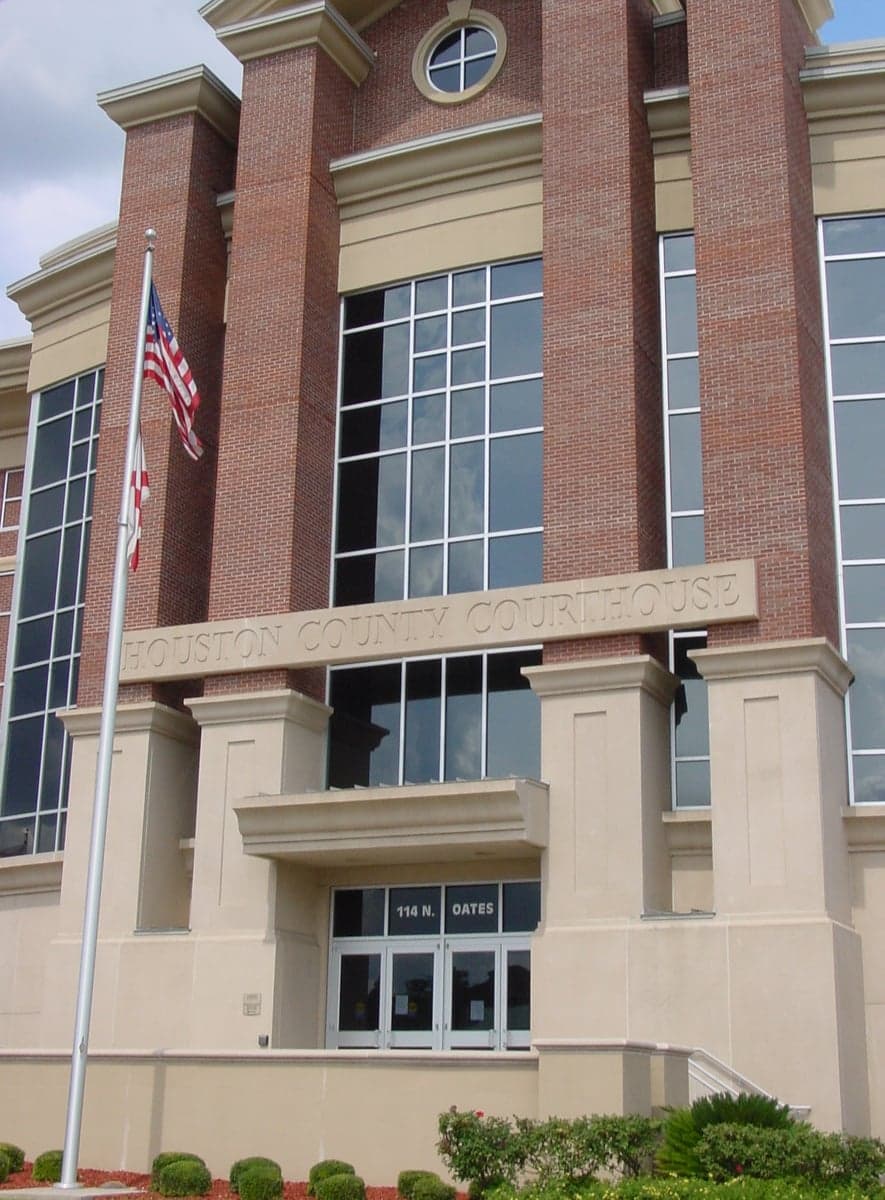
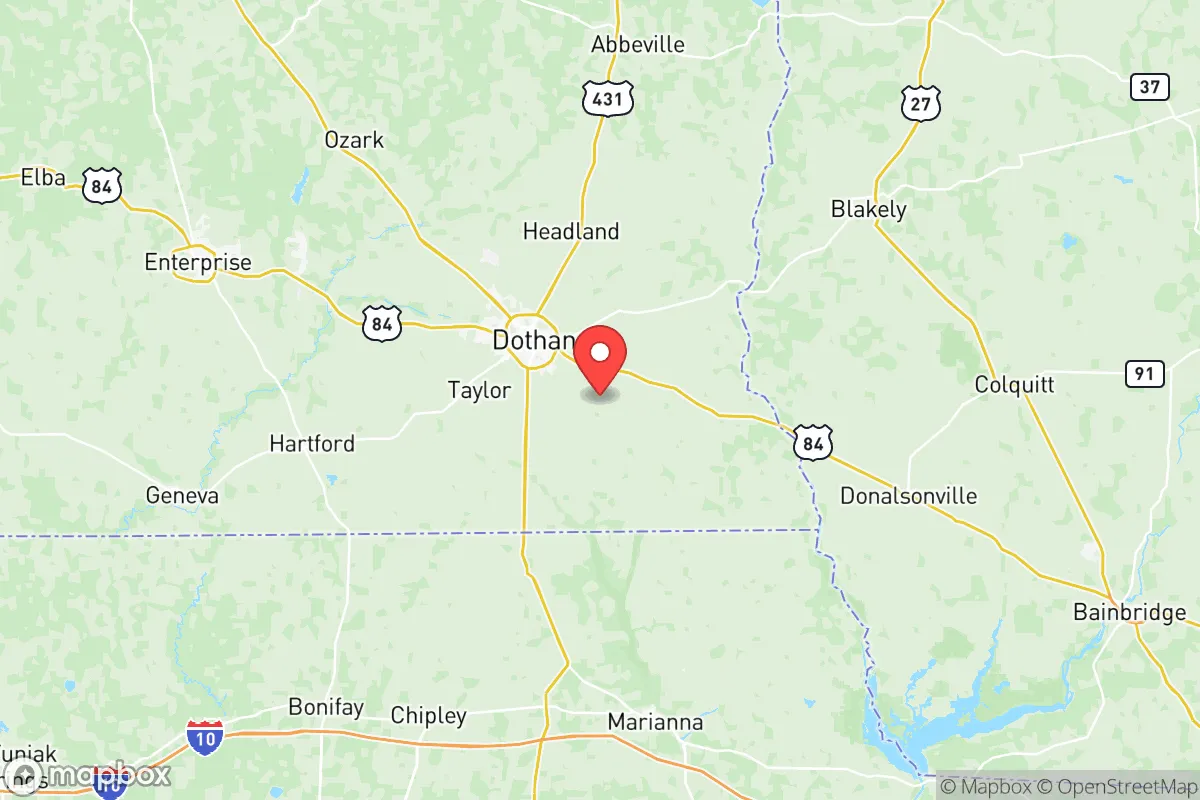
Photo: Wikipedia
Demographics of Houston County
Affluence Level in Houston County
A middle-class area roughly in line with national averages across income, home values, education, and employment.
People of Houston County
Houston County, Alabama, is a place where the character of its 107,628 residents is shaped by a deep-rooted Southern identity, a strong military presence, and a growing economic pragmatism. The population is predominantly White (63.8%) and Black (27.1%), with a small but notable Hispanic community (4.3%) and a very low foreign-born rate of just 1.7%, making it one of the least diverse counties in Alabama by international standards. The county’s distinctive markers are its role as the home of Fort Novosel (formerly Fort Rucker), the U.S. Army’s primary aviation training base, and its anchor city of Dothan, which serves as the commercial and medical hub of the Wiregrass region. This is a community where military families, multi-generational Southerners, and a modest but growing number of newcomers from other states coexist, creating a culture that is both traditional and adaptive.
Settlement & growth (pre-1960)
The human history of Houston County begins with the Creek (Muscogee) Nation, who controlled the rich pine forests and fertile creek bottoms of the Wiregrass region for centuries. The area was sparsely populated by Creek towns and hunting grounds until the Indian Removal Act of 1830 forced the Creeks out, opening the land to white settlement. The county was created in 1903 from parts of Dale, Geneva, and Henry counties, making it one of Alabama’s youngest counties, but its population story starts earlier with the first wave of settlers: Scots-Irish and English yeoman farmers who arrived from Georgia and the Carolinas in the 1830s and 1840s. These families, seeking cheap, unimproved land for cotton and subsistence farming, established small communities like Ashford, Cottonwood, and Webb, which remain small towns today.
The second major wave came after the Civil War, during Reconstruction and the late 19th century. Freed slaves, who made up a large portion of the county’s early population, stayed on as sharecroppers and tenant farmers, forming the foundation of the Black communities in Dothan and rural areas like Kinsey and Madrid. The arrival of the railroad in the 1880s transformed Dothan from a small crossroads into a regional trading center for cotton, timber, and peanuts. By 1900, the county’s population was overwhelmingly native-born, rural, and agricultural, with a small but growing merchant class in Dothan. The third wave, though smaller, was significant: Jewish merchants, primarily of German and Eastern European descent, arrived in Dothan in the late 19th and early 20th centuries, establishing dry goods stores and later becoming pillars of the local business community. Their descendants remain a small but influential part of Dothan’s civic life.
The single most transformative event for Houston County’s population was the establishment of Camp Rucker (later Fort Rucker, now Fort Novosel) in 1942. The U.S. Army chose the Wiregrass for its flat terrain, mild weather, and sparse population, ideal for training pilots. The base brought an influx of military personnel and civilian contractors from across the country, many of whom stayed after their service ended. This wave, which accelerated during the Cold War, fundamentally shifted the county’s economy from agriculture to a military-civilian hybrid. Towns like Enterprise (just north in Coffee County) and Dothan grew rapidly, with new subdivisions and schools built to accommodate the influx. By 1960, Houston County’s population had reached 50,000, with Dothan emerging as the dominant city and the military becoming the largest employer.
Modern era (post-1965)
The 1965 Hart-Cellar Act had a minimal direct impact on Houston County, as the foreign-born population remains very low at 1.7%. Unlike major metropolitan areas, the county did not see large waves of new immigrants from Asia, Latin America, or Africa. Instead, the post-1965 demographic story is one of domestic migration and suburbanization. The most significant shift has been the growth of the Hispanic population, which now stands at 4.3%. This community, primarily of Mexican and Central American origin, began arriving in the 1990s and 2000s, drawn by jobs in agriculture (peanut and cotton farming), poultry processing, and construction. They are concentrated in Dothan, particularly in the southern and eastern parts of the city, and in the town of Rehobeth, where a small but visible Hispanic commercial corridor has emerged.
The Black population, which was historically rural and tied to agriculture, has become increasingly urbanized and suburbanized. Many Black families moved from the countryside into Dothan proper and into newer subdivisions in Taylor and Midland City (just west in Dale County). The county’s Black community is now predominantly middle-class, with a strong presence in education, healthcare, and local government. The Asian population remains tiny at 0.7% (East/Southeast Asian) and 0.3% (Indian subcontinent), consisting mostly of professionals—doctors, engineers, and university faculty—attracted by the medical centers in Dothan and the engineering and aviation jobs at Fort Novosel. They are scattered throughout Dothan rather than forming a distinct ethnic enclave.
The most dramatic domestic migration has been the Rust Belt to Sun Belt movement, which accelerated after 2000. Retirees and job-seekers from Ohio, Michigan, Indiana, and Illinois have moved to Houston County for the lower cost of living, warmer climate, and slower pace of life. This wave is concentrated in age-restricted communities and newer subdivisions on the outskirts of Dothan, particularly around Grimes and Pansey. These newcomers are predominantly White and politically conservative, reinforcing the county’s existing cultural and political leanings. Suburbanization has also reshaped Dothan itself, with population growth shifting from the historic downtown to the Ross Clark Circle corridor and the western edge of the city, where big-box retail and new housing developments dominate.
The future
The population of Houston County is projected to continue growing slowly, driven primarily by domestic in-migration from other states and natural increase among the existing population. The county is not homogenizing into a single cultural bloc; rather, it is tribalizing into distinct enclaves along lines of race, class, and lifestyle. The military community around Fort Novosel remains a transient but influential group, while the long-time Southern families in rural towns like Columbia and Gordon maintain a traditional, agrarian identity. The Hispanic community is growing but slowly, and is likely to assimilate into the broader culture rather than forming a large, separate enclave, given the small numbers and the county’s strong assimilation pressures. The Black community is increasingly suburbanized and politically active, with growing representation in local government and school boards.
The immigrant communities—both Asian and Hispanic—are plateauing rather than surging, as the county lacks the large-scale industrial or service-sector growth that attracts new international arrivals. The foreign-born share is unlikely to rise above 3-4% in the next decade. The biggest demographic wildcard is the future of Fort Novosel: any major base realignment or expansion would dramatically alter the county’s population trajectory. For now, the county is absorbing new arrivals from the Rust Belt and other parts of the South, who are generally well-integrated into the existing social fabric. The cultural identity of Houston County is likely to remain conservative, Christian, and military-influenced, with a growing emphasis on healthcare and education as economic drivers.
For someone moving in now, Houston County offers a stable, slow-growing community where the population is overwhelmingly native-born, English-speaking, and rooted in traditional Southern values. The military presence provides a steady influx of new faces and a professional class, while the small towns offer a quieter, more insular lifestyle. The county is not becoming more diverse in a dramatic way, but it is becoming more suburban and more connected to the broader Sun Belt economy. It is a place where the past—the cotton fields, the railroad, the military base—still shapes the present, and where the future looks much like the present, only a little more spread out.

* Values derived from national, state, county, city and local statistics and may differ in a specific area. Last updated: 2026-05-08T22:47:32.000Z
Narrative content on this page is AI-generated and may contain mistakes. Verify any details that matter before acting on them.
ReloMaps may earn a commission from affiliate links at no extra cost to you.

